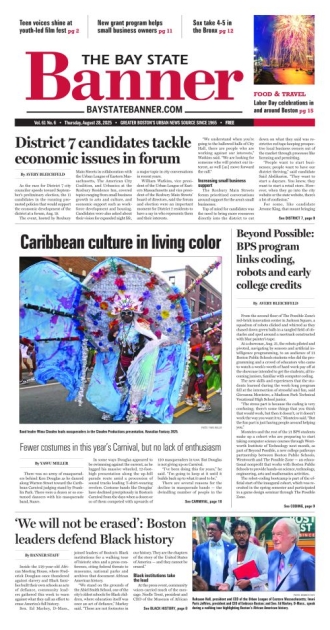
Giovanna
Monteiro, a Madison Park Technical Vocational High School junior, shows
code used to program an autonomous robot at a showcase at The Possible
Zone, Aug. 21. The showcase, in which 21 Boston students demonstrated
their ability to program robots to track colors and navigate a space,
was part of the launch of Beyond Possible, a college pathway program run
through a partnership between The Possible Zone, Boston Public Schools
and Wentworth Institute of Technology.
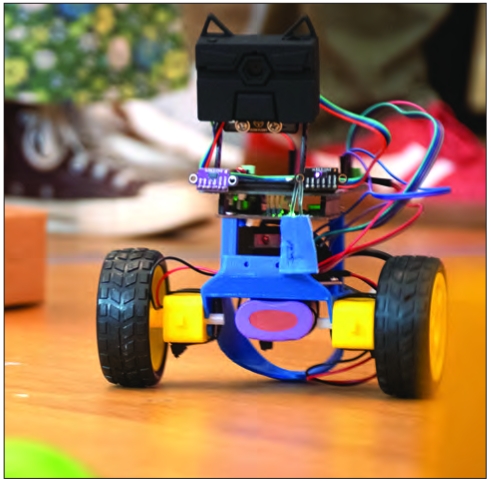
An autonomous robot tracks down a green ball during the showcase at The Possible Zone.
From the second floor of The Possible Zone’s red-brick innovation center in Jackson Square, a squadron of robots clicked and whirred as they chased down green balls in a tangled field of obstacles and sped around a racetrack constructed with blue painter’s tape.
At a showcase, Aug. 21, the robots piloted and pivoted, navigating by sensors and artificial intelligence programming, to an audience of 21 Boston Public Schools students who did the programming and a crowd of educators who came to watch a week’s-worth of hard work pay off at the showcase intended to get the students, all incoming juniors, familiar with computer coding.
The new skills and experiences that the students learned during the week-long program fell at the intersection of stressful and fun, said Giovanna Monteiro, a Madison Park Technical Vocational High School junior.
“The stress part is because the coding is very confusing; there’s some things that you think that would work, but then it doesn’t, or it doesn’t work the way you want it to,” Monteiro said. “But the fun part is just having people around helping you.”
Monteiro and the rest of the 21 BPS students make up a cohort who are preparing to start taking computer science courses through Wentworth Institute of Technology next month, as part of Beyond Possible, a new college pathways partnership between Boston Public Schools, Wentworth and The Possible Zone — an educational nonprofit that works with Boston Public Schools to provide hands-on science, technology, engineering, arts and mathematics activities.
The robot-coding bootcamp is part of the official start of the inaugural cohort, which was recruited in the spring semester and participated in a game design seminar through The Possible Zone.
Over
the next two school years, starting in September, the students, who
attend four BPS high schools — English High School, Dr. Albert D.
Holland High School of Technology, Madison Park Technical Vocational
High School and John D. O’Bryant High School — will take part in four
undergraduate computer science and data analytics courses through
Wentworth, three classes through The Possible Zone, and spend parts of
their summer shadowing and interning in the field.
Staff running the program said they’re hoping it will broaden the horizons and opportunities for more BPS students.
“The
idea is that there just aren’t enough opportunities for students in
Boston to have structured, supported college classes,” said Joanna
Sanborn, vice president of post-secondary pathways at The Possible Zone.
“This is really like a new effort to provide this in an after-school
model.”
For some, the coursework might lead to a career in a coding field; for others, it might be a chance to explore related options.
Jeronimo
Palacio, an O’Bryant junior, said that he’s heard that pursuing
something like computer science in college requires a bigger commitment,
but participating in Beyond Possible gives him a chance to see what
options he might be interested in pursuing.
“That
[big commitment] is just not me right now,” he said. “You know, I’m
just experimenting with different stuff and just trying to figure out
what I want to do and what I don’t want to do.”
For
Sanborn, who has been working on getting the program up and running for
a couple of years — conversations between the three partners began in
late 2023 — seeing the rubber hit the road with the students and their
autonomous robots is exciting.
The
week-long summer program was a steppingstone, preparing the BPS
students, who may not have had any prior experience with coding, for the
undergraduate-level computer science classes they’ll be taking in the
fall through the Wentworth partnership.
“We
know that these students are smart and capable and motivated, they just
need to be given the opportunity,” said Kate Stutz, director of college
access and success at Wentworth. “I think this week has really been
about giving them that opportunity and investing in them and believing
in them and knowing that we can fully equip them to be successful.”
The
autonomous robot curriculum was chosen because it gave the students
hands-on experience to make the coding knowledge real and tactile, said
Jeff Branson, vice president of STEAM industry and engagement at The
Possible Zone.
“They
have time to stop, do something with their hands, make changes to the
code, and then see how what they did in the code actually behaves in the
real world,” he said. “There’s this learning synthesis of, ‘I do this
on the code, and this is what the behavior looks like.’”
Though
the curriculum had some hiccups getting started — Branson, one of the
instructors who led the course, said one version of the planned lessons
was scrapped 10 days before class started because the hardware they were
working with wasn’t working predictably enough and would be tough to
teach — ultimately, it had success.
Of the two activities the students programmed their
robots to create, the tape racetrack was an idea that was developed,
without prompting, by the students.
“That
was students going, if we can train it on green, can we train it on
blue?” Branson said. “And I looked over and they were stretching tape
out across the floor, and the robot was following the tape.”
As
the program fully kicks off in September, the three partner
organizations are pursuing an official “early college” designation with
the state, which would bring in state funding for Wentworth to offer
college credits and allow classes during the school day.
That
initiative targets equitable access and creating pathways to college
and career, with the intention of making college aspirations easier and
less expensive. Students in the programs earn credits that count toward
post-secondary degrees, specifically in communities that have
historically been underrepresented in higher education.
A 2023 report from MassINC,
using state data, reported that early college programs in the state
increased the number of students attending college immediately after
high school by 15 percentage points and doubled the share of students
who remained in the college pipeline.
BPS
currently has 11 schools with early college partnerships across higher
education institutions including Bunker Hill Community College, the
University of Massachusetts Boston, Benjamin Franklin Cummings Institute
of Technology and Fisher College. Wentworth already has three early
college partnerships with BPS high schools.
The
Beyond Possible partnership, however, pushes the bounds on what is
traditionally included in the state’s initiative, Sanborn said.
Typically, those “early college” designations recognize one high school
in collaboration with one college. The cohort model — four high schools,
one university and a nonprofit — falls outside of that norm.
“Right
now, it’s really limited to a partnership between a higher ed
institution and a specific high school,” Stutz said. “By having a
consortium model, we’re really able to offer a more consistent
experience to more students, because it’s no longer dependent on where
they end up going to high school.”
If
approved, Sanborn said that it could help with recruitment to the
program. In February, when recruiting students, staff from The Possible
Zone said they were looking to pull 30 students from the four schools
into the college pathways program; when they kicked off with the
week-long bootcamp, they had recruited 21.
Some
of that, she said, may come from the commitment students have to make
outside of school hours, while they balance other commitments.
“It
makes us think that if we could push programs like this a little bit
into the school day, I think it would remove even more barriers for
students,” she said.
The
process of applying for the designation is on the radar of the three
organizations but is slow-moving until the official application period
with the state in the spring. If successful, it would also mean
recognition of the distinct model, which has the potential to unite
multiple stakeholders.
“It’s
worked because we’re all aligned on our values,” Sanborn said. “We
really agreed, early on, what were the essential components of our
partnership.”
That
includes things like a commitment to a low barrier for entry, making it
an accessible program to any student who wants to participate.
During
the program, students receive wraparound support and a stipend. Upon
completion, they will get conditional acceptance to Wentworth, as well
as Framingham State University and Bunker Hill Community College.
Efforts like the robotics deep dive helped with that accessibility, getting the students on a level playing field.
Monteiro
said that she only had a “tiny bit of interest” in coding and
technology ahead of the program. Participating in the deep dive to
prepare for the Wentworth classes “sparked her interest,” she said.
For Palacio, too, the experience brought around a new appreciation for the field.
“I
never really liked computer science, but here, honestly, we make
amazing projects,” he said. “I think it’s cool; I want to learn a little
bit more.”