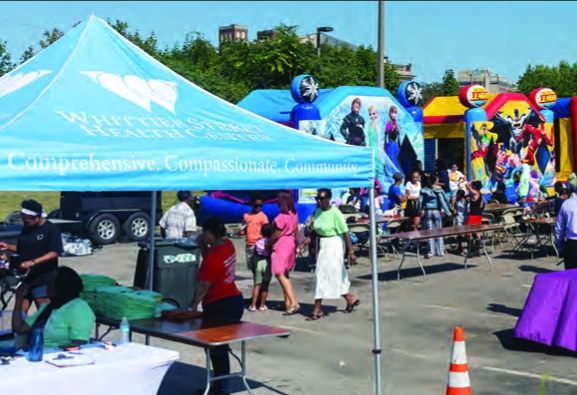
Community members gather at the Whittier Street Health Center Back to School BBQ, Aug. 8. The event marked the end of National Health Center Week. Under the heat of the summer afternoon, in the parking lot of Whittier Street Health Center, children jumped in bouncy houses, music blasted, the sweet smell of cotton candy wafted through the air and Jahquicia Bryant dabbed mustard on a hot dog.
Bryant, a Hyde Park resident, has been attending the Roxbury health center’s annual Back to School BBQ for over a decade. The event, which is now in its 23rd year, is a chance for the community to come together over hot dogs and hamburgers, while Whittier Street Health Center helps connect families with backpacks and school supplies ahead of the fall semester.
This year, it fell at the end of National Health Center Week, marked from Aug. 3-9 to celebrate community health centers and advocate the model of care.
“The whole idea of [the week] is to celebrate the work that we do, the impact, to really raise awareness around our role in addressing health equity and health disparities,” said Frederica Williams, president and CEO of Whittier Street Health Center.
At Harvard Street Neighborhood Health Center in Dorchester, it’s
a week to recognize the staff and patients of community health centers,
said Charles Murphy, president and CEO at Harvard Street. The health
center held a staff appreciation day and other events to celebrate its
patients throughout the week.
It’s also a chance to remind people about the vital role community health centers play.
“I
think it’s important every year, and we do it in August every year,
just to just kind of wave the flag a little bit,” Murphy said. “I think
there’s a value to that.”
For
Bryant, events like the Back to School BBQ at Whittier Street really
represent the place health centers hold in the community.
“It’s functions like this,” Bryant said. “It’s really helpful and useful.”
She
said her kids go through at least two backpacks a year. Having an event
where she knows she can check that item of the list — and the budget —
really helps out.
And
it’s reflective of the health center’s efforts, generally, to support
patients and families through not only medical care but wraparound
services too.
Bryant,
who grew up across the street, has been a patient at the health center
for 25 years, getting food access services through the center and, for
the past 12 years, relying on it for pediatric care. In that time, she
said she’s seen the center go out of its way to make sure patients
received quality care and had their needs met — like having enough food
to eat or being able to access care even if they spoke another language.
That
kind of community connection is part of the model, said Shade Cronin,
senior vice president of development and external affairs at the
Massachusetts League of Community Health Centers.
“Community
health centers are really embedded in their communities,” Cronin said.
“That work is really embedded in there for a reason.”
Murphy described the goal as making sure that health care exists as a right.
“Our mission is, ‘You need help? Come on in,’” he said. “We’re going to help you; we’ll figure out the pay side later.”
But this year’s celebration comes at a moment of flux for community health centers in Boston and nationally.
Recent
federal actions in Congress and from the administration of President
Donald Trump are poised to shift how health centers balance their
budgets, with those cuts coming in a number of ways.
The
largest may come from changes to Medicaid under the Trump
administration’s budget reconciliation package, dubbed for much of its
process through Congress, the “One Big Beautiful Bill.”
The
package, which was signed into law July 4, creates restrictions on who
can access Medicaid services in each state. The law includes a work
requirement, making it so individuals must work or do community services
for 80 hours per month to be eligible for benefits.
According
to an estimate from the Kaiser Family Foundation, the work requirement
alone will cause millions to go uninsured and result in $326 billion in
reduced federal Medicaid spending over 10 years, the largest reduction
by any one provision. The total Medicaid funding cuts were estimated at
$911 billion.
The
legislation also limits access to Medicaid programs nationwide for
immigrants. Under the law, only certain “qualified” immigration statuses
are eligible for Medicaid benefits; undocumented immigrants and
ineligible statuses will not be able to access the services.
For
Medicaid recipients, it also means a more frequent redetermination
process. Previously, individuals receiving Medicaid were required to go
through an annual process to re-verify that they were still eligible to
receive Medicaid benefits. Under the budget reconciliation package,
recipients will have to go through that redetermination process every
six months.
That more
frequent redetermination process may leave some individuals without
coverage if they miss paperwork or fall through bureaucratic cracks,
Murphy said.
All together, those reductions in Medicaid recipients are likely to result in less money coming to community health centers.
According
to data from the Kaiser Family Foundation, in 2023 Medicaid made up the
largest share of revenues by payer source in health centers nationwide,
at 43% of revenue across the board; the specific breakdown varied by
state. Locally, in Massachusetts it was also the largest share, at 34%.
In
a fact sheet, published at the end of June on the White House website,
the Trump administration said that the package protects Medicaid for
those who need it while eliminating “waste, fraud, and abuse.” According
to the White House, there “will be no cuts to Medicaid,” however,
Murphy said that doesn’t capture a full image of what the legislation
will mean for federally qualified health centers.
So, while the law doesn’t change rates, fewer patients accessing services means less pay coming into the health centers.
“You
talk to some of the folks in D.C., and they’ll say, ‘Oh, we’re not
cutting Medicaid; we’re not cutting it because all the rates are the
same,’” Murphy said. “But it’s the access. It’s going to be less people
taking advantage.”
And
patient counts could also drop following a recent change from the
United States Department of Health and Human Services, which, in early
July, changed a department rule adjusting the definition of a federal
public benefit under the Personal Responsibility and Work Opportunity
Reconciliation Act of 1996.
That
law shifted how the government handled social welfare policy, including
implementing work requirements and time limits for use. But it excluded
health centers, which Cronin said were historically viewed as a
community good, rather than an individual one.
The
new HHS rule includes the federal Health Center Program, which funds a
network of community health centers, alongside 12 other federal
programs.
In a
statement announcing the change, HHS said the Personal Responsibility
and Work Opportunity Reconciliation Act is intended to ban undocumented
immigrants from accessing the programs, however, the rule actually
limits access to only “qualified immigrants.” This excludes a number of
lawfully present immigration statuses, including people with Temporary
Protected Status and people with deferred action, in addition to
undocumented immigrants.
According
to a 2023 poll from the Kaiser Family Foundation, 30% of immigrant
adults who responded said they usually receive care from a clinic or
community health center. Among likely undocumented immigrants who
responded that number rose to 42%.
In
late July, Massachusetts Attorney General Andrea Campbell joined 19
other state attorneys general in suing the Trump administration to stop
the changes.
There are
other actions from the federal government that have limited or
threatened to limit funds. The administration’s early funding freeze
left some centers nationwide unable to access funds.
Federally qualified health centers also receive funding from the U.S. government through its Community Health Center Fund.
A
short-term funding bill passed by Congress in March extended support
through the fund through September but reduced federal spending to it by
$140 million. Cronin said federally qualified centers face further
questions about what long-term financial support from that source might
look like.
The impact of those shifts is still up in the air. Cronin said that one of the challenges right now is one of uncertainty.
“And
all of those pieces of uncertainty together are making it really
difficult for health centers to plan with risks to their funding,” she
said.
Those question
marks come from doubt around how many people will actually be impacted
by shifts in Medicaid, as well as pending legal challenges, but health
centers said the outlook doesn’t look good.
“Nobody
knows for sure what the impact is going to be in terms of bottom-line
numbers, but I think we’re all preparing for the worst as it presents
itself,” Murphy said. “We’re just going to have to adapt and figure
things out, just like any business.”
Murphy
said that Harvard Street is looking to keep any impacts away from
patient care; for Williams, limiting the impacts on staff and avoiding
layoffs is a priority.
The
risk, however, is that with limited funds health centers may be left in
a spot where they must make tough choices that could result in
shuttering programs or closing locations.
“If half your revenue is gone, you can’t offer the same level of services that you have been offering,” Cronin said.
That
leaves centers in a place where they must make the best contingency
plans they can, even as the bottom line of what those impacts might be
continues to move.
But while the present moment is more drastic than usual, limited funding is not alien to health centers, Cronin said.
“This is a group of leaders that’s innovative and creative and sadly are used to doing more with less,” she said.
For
now, it’s all speculation, so Williams said her focus is on maintaining
services and looking to shore up operations while the center can.
“We
just need to continue to remain focused on doing the best that we can
with what we have right now for as long as we have it, and then continue
to look for the opportunities,” Williams said.
Describing
herself as “an eternal optimist,” she said she’s focused on looking for
non-governmental dollars from philanthropic sources, fundraisers and
corporate partners, as well as internal sources like the center’s
pharmacy and glasses sales in its eye care center.
It’s
that sort of battening down the hatches that community health centers
are currently in the midst of. As further funding shifts loom on the
horizon, they’re left hoping for reinvestment down the line.
“It’s
coming down the pike; everybody’s preparing as best we can,” Murphy
said. “And then, who knows what the future brings? Hopefully some of it
comes back into vogue in our nation’s capital sometime.”


