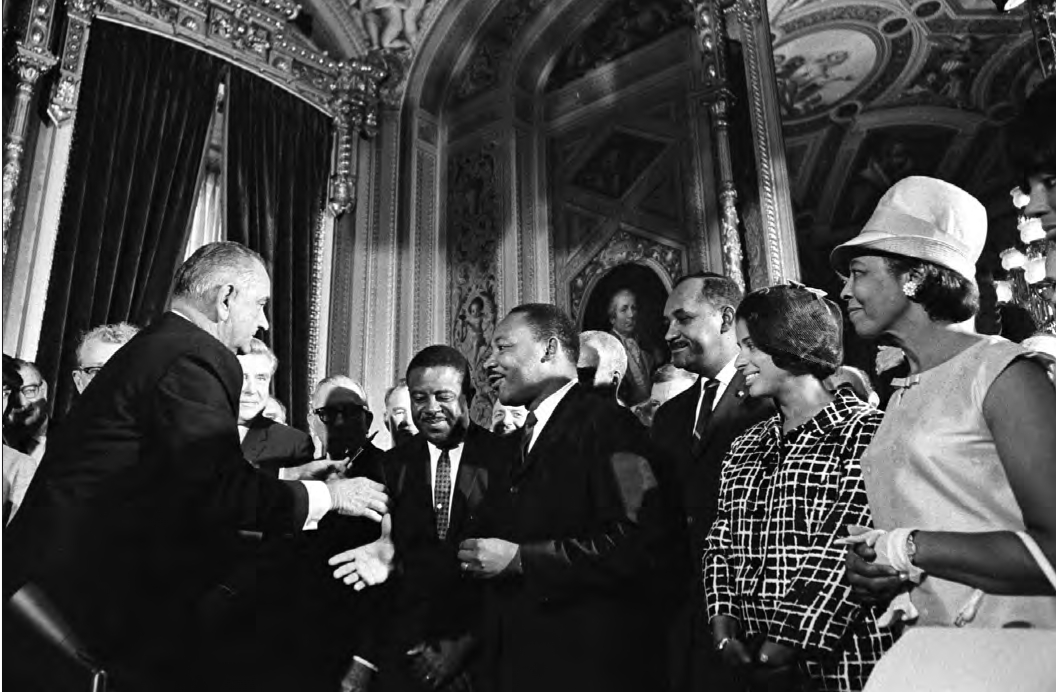
President Lyndon B. Johnson reaches to shake hands with Martin Luther King Jr. following his signing of the Voting Rights Act of 1965. As the law reaches its 60th anniversary, advocates say communities of color still face challenges accessing the polls. 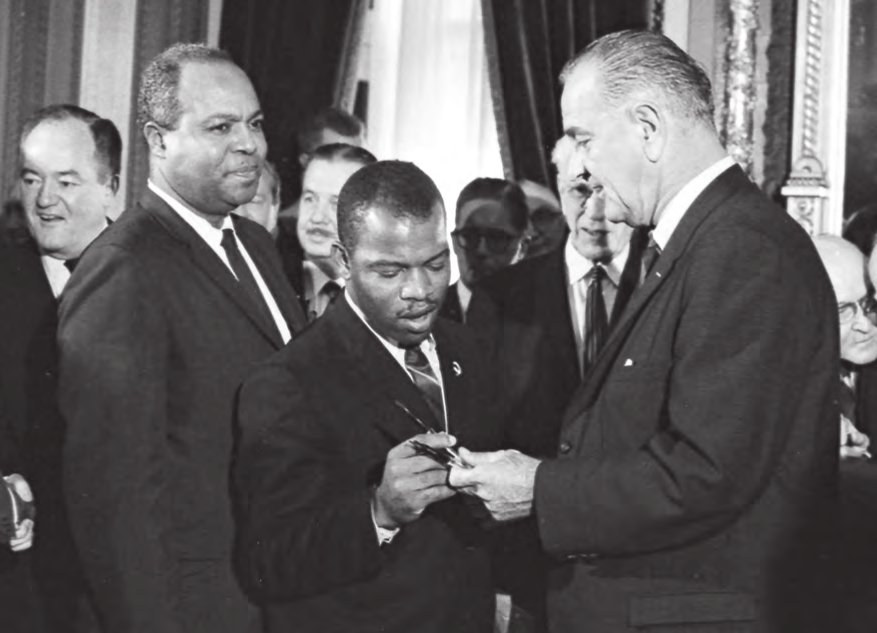
President
Lyndon Johnson hands a signing pen to civil rights activist John Lewis
after signing the Voting Rights Act of 1965. A propsed voting rights law
named after Lewis would extend and expand protections under the 1965
law.
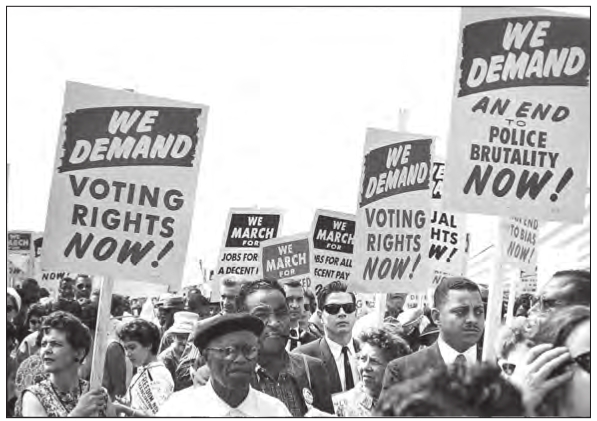
Demonstrators at the March on Washington for Jobs and Freedom in Washington, D.C., 1963.
60 years ago, during the civil rights movement, Congress passed the Voting Rights Act of 1965, outlawing discriminatory voting practices.
That landmark bill, signed into law by President Lyndon Johnson in August 1965, was designed to enforce voting rights enshrined by the Fourteenth and Fifteenth Amendments to the Constitution, especially for communities of color.
Now, 60 years after its passage, voting rights advocates are celebrating the impact it has had and calling for its protection amid various efforts that threaten to chip away at its impact.
For Shanique Spaulding Rodriguez, executive director of the Massachusetts Voter Table, the law’s 60th anniversary is a moment of inspiration.
“Sixty years ago, folks of color fought to create more access, to create opportunity,” Spaulding said. “As movement leaders, as movement organizations, it is our job to continue to fight.”
The law, when it was passed, took steps to ban literacy tests and poll taxes that had historically been used to keep voters of color out of the polls. It also established a system to identify state and local governments that had a demonstrated history of voting rights violations.
Those
governments were subject to federal election observers and had to ask
the federal government for permission to change how the elections were
administered, a process known as preclearance.
Provisions
in the Voting Rights Act were set to expire initially after five years
but were later renewed a total of five times. Those extensions also
sometimes expanded the act. For example, the extension in 1975
introduced a new requirement for certain jurisdictions to provide
language assistance to voters.
But advocates said there is still work to be done.
In
an Aug. 6 op-ed in The Crisis, the NAACP’s official publication, NAACP
President Derrick Johnson and Gary Bledsoe, a member of the
organization’s national board of directors, wrote that “over the
decades, diversity has flourished across much of the nation, proving the
Act’s success, though its mission remains unfinished.”
In that op-ed, they pointed to Supreme Court rulings that have pulled back on provisions of the Voting Rights Act.
For
example, the 2013 Supreme Court case Shelby County v. Holder
effectively eliminated the use of preclearance when the court determined
that preclearance itself was constitutional, but the formula the Voting
Rights Act used was outdated and therefore unconstitutional.
And recent debates around redistricting have put voting access in the spotlight.
In
June, Trump’s political team pushed for lawmakers in Texas to undergo a
mid-decade redistricting process to restructure congressional districts
in order to increase the likelihood of scoring five more seats in the
House of Representatives in the 2026 elections.
In a recent interview with CNBC, Trump said he thinks the Republican Party is “entitled” to five more seats there.
Normally, legislative maps
are redrawn every 10 years, with the decennial census. Currently, the
Voting Rights Act provides protections in the redistricting process to
prevent the dilution of minority votes.
A
plan to reshuffle the state’s districts was introduced by Republican
lawmakers at the end of July. State Democratic lawmakers in Texas then
fled the state to deny the state legislature a quorum.
The
Texas House of Representatives issued warrants for the absent lawmakers
— a largely symbolic gesture, as they only apply within state lines —
and Texas Attorney General Ken Paxton filed a lawsuit in his state’s
Supreme Court to attempt to remove the 13 lawmakers from their offices.
In
response, officials in California have threatened to attempt to launch a
redistricting process there to redraw the state’s voting maps to likely
remove five Republican seats in response.
“When we think about manipulating borders and thinking about, how do we split up blocks
of voters, that creates a problem,” Spalding Rodriguez said. “Obviously,
Texas will set a precedent for what the next decennial census process
will look like, as well as what redistricting looks like.”
Advocates
and lawmakers have also called for new legislation to reinforce voting
rights across the United States, with many throwing their support behind
calls for the passage of the John Lewis Voting Rights Advancement Act.
That
bill, which was first introduced in 2019, would perhaps most notably
modernize the formula for preclearance, in response to the 2013 Supreme
Court ruling. It was reintroduced in March.
Other
efforts locally could also increase access to the polls in
Massachusetts, Spalding Rodriguez said. She pointed to efforts around
same-day voter registration and decoupling the municipal census from
active voter rolls, which are legislative priorities for the Voter
Table.
“Many people
don’t realize that they’re no longer on the voting rolls, or they’ve
moved and they forgot to change their voter registration,” she said. “I
think if a voter shows up on Election Day and wants to vote, they should
be able to do so by being able to register the same day and be able to
cast their ballot.”
Currently, voters must register or update their registration 10 days before an election.
Spalding
Rodriguez also said she would like to see municipal censuses across the
state be decoupled from active voter rolls. In Massachusetts cities and
towns, registered voters who fail to respond to the municipal census
may be removed from the list of active voters.
While
this isn’t the same as being removed from the voter rolls altogether,
it means voters will have to submit a provisional ballot, with which
election officials will then confirm the voter’s eligibility to vote. If
it can’t be confirmed, the ballot will be destroyed and the vote not
counted.
The Voter Table also supports legislation to increase accessibility for people with disabilities at polling places.
Spalding
Rodriguez said those state policies, along with national efforts with
the Voting Rights Act and the John Lewis Voting Rights Advancement Act,
are important to continue protections for a multiracial democracy and an
equitable future.
“Whether
or not you’re of the demographic that policies are trying to prevent
from voting, it should be a concern overall for American democracy,” she
said. “If citizens are unable to vote, that is not democracy.”


