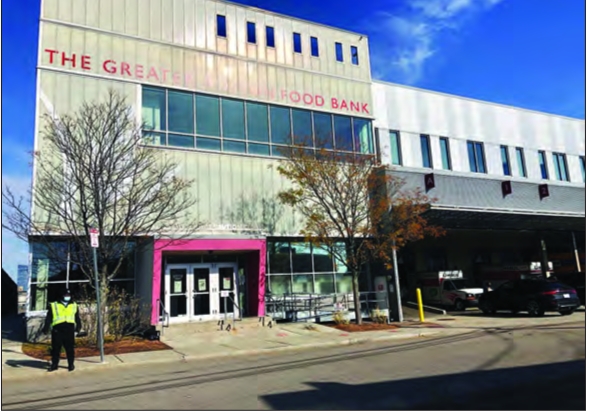
Of
the Boston Foundation’s new grant funding, announced Aug. 5, $1 million
will go to supporting operations at the Greater Boston Food Bank.
A new effort from the Boston Foundation will attempt to close gaps in food access across eastern Massachusetts through $1.5 million in new grant funding.
Of the new grant funding, announced Aug. 5, $1 million will go to supporting operations at the Greater Boston Food Bank.
Catherine D’Amato, president and CEO at the Greater Boston Food Bank, said the organization is “very excited” about the grant funding, which will support the purchase, storage and distribution of food.
“It will be incredibly helpful, and it will permit us to keep our inventory of healthy, nutritious foods and to be able to push those foods into the network to make sure foods are accessible and that they are equitable,” she said.
The remaining $500,000 will go to a cluster of nine or 10 other local food-access organizations, yet to be announced, throughout the region, said Orlando Watkins, vice president and chief program officer at the Boston Foundation (the Boston Foundation is a former sponsor of the Bay State Banner’s business section).
Watkins described it as a “hub and spokes” model, with the Greater Boston Food Bank operating as a central organization with sizable reach — they work with 600 smaller partners across 190 municipalities to distribute food — while also supporting other onthe-ground organizations in need.
But the grantmaking — and the choice to target food access with the funds — isn’t happening in a vacuum. In an announcement the Boston Foundation said the grants are in response to federal limits to the Supplemental Nutrition Assistance Program, formerly known as food stamps, which they said will push local food distribution systems to the brink.
“[The $1.5 million is] a good chunk of resources for us as a Boston Foundation, but even bigger than that, it’s a signal to the broader community that we need to be paying attention to what will be growing food insecurity in our communities,” Watkins said.
For
the Greater Boston Food Bank, that funding will replace some of the
federal support that the organization lost. D’Amato said the food bank
was slated to receive $4 million in food supplies through The Emergency
Food Assistance Program, a federal program that works with farmers and
manufacturers to direct products into the emergency food system.
The
Trump administration froze access to that program across the country
through the end of the year in March. She said it’s unclear if that
access will be restarted.
U.S.
Agriculture Secretary Brooke Rollins has said the cuts are intended to
pull back on Biden-era funding of programs that Rollins said inflated
statutory programs “without any plans for long-term solutions.”
Additionally,
the Trump administration’s budget reconciliation bill, referred to for
much of the legislative process, as the “One Big Beautiful Bill,” made
changes to the SNAP program that will reduce access to it.
That
law, signed July 4, expands work requirements to be eligible for the
program. The program previously had a requirement for able-bodied
recipients under 54 years of age to work or volunteer 20 hours per week
to receive benefits. The new law raises the age to 64, and removes
exemptions for veterans, people experiencing homelessness and former
foster youth. Parents with children older than 14 will now have to meet
the work requirement as well.
The law also restricts access to SNAP to only U.S. citizens and lawful permanent residents.
Those
changes could increase demand for the charitable food bank and food
pantry system by 55%, D’Amato said. For the Greater Boston Food Bank,
that shift could mean a need for an additional $98 million annually.
The Boston Foundation
described its new grant funding as the start of a broader,
multi-million-dollar commitment to address food insecurity in light of
the federal cuts.
It
is part of a framework developed at the foundation in recent months that
he said aims to “respond, protect and reimagine,” in the face of cuts
from the Trump administration, Watkins said.
That
framework has also included the foundation’s most recent round of its
Safety Net Grant Program, announced in April. That $2.6 million round of
grant funding, part of a program that the foundation runs twice a year,
distributed support to 77 organizations, focused largely on legal aid
and immigrant rights in response to what community members identified as
the greatest areas of need.
And
in May, the Boston Foundation, along with another research group,
published a survey of about 500 nonprofit organizations to get a
regional sense of how federal shifts might impact their ability to do
their work.
Now, the
foundation’s new grantmaking joins a broader push that
food-security-focused groups are trying to tackle in Massachusetts.
Erin
McAleer, president and CEO at Project Bread, an East- Boston-based
nonprofit working to tackle food insecurity across the state, said it’s a
“concerning moment” that is going to get worse as the federal cuts are
implemented.
The state
has faced other challenges around maintaining food access in recent
years. Project Bread reported that during the COVID-19 pandemic, the
state saw food insecurity rates more than double from 8.2% to 19.5% at
its peak, a trend which has lingered; as of September 2024, 18.4% of
households across Massachusetts reported food insecurity.
Now, however, the issue is a different one, D’Amato said.
“COVID saw one kind of need,” D’Amato said. “This is a very different kind of need; this is a federal budget.”
McAleer said, historically, efforts like SNAP have been federally funded, a landscape the budget reconciliation package upended.
“Usually,
the government steps forward during times of need and helps fill the
gap,” McAleer said. “But instead, during this challenging moment when
with inflation and cost of food and other costs of other things going
up, and more people struggling to afford groceries, they have decided to
take away the very tool that people have used to afford groceries.”
But the changes don’t stop state and local efforts to make sure communities have access to food.
In
2024, Project Bread helped launch the Make Hunger History Coalition, a
statewide effort that now has over 400 organizations and individuals
working together to attempt to eliminate hunger in Massachusetts.
Reaching
that ambitious goal may be complicated by the federal pull-back;
McAleer said there’s “no question” it won’t be met in the next four
years. She believes local efforts can keep moving the needle, even as
organizations like Project Bread now attempt to tackle the dual path of
responding to the cuts and new administrative barriers.
“There’s
no question that we are not going to be able to solve it in the next
few years, but that doesn’t mean we can’t continue to move forward on
progress and make sure we’re ready,” she said.
The
state, too, has launched efforts to determine how to ensure residents
continue to have access to enough food amid the federal shifts.
On July 17, Gov. Maura Healey announced the formation of a
new Anti-Hunger Task Force, which will include state and local leaders,
representatives from food banks, nonprofits and businesses, as well as
individuals directly impacted by food insecurity, to advise the governor
on how to mitigate against the federal cuts.
But behind the local
efforts to face down some of the gaps, like those presented to food
access under the budget reconciliation bill, is the awareness that local
actors cannot provide money on the same scale as the federal
government.
For
example, compare the $1.5 million from the Boston Foundation, or the
$265.5 million in various state investments in the Massachusetts budget
that was signed by Healey last month to the hundreds of billions of
dollars in SNAP spending that the Congressional Budget Office estimated
would decline between 2025 and 2034.
“I
don’t know how we’re going to squeeze more out of existing resources
when communities are already so in need, but we have to try,” Watkins
said.
For the Boston
Foundation, some of that work means looking beyond just grantmaking to
other ways they can support the communities they serve.
Watkins
said that they have worked on rallying other community members who can
contribute financially; the initial announcement regarding the
foundation’s food access grants slated $500,000 for the smaller “spoke”
organizations, outside of the Greater Boston Food Bank’s “hub,” but
conversations with others have potentially doubled that amount to a
total $1 million for the nine or 10 organizations the Boston Foundation
is looking to support.
This
has meant developing innovative solutions to cut costs while limiting
impacts on the services provided. For instance, sharing back-office
support to reduce how much nonprofits must spend as they face limited
funding.
“Maybe every
nonprofit organization doesn’t need an HR department, right? How much
does that save you in terms of reaching efficiencies?” Watkins asked.
“We’re trying to think innovatively, because it’s really the only option when the level of cuts has been so significant.”


