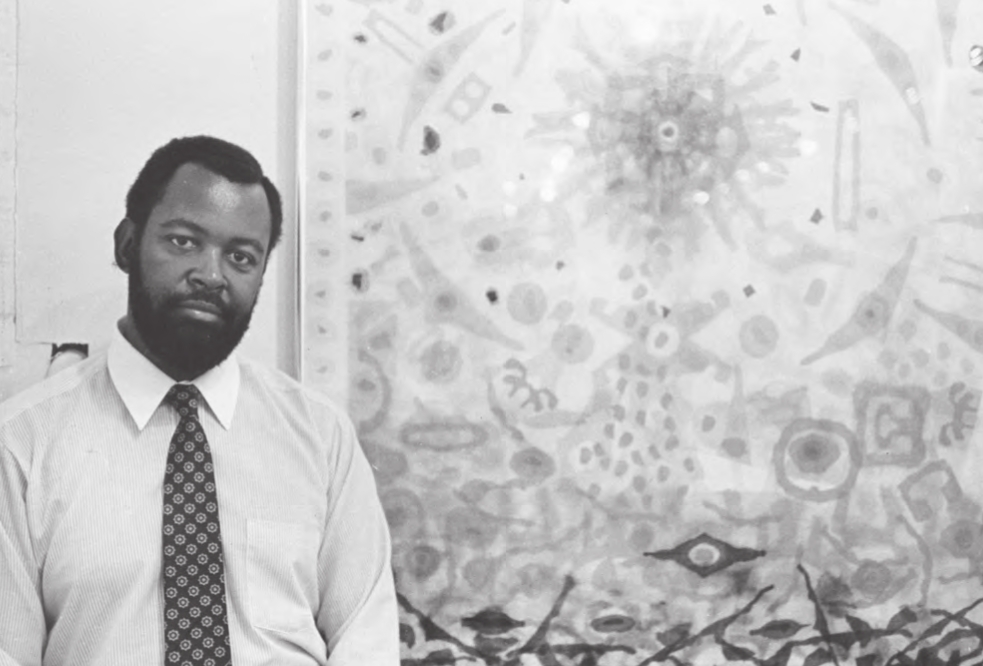
In
1978, Boston artist Dana Chandler founded the African American Master
Artists-in-Residence Program (AAMARP), in affiliation with Northeastern
University.

When Boston artist and social activist Dana Chandler Jr. died on June 9 at the age of 84, he left not only the legacy of his art. He created an institution in 1978 that also lives on: the African American Master Artists-in-Residence Program (AAMARP), in affiliation with Northeastern University (NEU). Through that institution, participants and audiences can experience Chandler’s love of art and community.
Professor Emeritus Reginald Jackson, Chandler’s colleague at Simmons College, told the Banner how the affiliation with Northeastern came about.
“Dana’s studio was ransacked one weekend while he was away,” Jackson said. “Dana went to the African American Institute at NEU and they led him to then-President Ryder, who requested space for Dana to setup a studio. Then Dana got the idea to bring master artists to share divided space to create the AAMARP.”
Next year from February 12 through August 2, the Institute of Contemporary Art (ICA) will display works by artists affiliated with the AAMARP.
Along with Chandler’s art, the exhibition will include works by Benny Andrews, Barbara Ward Armstrong, Ellen Banks, Calvin Burnett, L’Merchie Frazier, Kofi Kayiga, Renée Stout, Arnold Trachtman, John Wilson, Richard Yarde and Theresa India-Young.
“Dana C. Chandler Jr.’s impact on the arts community in Boston is immeasurable,” ICA curator Jeffrey De Blois told the Banner. “His art was brash and direct, frequently taking the multifarious, interlocking forms of American racism as its subject. Beyond his influential artwork, he was a tireless advocate for Boston’s Black artists, especially through the African American Master Artists-in-Residence Program he founded at Northeastern University. Chandler was a pillar in the community, someone who believed irrevocably in the transformative power of art and museums, a champion of access and someone who held the city’s arts institutions accountable.”
Chandler’s own work is on display at the Museum of Fine Arts, Boston, where visitors can see his artistry, including, “Black People break free of the Sucking, Mother-F—ing White Egg,” (from the portfolio The Fifteen Days of May) and “Fred Hampton’s Door 2.”
Being taken seriously by the MFA as a Black artist
did not occur until Chandler wrote the 1970 letter “A Proposal to
Eradicate Institutional Racism at the Boston Museum of Fine Arts” to the
museum’s director, Perry T. Rathbone, copying the board of directors
and the media. In the letter, Chandler stated: “Through all the history
of America, white museums have ignored, avoided and denied their
obligation to portray the contributions of the black man to American
history, be it cultural, scientific or aesthetic. We find this museum no
different. ... We can’t believe that this is simple ignorance or
unconscious racism — but we’ll soon know.”
Nowadays, the MFA acknowledges the value of
Chandler’s art. Carmen Hermo, the MFA’s Lorraine and Alan Bressler
Curator of Contemporary Art, told the Banner, “Chandler was a beacon for
the arts community in Boston. His artworks made bold statements in
bright and culturally responsive colors that drew on the past, present
and future of Black liberation movements. While building
the AAMARP as a space for creativity across many disciplines, he also
taught new generations of artists, and frequently visited and advised
the MFA over the decades, keeping the critical pressure on. His work is
currently on view in the contemporary galleries at the MFA, where it
speaks to his visionary and urgent belief that art must speak back to
our times.”
Chandler’s
work continues to provide a necessary context for creative achievement
in the Black community. Born in Lynn and raised in Roxbury, from the
1940s on Chandler experienced the intimate violence of local racism.
Having withstood this, his resilience led him to help build an artistic
community in Boston.
“Dana
C. Chandler has been monumental to the Black Arts Movement and well
beyond,” said Jackson. “Dana intrinsically knew that the business of
making art was not just an in-studio pursuit although he knew the
importance of occupation of space in an uninterrupted way. Dana has done
what no other person has done arguably worldwide; created an
institution that has endured for almost half a century to nurture and
support artists of African descent to be nurtured and supported.”
Quoted
at the St. Louis, Mo.-based Black Art Auction, which is dedicated
solely selling art created by African Americans, Chandler said, “Black
art is not a decoration. It’s a revolutionary force.”
His
unwillingness to separate art from its political dimension places him
in a cultural tradition that removes the aesthetic from its cultural
assumptions. As Bertolt Brecht, the German poet, playwright and director
wrote, “Art is not a mirror held up to reality but a hammer with which
to shape it.”