
The
National Urban League presented its “State of Black America” annual
report during this year’s conference, declaring the nation in a “state
of emergency.” 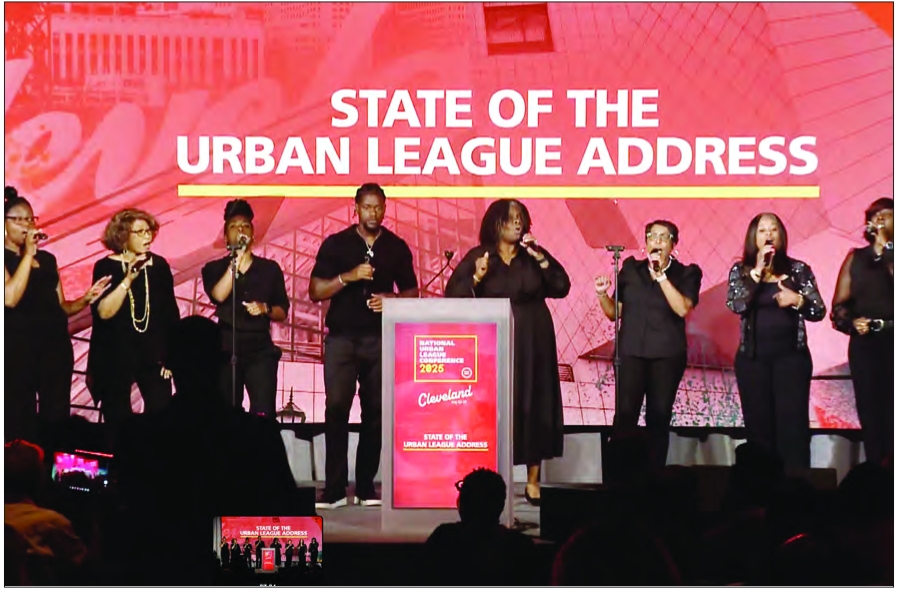
Mt. Zion Oakwood Village Praise & Worship Team performs at the State of the Urban League Address.
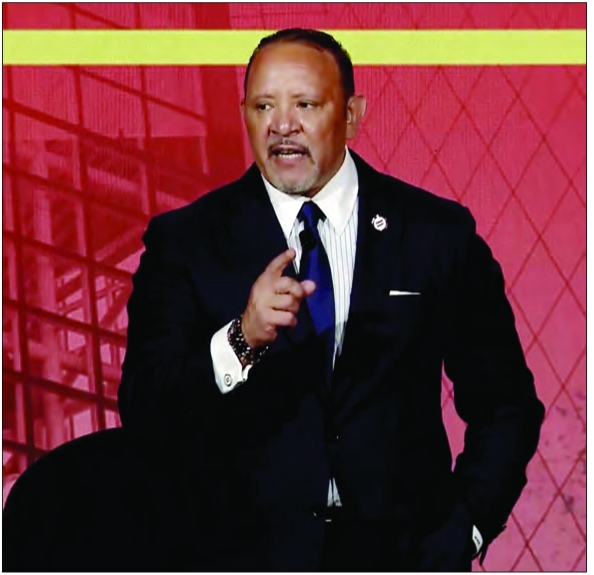
President of the
National Urban League, Marc H. Morial, addresses the crowd about the
urgency of Civil Rights being under attack.
From Alpha Phi Alpha Fraternity, Inc. in Philadelphia to the NAACP in Charlotte, historically Black organizations have spent the summer convening their members to conduct organizational business and confront the nation’s most pressing challenges.
For the past 115 years the National Urban League has done the same, bringing together leaders, advocates and community members to advance racial and economic justice. On July 17, delegates from the League’s 92 affiliates gathered in Cleveland for the 2025 National Urban League Conference, focused squarely on assessing and responding to the urgent conditions outlined in the latest “State of Black America” report.
At the opening plenary of this year’s conference, President Marc Morial delivered a powerful warning and a resounding call to action. Unveiling the 2025 “State of Black America” report, Morial declared the nation in a “state of emergency,” citing mounting threats to decades of racial progress in civil rights, democracy and economic equity.
“This report speaks not only to the state of Black America,” Morial said, “but also to the state of the nation and the state of our democracy. We will not go away quietly — people of goodwill, who love this nation, are fighting back.”
The report, an annual flagship publication of the National Urban League, outlines urgent threats to racial justice and
democracy across a range of sectors, including economics, employment,
education, health, housing, criminal justice and civic participation. It
warns of a dangerous national tilt toward authoritarianism and
highlights efforts to roll back federal protections that have
historically safeguarded the rights of marginalized communities.
Visually
striking, the cover of this year’s report features a burning
wastebasket filled with the logos of federal agencies that have been
disrupted, defunded or dismantled — particularly under the Trump
administration. The imagery foreshadows what is at stake: the hollowing
out of institutions that once offered modest, but essential, protection
for Black communities.
The
report identifies systemic racism as the root of these policy shifts.
“What started as a war on ‘woke’ has become a war on truth and a tool to
dismantle voting rights and other hard-won freedoms,” Morial said,
referring to the rise of anti-Black rhetoric from fringe ideology to
mainstream political discourse.
One
of the most sobering sections of the report documents the radical
transformation of the U.S. Department of Justice’s Civil Rights Division
from a historic guardian of equal protection to what Morial described
as a “tool of political retribution.” Among the developments cited: the
DOJ’s withdrawal from critical voting rights litigation, its dismissal
of cases against individuals who tampered with election equipment and
the pardoning of January 6 insurrectionists.
Morial
also pointed to troubling employment trends. “For the first time in a
long time, Black unemployment is rising while white unemployment is
falling,” he noted, highlighting a record number of African American
women entering the ranks of the unemployed. “This is the real,
demonstrable impact of these policies.”
The report also defends the
role of diversity, equity and inclusion (DEI) initiatives in expanding
access to civic participation.
Morial
drew a direct line from civil rights legislation to economic mobility:
“The throughline from the Civil Rights Act to increased civic
participation and expanded economic opportunity is the hallmark of the
second half of the 20th century.”
Despite
a wave of voter suppression efforts like the more than 300 laws
introduced across the country fueled by election misinformation, the
report underscores the
effectiveness of inclusive voting policies. In states with same-day
voter registration, participation increased by 5%. Moreover, 71% of
individuals who registered to vote online turned out, compared to 48%
and 52% for mail and state agency registration, respectively. Notably,
the report also found that 81% of Americans support ranked-choice
voting.
The report highlights the legal resistance led by civil rights organizations and state governments.
It
cites a lawsuit filed by the National Urban League and allied
organizations challenging three federal anti-equity executive orders, as
well as two lawsuits filed by the Massachusetts attorney general in
coalition with other state attorneys general. As of May, 247 cases have
been filed in U.S. district courts related to these issues, a number the
Urban League pledges to continue monitoring.
“The
arc doesn’t bend toward justice on its own, we must bend it with
strength and will,” Morial said in closing, reflecting on the legacy of
Vernon Jordan, who issued the first State of Black America report in
1976 after the Ford administration ignored the needs of Black Americans.
“We stand in that same spirit today with a report that is unapologetic
in its stance.”
Massachusetts
is highlighted in the report as a center of resistance to federal
rollbacks, due in part to litigation filed by the state’s attorney
general. On the ground, the Urban League of Eastern Massachusetts (ULEM)
is not only amplifying the report’s findings but also implementing
programs aimed at building economic self-sufficiency and generational
wealth in the Black community despite ongoing federal cutbacks.
Through
its Project Ready STEM initiative and adult training programs, ULEM is
equipping participants with skills in coding and artificial intelligence
to prepare them for emerging employment opportunities.
The
organization is also actively advocating for systemic reforms,
including same-day voter registration, ranked-choice voting and the
automation of criminal record sealing to remove barriers to employment.
In doing so, ULEM continues to serve as an economic first responder
preparing Massachusetts’ most vulnerable communities for the impact of
national policy shifts.


