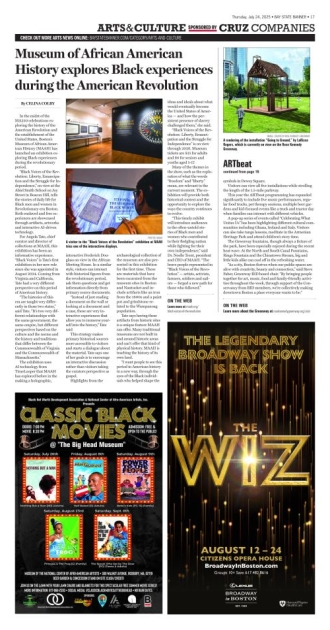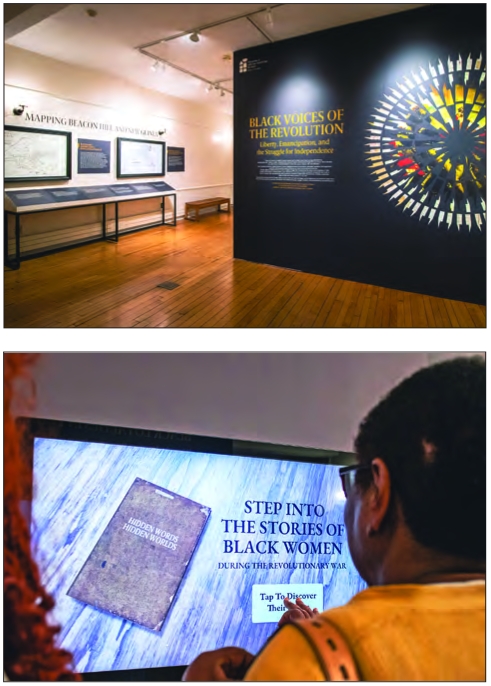
A visitor to the “Black Voices of the Revolution” exhibition at MAAH tries one of the interactivve displays.In the midst of the MA250 celebrations exploring the history of the American Revolution and the establishment of the United States, Boston’s Museum of African American History (MAAH) has launched an exhibition exploring Black experiences during the revolutionary period.
“Black Voices of the Revolution: Liberty, Emancipation and the Struggle for Independence,” on view at the Abiel Smith School on Joy Street in Beacon Hill, tells the stories of daily life for Black men and women in Revolutionary-era Boston. Both enslaved and free experiences are showcased through artifacts, artworks and interactive AI-driven technology.
For Angela Tate, chief curator and director of collections at MAAH, this exhibition has been an informative experience. “Black Voices” is Tate’s first exhibition in her new role since she was appointed in August 2024. Coming from Virginia and California, Tate had a very different perspective on this period of American history.
“The histories of this era are taught very differently in those two states,” said Tate. “It’s two very different relationships with the same government, the same empire, but different perspectives based on the culture and the norms and the history and traditions that differ between the Commonwealth of Virginia and the Commonwealth of Massachusetts.”
The exhibition uses AI technology from TimeLooper that MAAH has explored before in the making a holographic, interactive Frederick
Douglass on view in the African Meeting House. In a similar style,
visitors can interact with historical figures from the revolutionary
period, ask them questions and get information directly from primary
source documents.
“Instead
of just reading a document on the wall or looking at a document and a
case, these are very interactive experiences that allow you to immerse
yourself into the history,” Tate said.
This
strategy makes primary historical sources more accessible to visitors
and starts a dialogue about the material. Tate says one of her goals is
to encourage an interactive discussion rather than visitors taking the
curators perspective as gospel.
Highlights
from the archaeological collection of the museum are also presented in
this exhibition for the first time. These are materials that have been
excavated from the museum sites in Boston and Nantucket and include
artifacts like an iron from the 1800s and a paint pot and grindstone
related to the Wampanoag population.
Tate
says having these artifacts from historic sites is a unique feature
MAAH can offer. Many traditional museums are not built in and around
historic areas and can’t offer that kind of physical history. MAAH is
teaching the history of its own land.
“I
want people to see this period in American history in a new way,
through the eyes of the Black individuals who helped shape the ideas and
ideals about what
would eventually become the United States of America — and how the
persistent presence of slavery challenged them,” she said.
“Black
Voices of the Revolution: Liberty, Emancipation and the Struggle for
Independence” is on view through 2026. Museum tickets are $15 for adults
and $8 for seniors and youths aged 5-17.
Many
of the themes in the show, such as the exploration of what the words
“freedom” and “liberty” mean, are relevant to the current moment. The
exhibition will provide both historical context and the opportunity to
explore the ways the country continues to evolve.
“This
timely exhibit will introduce audiences to the often-untold stories of
Black men and women who contributed to their fledgling nation while
fighting for their own independence,” said Dr. Noelle Trent, president
and CEO of MAAH. “The brave people represented in “Black Voices of the
Revolution” — artists, activists, farmers, soldiers and sailors — forged
a new path for those who followed.”
ON THE WEB
Learn more at maah.org/black-voices-of-the-revolution