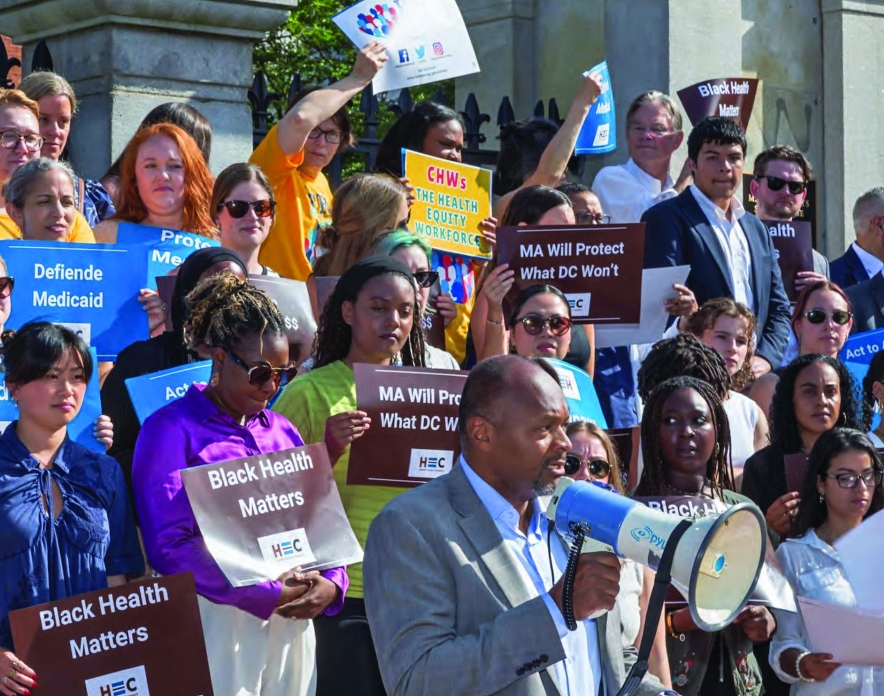
Michael
Curry (front), president and CEO of the Massachusetts League of
Community Health Centers, delivers remarks at a rally at the State
House, July 15, before a legislative hearing for the Act to Improve
Health Equity. The bill, omnibus legislation, would aim to shift
workforce, health care coverage and establish statewide benchmarks in an
effort to increase health disparities statewide.
A sweeping omnibus bill at the State House would target widespread health reform across the state, looking to change how the public and private entities across the state approach health care access, insurance and workforce.
The bill, officially called An Act to Advance Health Equity, saw its legislative hearing before the State House’s Joint Committee on Health Care Financing July 15.
“We can’t continue to accept the system where someone’s race, their income, their immigration status actually determines whether they get quality care,” said Sen. Liz Miranda in testimony at the hearing.
The changes will help everyone, from communities that have long borne the brunt of health disparities to the rest of residents across the state, said Michael Curry, a founding member of the Health Equity Compact, an advocate for the legislation.
“When we build a system that works for [the] marginalized, we build a system that works for everyone,” said Curry who serves as president and CEO of the Massachusetts League of Community Health Centers.
The legislation, which was filed this session in February, has been filed in previous legislative sessions. Last year, the omnibus package didn’t pass, but some provisions from it were passed separately in other legislation.
This year’s bill has a wide range of provisions targeted at different ways of closing health disparity gaps statewide, including broadening workforce supports, creating new statewide health equity goals and ensuring factors like immigration status don’t impact people’s access to care.
Curry said the legislation is especially important in the current moment, as the federal
government cuts some funding for safety net programs like Medicaid and
the Supplemental Nutrition Assistance Program in President Donald
Trump’s budget reconciliation bill, passed earlier this month.
“This is another crisis on the scale of COVID, and it demands the same kind of leadership,” Curry said.
Advocates
also touted provisions in the legislation that, they said, don’t
require new money to try to close equity gaps. Christina Severin,
president and CEO of the Community Care Cooperative, said in her
testimony that the bill makes “the bold and much needed choice to spend
existing dollars more rationally.”
“By
aligning our spending and our desired outcomes, we can build a health
care system that is both fair and financially stable and achieve our
health equity goals,” Severin said.
For
patients, assistance in the legislation could mean continued coverage
even under those cuts, said Cynthia Barginere, chief operating officer
at UMass Memorial Health in Worcester.
“The
legislation will help to support operations and maintain the financial
viability of our safety net organizations,” she said.
Health equity through workforce supports
At
the hearing, supporters highlighted provisions in the proposed
legislation that would increase support for health care workers across
the spectrum, from fostering the training of new primary care physicians
to setting up systems to reimburse others in the space, like community
health workers and translators.
Those
efforts would help address workforce shortages in health fields across
the state and make sure equitable care is more broadly accessible, said
Everett Handford, chief government affairs officer at Caring Health
Center in Springfield in testimony at the hearing.
“Our
patients deserve a system where access to care doesn’t depend on ZIP
code or a language, but where every community has trusted providers
ready to meet their needs,” Handford said.
Encouraging
the training of primary care physicians can be an important step to
making sure communities stay healthy. Advocates in the space have long
called for a greater focus on primary care to catch issues early instead
of leaning heavily into the kind of specialty care that patients rely
on when something goes wrong.
Across
Massachusetts, the balance of working physicians leans towards that
specialist bucket. According to the Kaiser Family Foundation, as of
April, just shy of 56% of physicians in the state were specialists.
But shifting that, supporters said, could help support programs where shortages especially impact community members.
The
shortage of primary care physicians is directly tied to efforts to
advance health equity, said Renee Crichlow, chief medical officer at
Codman Square Neighborhood Health Center.
“When we invest in providers who reflect and understand the communities that they
serve, we create lasting solutions to workforce shortages,” said
Crichlow, testifying on behalf of the Massachusetts Medical Society.
One
prominent step the bill proposes is to opt into a federal system that
lets Medicaid funding be used to pay for the training of new
professionals. Under the Medicaid Graduate Medical Education system,
state money with matched federal funds could help pay for physicians’
residencies and the training of other professionals. Those efforts would
include funding training at community health centers, which often serve
communities most impacted by health disparities.
According
to a report by American Association of Medical Colleges, as of 2022,
Massachusetts was one of seven states that don’t use the program to
support the training of medical professionals.
Crichlow called opting into the Medicaid Graduate Medical Education system a “transformational opportunity.”
“It’s
not merely a funding allocation, it’s a strategic investment in the
future of health care delivery in Massachusetts,” she said.
That
funding would help train new primary care physicians, as well as other
primary care professionals like nurse practitioners, sexual and
reproductive health practitioners and dentists and dental hygienists.
The
bill also targets support for health care workers outside of doctors
and nurses, especially those who might work closely with communities
that have long faced barriers to equitable care.
Under
the proposed legislation, MassHealth would be required to reimburse
roles like community health workers — public health workers who work in
and with community members to connect them to resources and care.
Yoann
Sophie Jean-Felix, director of education and workforce development at
the Massachusetts Association of Community Health Workers, described the
state’s community health workforce as “multilingual, culturally
responsive and deeply rooted professionals who use their lived
experience and skills to help neighbors navigate systems that were not
built for them.”
The
bill would formerly include community health workers in new health
equity zones — communities in the state with demonstrated health
inequities and poor health outcomes — expand recognition in patient
navigation and establish reimbursement of community health workers by
private and public insurance. It “takes critical steps to make sure
community health workers are a permanent part of our equity
infrastructure,” Jean-Felix said.
The
reimbursement would bring sustainability to the network of community
health workers, she said. Currently, she said, community health workers
may struggle to make ends meet financially or may need a second job.
The
bill would also provide for the reimbursement of other health-related
professionals, like translators, who can help connect patients to more
appropriate care.
And
all those workforce supports, together, can better support the patients
that need it most, Barginere said. The use of community health workers
has shown a way to keep patients with chronic illnesses healthy and out
of the hospital, while a greater primary care workforce could help keep
patients out of the emergency department by catching issues sooner, she
said.
“We want to have
the ability to take care of people when they need it, but we want to
see people stay as healthy as they possible can,” Barginere said.
Tracking disparities and results
If passed, the bill would also create a system of health equity benchmarks across the state.
That system would be established by a temporary commission created under the law, which would be chaired by the
Senate and House leadership of the Joint Committee on Health Care
Financing and staffed with other officials from the state’s legislative
and executive branches, as well as appointees representing people from
across the health and health care spaces.
“That
which gets measured gets done — or evaluated or analyzed gets done,”
Curry said. “We haven’t done a good job of knowing how drastic the
disparities in the state are.”
The
proposed law outlines a system of benchmarks that would target, at
least, reducing disparities in metrics like life expectancy between
racial and ethnic groups; reducing disparities geographically; improving
performance among metrics among certain segments of the population like
care during and after pregnancy; and creating targets and
responsibilities for specific stakeholders.
The
legislation would also create greater state oversight through a
secretary of equity. That cabinet-level position would lead a newly
established Executive Office of Equity, which would lead efforts to
increase equity, create and publish data dashboards to track
population-level outcomes and coordinate with other state entities to
foster equity efforts across Massachusetts.
And the bill would create a Health Equity Zone Trust Fund, a pot of money administered
by the Department of Public Health to directly fund health equity
projects in those communities in the state with demonstrated health
inequities.
In
testimony at the hearing, state Senator Miranda said the bill at large
does a lot of great things, but that direct investment from the state is
the reason she joined in supporting the legislation.
“Creating
a Health Equity Zone Trust Fund that actually gives neighborhoods the
power to develop their own solutions is essential in districts like
mine, where we’re seeing deserts in primary care, food access and
pharmacies,” she said.
Increasing access for immigrants
Other
parts in the legislation would close access gaps for the state’s
immigrant communities. Currently, some but not all immigrants are
eligible for coverage under MassHealth.
Some provisions in the bill would take steps to create new MassHealth coverage for residents, regardless of immigration status.
“Immigrants in Massachusetts are often forced to rely on a complex patchwork of safety
net programs for their health care,” said Amy Rosenthal, executive
director of Health Care for All. “Eliminating immigration status as a
barrier to MassHealth coverage would help more people live safe and
healthy lives, regardless of their immigration status.”
The
bill could get better and more complete care for immigrants who aren’t
currently able to access MassHealth due to their immigration status.
“By
removing barriers like immigration status to MassHealth access, this
bill ensures people can get the care they need from the people they
trust,” said Jean-Felix, from the Massachusetts Association of Community
Health Workers.
And
it could connect immigrants who are eligible but are wrongly denied
enrollment due to overly complex eligibility regulations, said Mindy
Greenberg, a staff attorney in the immigrant initiative at Health Law
Advocates.
“For many
of our clients and their families, gaining access to health coverage is
life-changing,” Greenburg said. “But no one should need a lawyer to
enroll in health insurance.”


