Boston
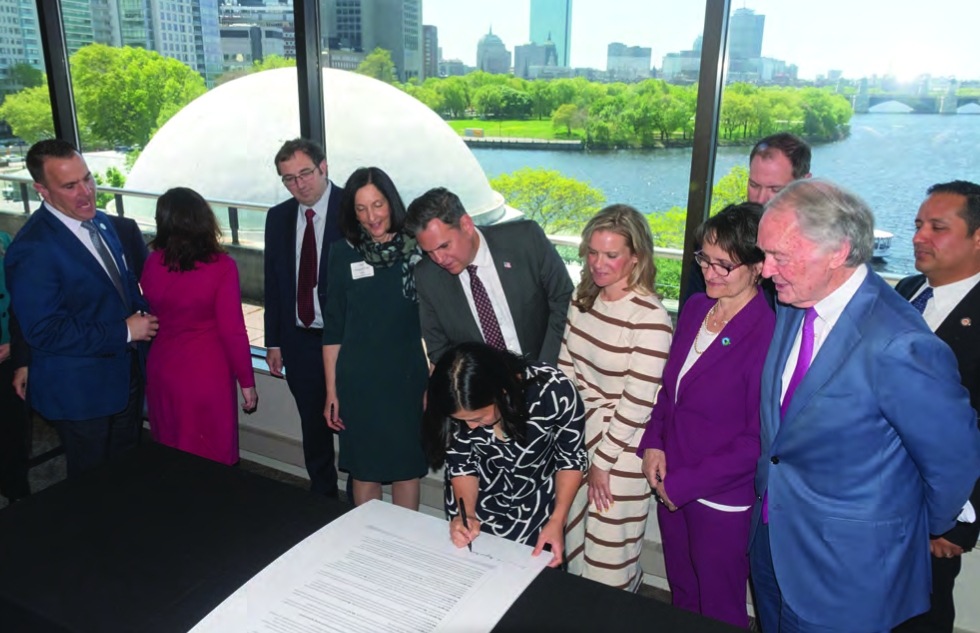
Mayor Michelle Wu (center) signs the Greater Boston Metropolitan Mayors
Climate Commitment, a 10-year update on a regional agreement between
the Metro Mayors Climate Task Force, during the Metro Mayors Climate
Summit at the Museum of Science, May 12. Wu was one of 17 municipal
leaders to sign the commitment, which includes priorities around siting
clean energy, addressing resilience of vulnerable infrastructure and
reducing emissions from transportation and buildings.

Chelsea City Manager Fidel Maltez signs the Greater Boston Metropolitan Mayors Climate Commitment.
Since the start of the second Trump administration in January, climate and resilience efforts have seen funding cuts hamper progress. Rollbacks of environmental regulations have reduced protections limiting emissions from power plants and vehicles, as well as water and air quality standards. A federal push against diversity, equity and inclusion has targeted environmental justice efforts to balance environmental harms and benefits across the country.
But, from a room at the Boston Museum of Science, with wide windows looking out over the Charles River and beyond to the banks of Boston and Cambridge, mayors and town and city managers from across the metro Boston area came together, May 12, to renew a commitment to continuing to address climate change — and to do it together.
“The Atlantic Ocean does not pay any attention to municipal boundaries, neither do most of our rivers and certainly our atmosphere doesn’t,” said Marc Draisen, executive director of the Metropolitan Area Planning Council, which helped organize the Metro Mayors Climate Taskforce. “So, while we have to pay attention to those boundaries, we also have to speak and shake hands and take action across those borders.”
The event was this year’s Metro Mayors Climate Summit, a gathering of 17 municipal leaders from communities from Lynn at the northern end to Braintree at the south and as far west as Newton.
The cornerstone of the summit was the signing of a climate commitment, re-upping an agreement made by the group of municipal leaders 10 years ago.
In 2015, the Metro Mayors Climate Task Force gathered to collectively sign a regional climate commitment with six commitments, including sharing best practices, aligning action, and integrating climate preparedness into municipal actions.
The new agreement, signed at the summit, advanced new commitments.
These
ones target more particular efforts — steps like supporting the siting
of clean energy, funding resilience efforts at vulnerable infrastructure
points, and addressing emissions from buildings and transportation,
which are the two largest emitting sectors, according to state data.
Environmental
justice and goals to help the state’s populations more vulnerable to
the impacts of climate change are centered on those efforts.
Those
kinds of regional initiatives include, for example, projects like
Wicked Hot, an initiative along the Mystic River that looked at
temperature disparities throughout that watershed, which demonstrated
that previously redlined neighborhoods were, on average, 4 degrees
hotter than non-redlined ones.
That
effort has now led to a regional cooling project that targets
innovative cooling solutions that also respond to different municipal
needs.
The agreements
to work together are especially important in response to a federal
administration under President Donald Trump that has pulled back on
climate action and protections, speakers said.
“I
think MAPC is exactly the kind of institution that communities need for
preparing for a changing climate right now, … particularly in a moment
when we no longer can count on the federal policies and support that we
saw in the previous administration,” said David Sittenfield, director of
the Museum of Science’s Center for the Environment, citing uncertain
budgets that cities and towns now face when it comes to climate and
resilience efforts.
Those pullbacks have included steps that have slowed or halted local environmental and resilience projects.
For
example, on the border of Chelsea and Everett, at the Island End River,
a series of joint measures between the two cities was slated to build a
storm wall and refresh a park space with a revitalized salt marsh to
improve coastal resilience.
The
$120 million project is intended to create protection for the nearby
New England Produce Center, the hub of fruit and vegetable distribution
for all of New England and up into Canada, as well as transportation and
health care infrastructure, a high school and the homes of about 5,000
residents.
In April,
the Federal Emergency Management Agency scrapped its Building Resilient
Infrastructure and Communities program, pulling back on $50 million that
had been awarded to the Island End project for construction costs.
In
its statement announcing the end of the grants, FEMA called the program
“politicized” and “wasteful and ineffective.” That grant program was
launched by Trump’s first administration in September 2020.
But
local leaders said the program — and the funding it would have provided
to the Island End project and other metro Boston resilience efforts —
is important to get ahead of future climate impacts.
“We
want to respond to crises that are going to come in the future, not
spend a lot of money on response to flooding, on response to damage,”
said Fidel Maltez, city manager for the city of Chelsea.
Without the federal funds for construction, Maltez said the project may not be able to progress for now.
The
effort has been highlighted as having a regional impact, both due to
the significance of the New England Produce Center and its role in
closing flood pathways in concert with other projects along the Mystic
River.
“We’ve gotten a
lot of tough news when it comes to federal funding over recent months,
but that was the one that really hurt,” said Katherine Antos,
undersecretary of decarbonization and resilience at the state Executive
Office of Energy and Environmental Affairs, who signed a letter of
support for the project when she previously served as deputy executive
director for planning and sustainability at MAPC.
The
end of the BRIC grant program meant the loss of over $84.8 million for
projects in the metro area, along with another $3.4 million for
statewide efforts.
Leaders
at the summit also spoke out against what they called a move away from
science in Trump’s Environmental Protection Agency.
“Wouldn’t
it be a better system if we simply stopped all our science, our
research, our testing, our analysis, and just proceeded blind in the
dark — which seems to be, unfortunately, the way we are going on the
federal level,” said Marc Draisen, executive director at MAPC.
As
part of an organizational restructuring, the EPA has announced plans to
shut down its Office of Research and Development — its scientific
research arm. Lee Zelden, the agency’s director, has said the move
intends to incorporate its scientists directly into program offices, but
reporting from the journal Nature found that, according to internal
emails, the restructuring has included cuts in funding for long-term
projects and the closure of ORD labs.
The EPA has also ordered staff to begin canceling research grants, and Chemical and Engineering News reported that, as of
May 2, ORD scientists were given a week to apply for a new job in the
agency or accept early retirement.
But
local leadership in climate work isn’t new, said Rebecca Tepper,
secretary of the Executive Office of Energy and Environmental Affairs.
“It really is vitally important that climate work right now, and always has been, from the bottom up,” she said.
And
municipal leaders may garner more confidence from the communities they
serve, said Staci Rubin, commissioner of the Department of Public
Utilities.
“You all
are the people that your constituents trust,” she said, calling on
cities and towns to voice support for efforts like a National Grid pilot
program to install over 100 heat pumps in Winthrop and Leominster as
part of a DPU-led push to get the state’s utilities to launch targeted
electrification programs.
And speakers at the event cited the importance of municipal efforts as the ones closest to the people served by them.
Sen. Ed Markey, who delivered closing remarks at the event, spoke in support of what he called “global localism.”
“It’s
global warming solved at the local level, town by town, city by city,
program by program, that ultimately is going to transform the way in
which our entire plan is saved,” he said.
Boston
Mayor Michelle Wu, who also gave closing remarks, said she sees local
leaders as the ones who don’t have the luxury of just speaking to
cameras, and instead must roll up their sleeves.
“This
work is going to take all of us,” Wu said. “Because the climate crisis
doesn’t care about city limits, but especially because it’s city leaders
who get things done.”