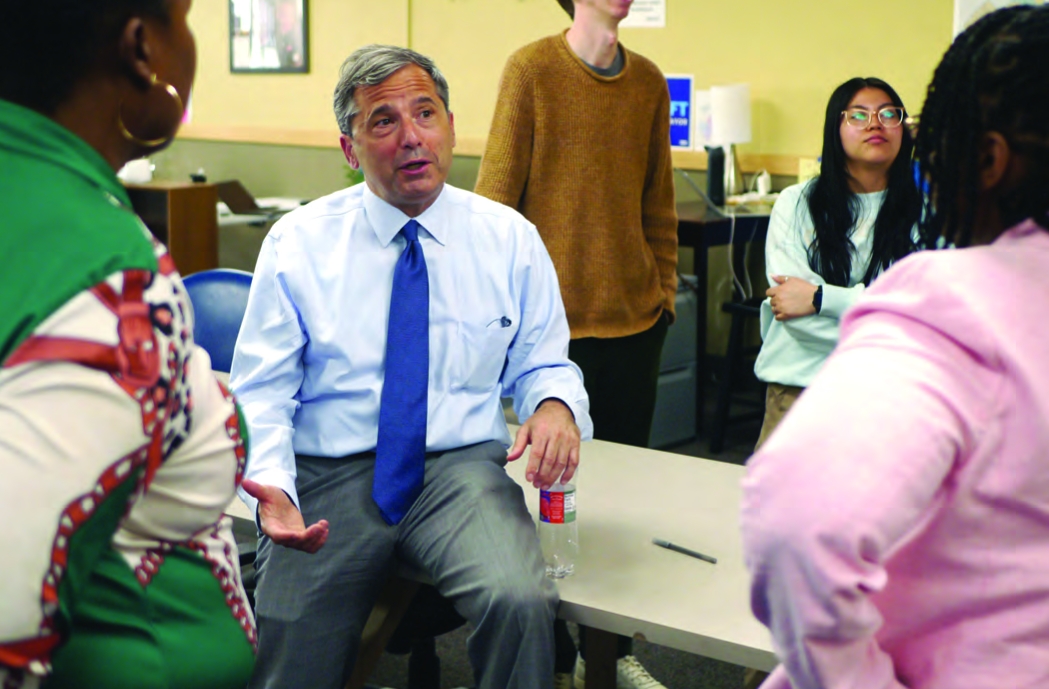
Mayoral candidate Josh Kraft chats with campaign staff and volunteers at his Nubian Square office. 
Mayoral candidate Josh Kraft
When Josh Kraft kicked off his campaign Feb. 4 at the Prince Hall Grand Lodge in Grove Hall, the significance of the venue was not lost on the largely African American crowd that turned out. Nor was the significance of the opening of his campaign office last month in Nubian Square.
Facing an incumbent mayor whose approval rating in the Black community was at just 36% in February, according to an Emerson College poll, Kraft’s choice of locations makes political sense.
Beyond poll numbers, however, is the consideration of longstanding relationships. As the former head of the Boys and Girls Clubs of Boston, the president of the board of the Urban League of Eastern Massachusetts and as the head of Kraft Family Charities, Kraft says he has spent 35 years working in Boston’s neighborhoods, much of that time in the city’s Black communities.
“I’ve seen Josh all over the community for years,” said Charlie Titus, former chancellor of athletics at UMass Boston. “He’s unassuming, he’s caring and he’s happy to share resources and his time.”
Going up against an incumbent mayor can be an uphill battle. Mayor Michelle Wu has honed her campaign skills over five citywide election cycles and now draws on legions of city workers, many of whom were present at her April campaign kickoff, as well as support from other elected officials and candidates.
For his part, Kraft said his campaign is drawing volunteers from across the city.
“People want to get involved with us, and the greatest example was the first day of signature gathering,” he said in an interview. “We had 400 volunteers in the field, and we got 6,500 signatures.”
So far, Kraft has taken several lines of attack against Wu, including the city’s deployment of bike lanes in virtually every neighborhood, Wu’s push to lease White Stadium to a for-profit soccer team and what he says is a lack of housing production under her administration.
“A
lot of people, they say they’re ready for change because the bottom
line — and I hear this in every neighborhood, everywhere I go — people
don’t feel like they’re heard,” Kraft said. “They feel like their
concerns are ignored. They’re not part of any process. They feel like
the city makes decisions without any thoughtful community feedback.”
That line of attack seems to have resonated with some of his supporters.
“We
need someone who’s not afraid to come into the community and listen to
the community,” said retired Boston Police Officer Larry Ellison. “Wu
doesn’t listen to people.”
While
Kraft may have found an avenue of attack against Wu that resonates with
some Boston voters, campaign platforms in citywide races need to touch
on a variety of issue areas. In an interview, Kraft shared his positions
on areas including housing, education and the city budget.
Housing
“The
number one issue for people in the city is cost of living,” Kraft said.
“And the number one driver of that is housing — still unaffordable and
unattainable for many people. And we need create pathways to housing,
especially for working people.”
Kraft
maintains that Wu administration officials have slowed the pace of new
housing construction in Boston with new regulations, including a new
Inclusionary Development Policy goal requiring that 20% of units in new,
multi-family developments be affordable.
(Wu administration
officials say more than 17,000 housing units have been built or started
construction during her tenure and another 12,000 have been added to the
construction pipeline.)
School Committee
Although
Wu campaigned for mayor saying she supports a hybrid elected/appointed
School Committee, she has since retreated from that position and now
says she favors the current all-appointed structure.
Kraft says he supports a hybrid structure.
“Having elected members to join the School Committee really resonates with folks in all different communities,” he said.
He said he has not yet decided what the proportion of elected to appointed members should be.
Mass & Cass
Kraft says he would direct police to crack down on public drug use and nuisance crimes in areas with increased drug activity.
“We’re
letting people struggle in their own vicious circle of substance use,
mental illness and homelessness, and we have to address it,” he said.
“Our plan is about recovery first, but also, we’re working with police
in a proactive way to end public disorder — public use of drugs, crime.
We’re
going to work on it. And also, the crime being committed on our most
vulnerable folks, those struggle with substance use are being preyed on
by drug dealers and sex traffickers. We want to put an end to that.”
City budget
Kraft
is critical of Wu’s handling of city finances, maintaining that her
administration should have cut from the budget before raising property
taxes.
“The budget’s
grown 20% in three years, but at the same time, residential tax bills
average increase was 10% last year, but yet the mayor and her team said
that there’s nothing to cut from a $4.6 billion budget,” he said.
“That’s not only hard to believe; it’s disrespectful to citizens who are
making hard fiscal choices in their own life.”
Asked what he would cut, Kraft did not cite specific items in the budget.
“What
I would do is I would bring the leaders of different departments in the
room and entrust them to cut their budget by 2% and then I would work
with them on that,” he said. “That’s what I’ve learned from my
management experience.”
White Stadium
Kraft’s
critique of Wu’s White Stadium deal covers both what he says is her
top-down decision-making process and the commitment of $100 million in
city funds in support of creating a stadium for professional soccer.
“At
the same time as this fiscal crisis, I know that the city’s committed
over $100 million to White Stadium to a project that primarily benefits a
private entity, and that was done over the vociferous protests of folks
in that community,” he said.
Family matters
Kraft
has come under fire for his family’s connections to rightwing political
figures. His father, New England Patriots owner Bob Kraft, has enjoyed a
close relationship with President Trump.
After
Bob Kraft helped broker a meeting between members of the law firm Paul,
Weiss, Rifkind, Wharton, & Garrison LLP, four members of the firm
gave Josh Kraft $1,000 campaign donations.
Kraft said there was no quid pro quo behind the donations.
“Brad
Karp — he’s a Democratic fundraiser. He raised hundreds of millions of
dollars for Kamala Harris,” he said. “It’s a Democratic law firm.”
Kraft stressed that his politics differ substantially from those of his father.
“I’m
a Democrat,” he said. “I’ve never voted for Donald Trump in any
election. I’ve never written him a check. I don’t think he has the
temperament or the ethics to be the president of the United States. I
love my dad. We agree on many things. We have disagreed about Donald
Trump since 2016 since he first ran. And on top of that, my father is
not running for mayor of the city of Boston. I am.”
What’s next
While
14 Boston residents have pulled nomination papers for this year’s
mayoral contest, the requirement that candidates submit signatures from
3,000 registered voters by May 20 will likely winnow the field down
significantly. The city has until June 24 to certify that candidates’
signatures are from voters registered in Boston and that those named on
each candidate’s papers haven’t previously signed another mayoral
candidate’s papers.
Kraft has so far reported $855,582 in campaign contributions in his first three months of fundraising.
Wu has reported $798,151 in contributions in the same period but began with $1,761,011 in savings in her campaign account.
Both
candidates are expected to benefit from independent expenditure
committees that typically pay for advertisements and mailers on a
candidate’s behalf.
Voters
can expect to receive mailers and visits from canvassers from each
well-funded campaign over the summer. If more than two candidates submit
enough signatures to make the ballot, there will be preliminary
balloting in the mayor’s race September 9 to whittle the field down to
two candidates. If not, the two candidates will face off in the Nov. 4
general election.