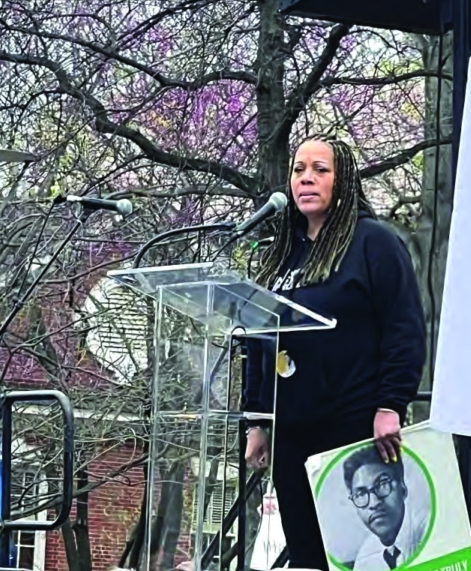
Organizer
Kadida Kenner is the executive director of the New Pennsylvania
Project. The organization is a voting rights organization with a
year-round primary focus on voter registration, civic education and
mobilization.
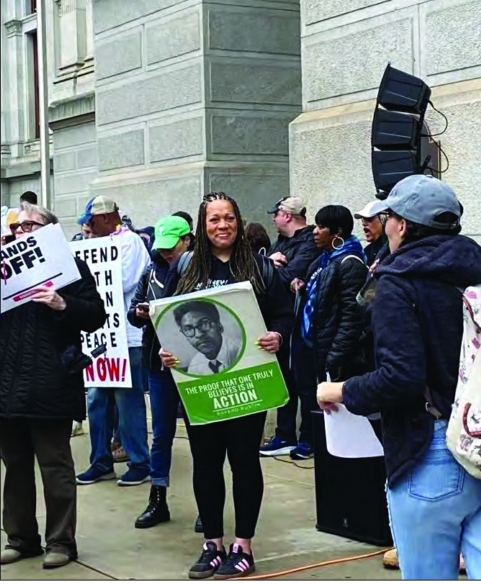
From the podium at Philadelphia’s Independence Mall, Kadida Kenner, executive director of the New Pennsylvania Project, scanned the vast human landscape at the April 5 “Hands Off!” protest. Among the estimated 30,000 assembled, she made a stark observation: Black protesters were missing.
National organizers claim approximately 1,400 rallies drew some 4 million, reportedly the largest mass protest in the nation’s history. In big cities, small towns and overseas, protesters demonstrated their outrage against the Donald Trump/Elon Musk policies.
From anecdotal and visual assessments, the constituency that represented the largest opposition to the Trump presidency did not show up — especially the ranks of Black women, who gave 92% of their votes to Kamala Harris.
Making a collective statement by their absence, social media memes depicted Black folks stepping to line dances and waving hand fans as an answer to multiracial protests, or what Kenner, a speaker at the Philly rally, describes as “taking a break and leaning into our joy.”
Salandra Benton, executive director of the Florida Coalition on Black Civic Participation, stayed home. “We’ve been working first, second, and third shift. It’s time for someone else to pick up the slack. We’re weary, and a piece of our spirit was robbed from us in the last election. For Black women, this is a season of reflection and self-care.”
When America gets a cold, Black people get pneumonia
Benton,
mindful of that metaphor, insists everyone, save for billionaires, is
being harmed by the Trump administration’s policies. “Maybe the
organizers of these mass rallies should focus on working-class whites
who supported Trump,” said Benton, who is also convener of the Florida
Black Women’s Roundtable.
Benton
and others interviewed on this subject underscored that Black
organizing remains pivotal. But multiracial public demonstrations are a
low priority compared to beating back the threats to 60 years of racial
progress.
Longtime
activist and writer Bill Fletcher acknowledges the state of despair but
also laments the lack of a focused Black movement. “There are disparate
actions and organizations with various levels of effectiveness, but no
cohesion,” said Fletcher. “We can’t discount the exaggerated impact of
social media and well-funded right-wing disinformation.”
The
fix for Fletcher is sustained campaigns that defend and safeguard
against attacks by the Trump administration to unleash denaturalization
policies on American citizens, dismantle the Smithsonian National Museum
of African American History and Culture, and retrench the 14th
Amendment, which guarantees equal protection.
“We are in a war, and the other side seeks to annihilate us. We can’t go
it alone,” said Fletcher, who recommends strategies to fight back and
solidify coalitions with Black organizations and progressive whites.
While
multiracial organizing is an important weapon in the toolkit of social
change, there must be reciprocity in the give and take, says Helen
Butler, executive director of the Georgia Coalition for the People’s
Agenda.
“We have to
forge partnerships with people who embrace our issues as much as they
expect us to embrace theirs,” said Butler, who led voter mobilization
campaigns that elected
Georgia’s first Black,Raphael Wornock, and first Jew, Jon Ossoff, to the
U.S. Senate in 2020. “Strong multiracial protests emerged around the
murder of George Floyd, but today, we get little support outside of our
community fighting ongoing police abuse.”
Multiracial
protests are important public statements, says Kenner of Philadelphia,
who describes such activities as “human yard signs.”
“Demonstrations
are events, not movements,” Kenner said. “They proclaim to the world
your beliefs, joining with people who share your values and say we are
not alone.” Recalling Mississippi Civil Rights activist Fannie Lou
Hamer: Nobody’s free until everybody’s free, Kenner stressed, “If we’re
erased, the aim is to also deny the generational horrors that have been
visited upon Black people. But our oppression impacts the nation.”
From
the Middle Passage forward, Black people have endured a multicentury
fight for democracy, punctuated with violence, victories and progress.
But movements and activism have never wavered. “Historically, we’ve been
fighting a civil war in America for a long time. The wealthiest among
us is screwing all of us,” said Erica Smiley, executive director of Jobs
With Justice, an organization dedicated to workers’ rights and economic
empowerment.
“I don’t
think Black folks have been out of the mix in power-building,” Smiley
continued. She notes the call to boycott Target for abandoning its
diversity, equity and inclusion policies was issued by Black leadership.
Though Target won’t comment, the boycott has had a marked impact on the
store’s foot traffic and bottom line, she conjectures.
“Millions
of Black folks haven’t been to Target for weeks. Not showing up there
is far more powerful than showing up for a protest. Showing up for a
workers’ strike makes a greater impact than missing a public rally.”
Smiley makes a distinction between public activism and protests, and
power-building and winning.
Through
a lens of race and economic power, she explains that Jobs With Justice
is part of the labor movement, as opposed to the institutionalized union
movement. But organized labor and the labor movement have a symbiotic
relationship that is essential for the success of all working people.
“Anyone
who doesn’t understand that Black history is also the history of Black
workers, beginning with forced labor and enslavement, misses the point
(about) the importance and power of the labor movement,” Smiley
maintains.
“Industries,
companies and profiteers know the power of the labor movement across
race and gender. They need us more than we need them.”
Gwen McKinney is the campaign director and creator of Unerased| Black Women Speak.