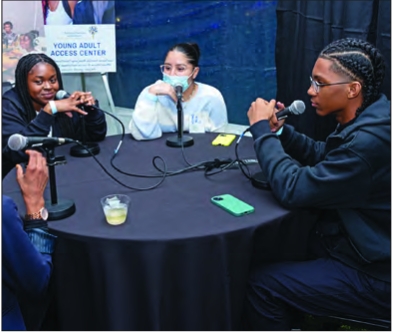
Participants
from Children’s Services of Roxbury’s Youth, Purpose & Partnership
program host a podcast at Children’s Services of Roxbury’s 2022
“Friendrasier” event. The organization is one of about 50 awarded grants
from the city of Boston’s Office of Black Male Advancement last week. 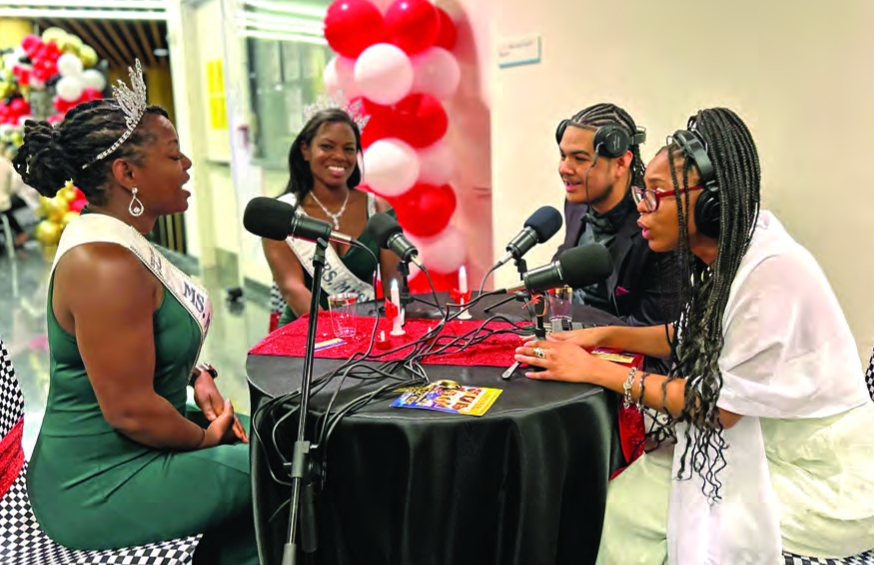
Participants
from Children’s Services of Roxbury’s Youth, Purpose & Partnership
program host a podcast conversation at their 2024 Youth Ball. The
organization is one of about 50 awarded grants from the city of Boston’s
Office of Black Male Advancement last week.
$500,000 in city grants will go to community-based organizations to support Black men and boys across Boston in a spate of new awards announced last week.
The grants from the city’s Office of Black Male Advancement, announced April 14, will go to 52 organizations, with areas of focus like mentoring and out of school time, housing mobility and economic inclusion.
“We have a moral responsibility, not just as an organization, but as a community, to make sure that the next millionaires, billionaires, the next change makers, the next leaders, come from this community,” said Harry Harding, vice president of innovation and strategic partnerships at Children’s Services of Roxbury, one of the awardees.
The grants are aimed at supporting organizations already doing work to support Black men and boys in the community, city officials said.
“The Community Empowerment Grants will provide organizations that have a proven track record with the financial investment and technical assistance to deepen their work,” said Frank Farrow, executive director of the Office of Black Male Advancement, in a statement.
Mayor Michelle Wu said the grants reflect the support the city aims to provide to empower Black men and boys across Boston.
“These grants support and uplift organizations who are already deeply invested in their communities and doing critical work every day across neighborhoods,” Wu said in a statement. “I’m grateful to the Office of Black Male Advancement for their critical work to ensure that Boston is a city for everyone.”
For Children’s Services of Roxbury, which received funding to support youth and young adult pathways, the award will go towards its Youth,
Purpose and Partnership Program, which connects teens in the community
to explore digital storytelling as a way of fostering 21st-century
skills and connecting them to leadership opportunities in their
community, Harding said.
“The
beauty of it is that we want to give them access to all the different
kinds of technology that may put them in positions to thrive,” he said.
The
grant award will largely go toward supporting salaries of the staff who
run the program, as well as stipends for the young people, who are paid
to participate in the program.
That
funding will help the teens served by the program to develop skills
that they can transfer to careers. The program will give participants
the chance to learn technological skills to produce community-driven
stories while also allowing for centering voices that Harding said
sometimes aren’t heard.
“These
young people want to put events together, want their peers to come,
they want adults in the community to come because they care about the
community they live in,” he said. “Their perspective is sometimes lost
in the mix. We don’t always invite young people to tell us how things
can be better in the communities that they also live in.”
Other awardees highlighted the impact the funding of the grants will have on young people as well.
“It’s
important for the city and anybody that cares about our youth to make
investments in the youth,” said William Dickerson II, senior pastor at
Greater Love Tabernacle. “We can talk about them, and we can criticize
them, but if we’re not willing to put up the resources and to help them,
then were just making noise.”
Dickerson’s
Dorchester church, another recipient of the grant funding, will use its
award to support the free field trips and educational programming it
runs.
He said programming has included education around things like health and trips to go skating or bowling.
“This
helps the young boys be directed in the right way,” he said. “It’s not
about proselytizing; it’s about helping them stay off the streets and do
productive things.”
He cited the often-used adage,
“It takes a village to raise a child.”
“Some
of these kids may not have the resources, but they do have the
intelligence, and they do have the potential to be the best version of
themselves to make the city even a better place for all,” Dickerson
said.
Recipients under
the grant program will also be able to access a “Capacity Building
Institute,” aimed at connecting them to receive coaching and technical
assistance to help raise funds.
Harding
said he anticipates that the kind of programming offered to these
community-based organizations will help build connections between
organizations that are often working with the same or similar
communities.
“Partnership
is really … the name of the game,” Harding said. “We won’t get to the
goals that we have … without investing in partnerships and building out
capacity to support that.”
That
kind of capacity building, plus the financial support offered by the
city, will also help close gaps to access and dispel the concept that
Boston is resource-rich and network-poor, Harding said.
“If
we work together and collaborate together more, there’s going to be
better outcomes that come with a certain level of investment and
resources,” he said.


