(left)
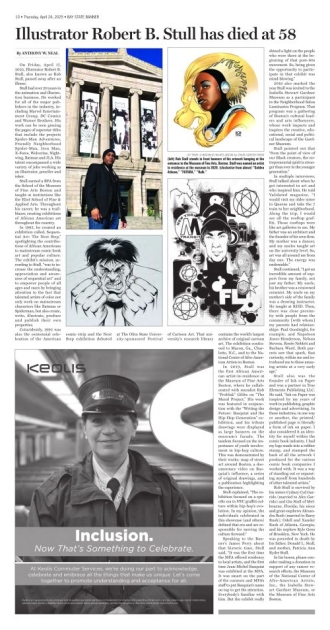
Rob Stull stands in front banners of his artwork hanging at the
entrance to the Museum of Fine Arts, Boston. Stull was named an artist
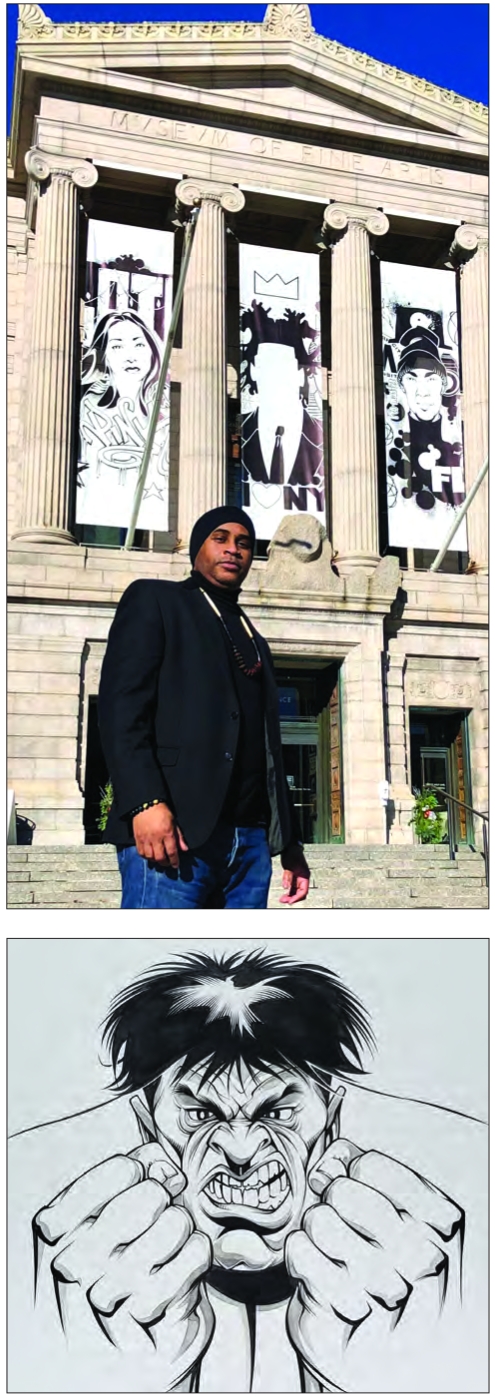
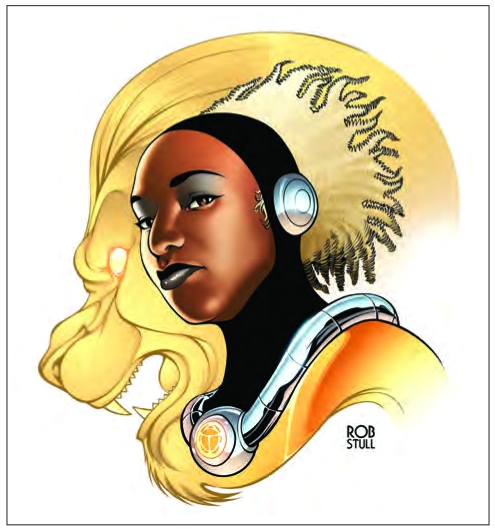
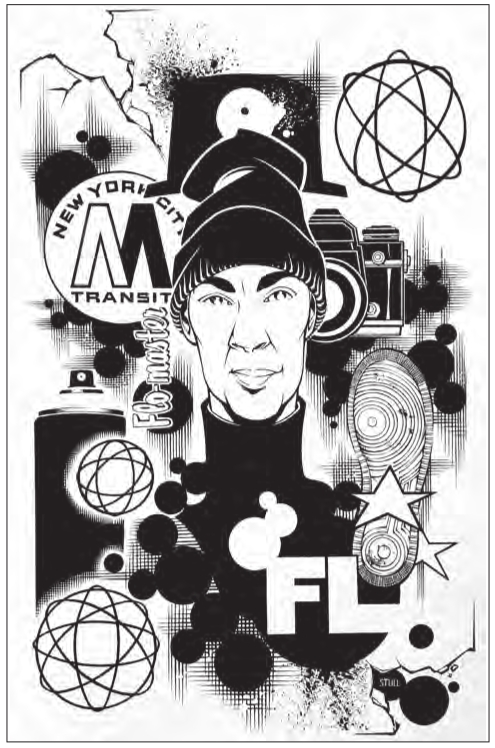
in residence at the museum in 2020. (clockwise from above) “Golden
Athena,” “FUTURA,” “Hulk.”
On Friday, April 17, 2025, Illustrator Robert B. Stull, also known as Rob Stull, passed away after an illness.
Stull had over 20 years in the animation and illustration business. He worked for all of the major publishers in the industry, including Marvel Entertainment Group, DC Comics and Warner Brothers. His work can be seen gracing the pages of superstar titles that include the projects Spider-Man Adventures, Friendly Neighborhood Spider-Man, Iron Man, X-Force, Wolverine, Nightwing, Batman and JLA. His talent encompassed a wide variety of jobs working as an illustrator, penciler and inker.
Stull earned a BFA from the School of the Museum of Fine Arts Boston and taught at institutions like the Eliot School of Fine & Applied Arts. Throughout his career, he was a trailblazer, creating exhibitions of African American art throughout the country.
In 1995, he created an exhibition called, Sequential Art: The Next Step,” spotlighting the contributions of African Americans to mainstream comic book art and popular culture. The exhibit’s mission, according to Stull, “was to increase the understanding, appreciation and awareness of sequential art” and to empower people of all ages and races by bringing attention to the fact that talented artists of color not only work on mainstream characters like Batman or Spiderman, but also create, write, illustrate, produce and publish their own properties.
Coincidently, 1995 was also the centennial celebration of the American comic strip and the Next
Step exhibition debuted at The Ohio State University-sponsored Festival
of Cartoon Art. That university’s research library contains the world’s
largest archive of original cartoon art. The exhibition continued to
Macon, Ga., Charlotte, N.C., and to the National Center of Afro-American
Artists in Boston.
In
2019, Stull was the first African American artist-in-residence at the
Museum of Fine Arts Boston, where he collaborated with muralist Rob
“Problak” Gibbs on “The Mural Project.” His work was featured in
conjunction with the “Writing the Future: Basquiat and the Hip-Hop
Generation” exhibition, and his tribute drawings were displayed as large
banners on the museum’s facade. The tandem focused on the importance of
youth involvement in hip-hop culture.
This
was demonstrated by their works: map of street art around Boston, a
documentary video on Basquiat’s influence, a series of original
drawings, and a publication highlighting the experience.
Stull
explained, “The exhibition focused on a specific era in NYC graffiti
culture within hip-hop’s evolution. In my opinion, the individuals
celebrated in this showcase (and others) defined that era and are
responsible for moving the culture forward.”
Speaking
to the Banner’s James Perry about that historic time, Stull said, “It
was the first time the MFA offered residency to local artists, and the
first time Jean-Michel Basquiat was exhibited at the MFA. It was smart
on the part of the curators and MFA’s staff to put Basquiat’s name on
top to get the attention. Everybody’s familiar with him. But the exhibit
really shined a light on the
people who were there at the beginning of that post-80s movement. So,
being given the opportunity to participate in that exhibit was
mind-blowing.”
2019
also marked the year Stull was invited to the Isabella Stewart Gardner
Museum as a participant in the Neighborhood Salon Luminaries Program.
That program was a gathering of Boston’s cultural leaders and arts
influencers, whose work impacts and inspires the creative, educational,
social and political landscape of the Gardner Museum.
Stull
pointed out that “from the point of view of our Black creators, the
entrepreneurial spirit is stronger than ever in the younger generation.”
In
multiple interviews, Stull talked about when he got interested in art
and who inspired him. He told Validated magazine, “I would visit my
older sister in Queens and take the 7 train to her neighborhood. Along
the trip, I would see all the rooftop graffiti. Those rooftops were like
art galleries to me. My father was an architect and the founder of his
own firm. My mother was a dancer, and my uncles taught art on the
university level. So, art was all around me from day one. The energy was
undeniable.”
Stull
continued, “I got an incredible amount of support from my family, not
just my father. My uncle, his brother was a renowned ceramist. My uncle
on my mother’s side of the family was a drawing instructor. He taught at
RISD. Then, there was close proximity with people from the community
[with whom] my parents had relationships: Paul Goodnight, for example,
and Napoleon Jones-Henderson, Nelson Stevens, Renée Neblett and Barbara
Ward. Both parents saw that spark, that curiosity, within me and
introduced me to these amazing artists at a very early age.”
Stull
also was the founder of Ink on Paper and was a partner in True Elements
Publishing LLC. He said, “Ink on Paper was inspired by my years of work
in publishing, graphic design and advertising. In those industries, in
one way or another, the printed/ published page is literally a form of
ink on paper. I also considered it an identity for myself within the
comic book industry. I had my logo made into a rubber stamp, and stamped
the back of all the artwork I produced for the various comic book
companies I worked with. It was a way of standing out or separating
myself from hundreds of other talented artists.”
Rob
Stull is survived by his sisters Cydney Cyd Garrido (married to Alex
Garrido) and Gia Stull of Melbourne, Florida; his niece and
great-nephews Alexandra Rush (married to Barry Rush); Odell and Xander
Rush of Atlanta, Georgia; and his nephew Kyle Gens of Brooklyn, New
York. He was preceded in death by his father, Donald L. Stull, and
mother, Patricia Ann Ryder Stull.
In
his honor, please consider making a donation in support of any cancer
research efforts, the Museum of the National Center of Afro-American
Artists, Inc., the Isabella Stewart Gardner Museum, or the Museum of
Fine Arts Boston.