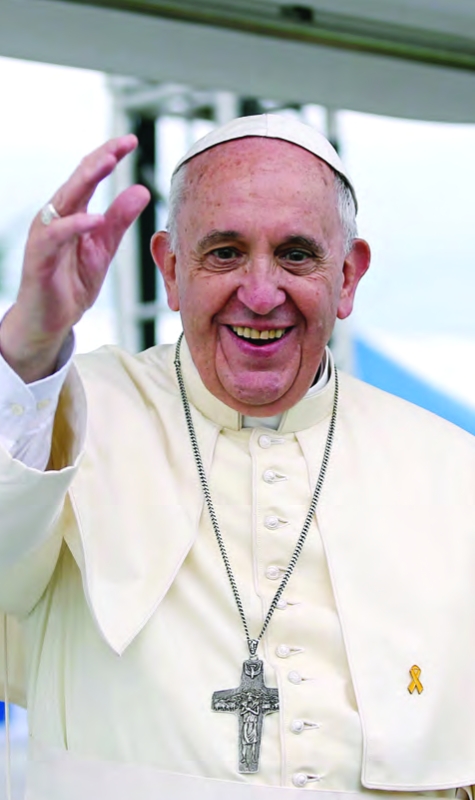
Pope Francis greets worshippers during a visit to South Korea in 2014. 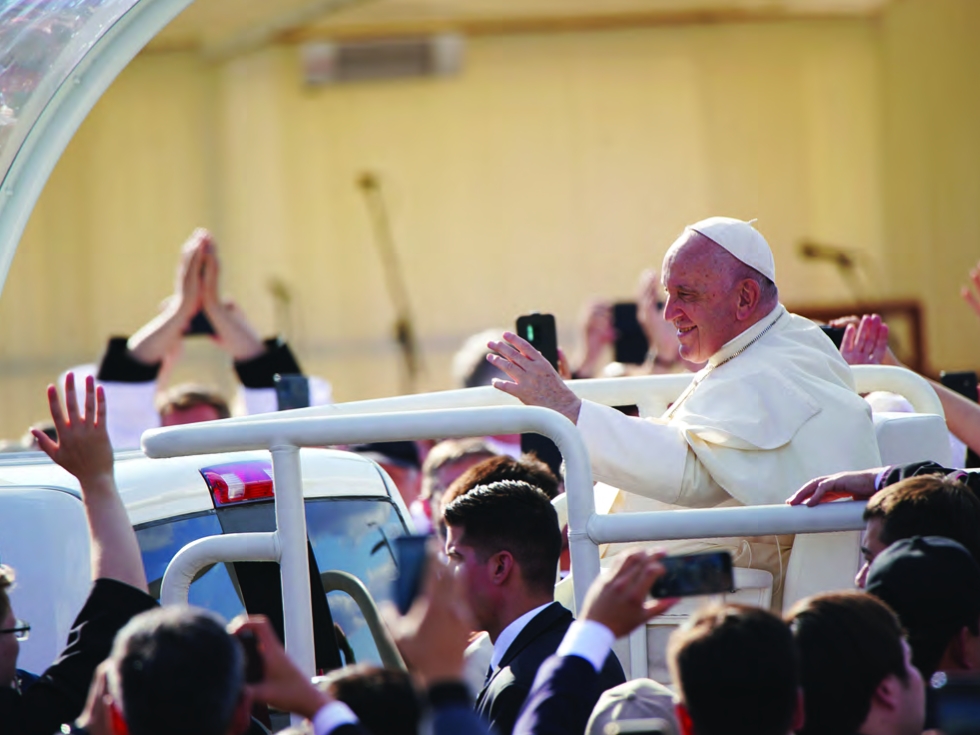
Pope Francis visited Kazakhstan in September 2022 to attend the Seventh Congress of Leaders of World and Traditional Religions.
Faith leaders, politicians and people around the world are mourning the loss of Pope Francis, 88, the first Latin American pontiff and a spiritual leader, who died on Easter Monday.
More than a barrier-breaking pope, Francis is being remembered as a humble servant leader who redefined the Catholic Church through his focus on social justice.
Cardinal Kevin Farrell, the Vatican’s camerlengo, delivered the official announcement of the pope’s death from the chapel of the Domus Santa Marta.
“At 7:35 this morning, the Bishop of Rome, Francis, returned to the home of the Father. His entire life was dedicated to the service of the Lord and of his Church,” the cardinal said.
Church bells rang out across Rome as the news spread.
Francis had been hospitalized since Feb. 14 at Gemelli Hospital in Rome with a respiratory illness that progressed into double pneumonia. It marked the longest hospitalization of his 12-year papacy. He made his final public appearance on Easter Sunday, delivering a blessing to thousands in St. Peter’s Square. The day before, he met briefly with U.S. Vice President JD Vance, whose official social media account had earlier this year incorrectly announced the pope’s death.
“I was happy to see him yesterday,” Vance wrote in a statement on X, formerly known as Twitter, “though he was obviously very ill.”
District of Columbia Mayor Muriel Bowser, who met Francis during his visit to the White House in 2015 under President Barack Obama, highlighted the significance of the pope’s work and ministry.
“Pope Francis challenged us to lift up our neighbors with love and compassion, take care of our planet, and look after the least, the last, and the lost among us,” Bowser wrote on X, posted with a picture of Obama introducing her to the pope.
“The loss of Pope Francis will be felt throughout our city and around the world today—but I know that the D.C. community will continue to be guided by his words, motivated by his actions, and inspired by his commitment to faith.”
Bowser offered Washingtonians a call to action in remembering the pontiff’s life.
“May we remember,” Bowser said, “his words today and always: ‘Who am I to judge?’
A life of humble service: ‘My people are poor, and I am one of them’
Born Jorge Mario Bergoglio on December 17, 1936, in Buenos Aires, Argentina, Francis was the son of Italian immigrants. According to his official biography, Francis’ father worked as a railway accountant and his mother raised five children.
Bergoglio trained as a chemical technician before entering the seminary in 1958, joining the Society of Jesus. He was ordained a priest in 1969, became provincial of the Jesuits in Argentina in 1973 and later served as archbishop of Buenos Aires. In 2001, Pope John Paul II made him a cardinal.
His rejection of luxury defined much of his ministry. He lived in a modest apartment, cooked his own meals and used public transportation.
“My people are poor, and I am one of them,” he once said.
Church
officials said his papal motto, “Miserando atque eligendo,” reflected a
commitment to humility and mercy. As pope, Francis chose to live in the
Vatican guesthouse instead of the Apostolic Palace.
Elected pope on March 13, 2013, Francis became the first Jesuit and the first non-European pope in more than a millennium.
He
quickly set a new tone — denouncing the excesses of capitalism, calling
for action on climate change and urging compassion for migrants and the
poor. His 2015 encyclical “Laudato si’” remains one of the most
influential religious declarations on the environment.
The
Latin phrase “Per favore, non dimenticatevi di pregare per me,” which
translates to “Please, don’t forget to pray for me,” quickly became a
trademark for all of Francis’ public rhetoric, and crowds would
sometimes recite the line along with the pontiff.
His
papacy, however, drew the ire of conservatives. He challenged
entrenched power structures, supported limited civil recognition for
same-sex couples, and opened discussions on the role of women in the
Catholic Church. His critiques of nationalism and authoritarianism,
especially those tied to rightwing politics, were frequent and pointed.
In
February, Catholic author Alessandra Harris, writing in the National
Catholic Reporter, addressed the tensions within American Catholicism,
where a majority of white Catholics helped elect Donald Trump despite
the pope’s warnings.
“We
are living in a time when self-professed Catholics are not only turning
a blind eye to evil, but have elected and are supporting President
Donald Trump, who is against diversity, against immigrants, against the
poor, and seeks to destroy the multiracial democracy that was hard
fought and won by the sweat and blood of African Americans and
progressives in the United States,” Harris wrote.
She noted that Trump’s actions and agenda completely go against the pope’s values.
“Pope
Francis has always directed Catholics to care for immigrants, refugees
and foreigners,” Harris continued. “Yet these exhortations fall on deaf
Catholic ears in the United States, a country of foreigners. … Although
America has been known around the world as a beacon of democracy, the
reality is that the United States has only been a democracy that
included all people since the 1960s.”
Officials
said Francis never shied away from confronting tensions. He urged the
Church to reject exclusion and embrace solidarity throughout his papacy.
He condemned what he called “spiritual worldliness” — a form of
self-centeredness and moral detachment — and called trampling on human
dignity “a serious sin.”
He
authored several works, including “Meditaciones para religiosos,
Reflexiones sobre la vida apostólica” and “Reflexiones de esperanza.”
As
grand chancellor of the Catholic University of Argentina, he led
initiatives for education and poverty relief and as archbishop of Buenos
Aires, he launched citywide missionary projects targeting the poor and
marginalized.
Even as
his health declined, he remained active in Church matters and global
affairs. His final message, delivered on Easter Sunday, was one of peace
and hope.
“His entire life was dedicated to the service of the Lord and of his Church,” Farrell said.
African Americans and the Catholic Church, Black people celebrate the life of Pope Francis
Harris
noted the Church’s longtime history of racial exclusion and silence,
referencing a 1903 indictment by Belgian priest Joseph Anciaux that
exposed the U.S.
Catholic Church’s failure to serve Black communities.
In
1968, the National Black Catholic Clergy Caucus declared the Catholic
Church in the United States “primarily a white racist institution.”
Harris
cited that legacy in a modern context, writing, “With 59% of white
Catholics voting Trump into office — and the failure of the U.S.
Conference of Catholic Bishops to strongly condemn Trump’s racist and
anti-immigrant agenda — the Catholic Church is once again siding with
white supremacy or hoping to benefit from its proximity to whiteness at
the expense of people who are Black, Native, noncitizens and LGBTQIA+.”
Despite
claims of racism and discrimination in the Catholic Church, many noted
Pope Francis’ ministry elevated diversity Pope Francis across the
denomination.
“We
cannot tolerate or turn a blind eye to racism and exclusion in any form
and yet claim to defend the sacredness of every human life,” Francis
said in June 2020, according to Vatican News, amid the social unrest
after the police murder of George Floyd in Minneapolis.
Nate
Tinner Williams, editor of Black Catholic Messenger, emphasized the
importance of Francis’ ministry for African Americans and people around
the world.
“Pope
Francis inaugurated a watershed moment in the history of the Catholic
Church, bringing unparalleled compassion and concern for modern issues
to the fore. He spoke out fearlessly and ch allenged his fellow leaders,
spiritual and secular, to greater recognition of human dignity and the
need for a more peaceful
world,” said Tinner Williams. “His impact can hardly be measured and to
say he will be missed would be a grand understatement. He was a
monumental force in 21st-century Christianity.”
While
they are not Catholic, Pastors Kofie and Lachele Bryant of Inspired
Life Ministries in Suitland, Maryland, noted the importance of Francis’
ministry for Christians and all people.
“We
are deeply moved by the passing of Pope Francis, whose life exemplified
humble service and compassion for the marginalized. His dedication to
living the values of the Gospel with faithfulness, courage, and
universal love — especially for the poorest and most vulnerable — stands
as a powerful testament to Christ’s teachings,” the Bryants said in a
statement to The Washington Informer.
Noting
they come from different traditions in the Christian faith, the Bryants
celebrated Pope Francis as “a bridge-builder who sought unity amid
diversity and spoke truth to power.”
“His voice for peace, environmental stewardship,
and human dignity transcended religious boundaries and reminded us all
of our shared responsibility to one another,” they continued. “Today, we
join millions worldwide in prayer and reflection, celebrating a life
well-lived in service to God.”
Bishop
Joel Peebles, presiding bishop of the Global United Fellowship, praised
Pope Francis as an inspirational figure and seeks to honor his legacy
of service.
“As the
266th successor of Saint Peter and Shepherd to millions within the Roman
Catholic community, Pope Francis embodied a spirit of humility, mercy,
and tireless advocacy for the marginalized. His pontificate will be
remembered for its emphasis on compassion, interfaith dialogue, and
justice for all humanity,” said Peebles. He also pledged to stand in
prayerful solidarity with those mourning the passing of the pope.
“May the light of his witness continue to guide the hearts of leaders and believers across the world,” continued Peebles.
Sean
Michael Wilson, a Maryland resident who was raised Baptist and attends a
non-denominational church, emphasized the importance of Pope Francis’
ministry beyond the Catholic Church.
“I
am sorry for the passing of Pope Francis, and I wish that his successor
will continue his work of progressive change,” Wilson told The
Informer.
Social media
user Bonnie Greer suggested the Archdiocese of Washington’s Cardinal
Wilton D. Gregory, as someone to consider for the next pope.
“Time
for the Catholic Church to turn to the so-called global South for the
next pontiff maximus,” Greer wrote on X. “There are plenty of
candidates, including Chicago-born and first African-American Prince of
The Church: Cardinal Wilton D. Gregory.”
This story originally appeared in the Washington Informer.