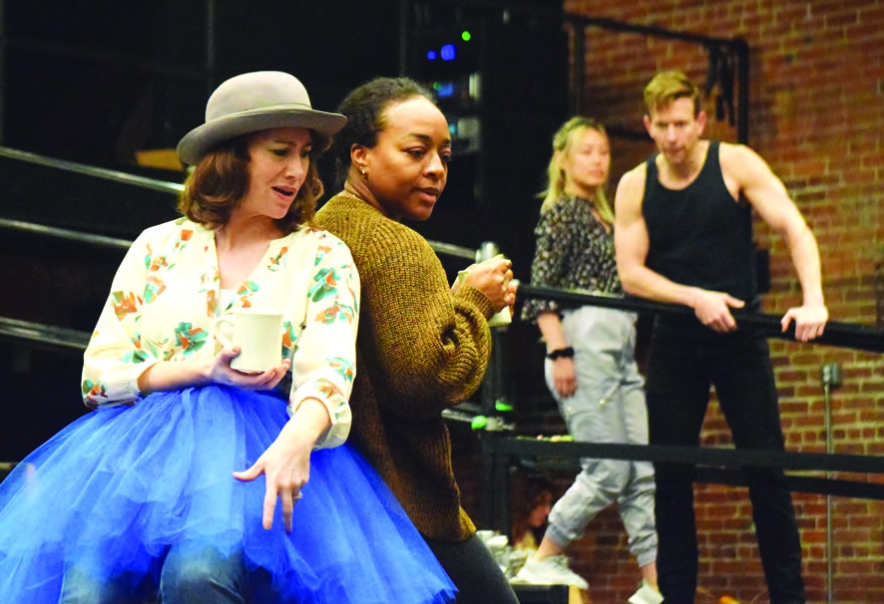
Brandie Sutton (front, right) and Anya Matanovic in rehearsal for Boston Lyric Opera’s “Carousel.”When Richard Rodgers and Oscar Hammerstein II created “Carousel,” which Time magazine declared “the Best Musical of the 20th Century,” they adapted a bleak 1909 drama “Liliom” (tough guy) by Hungarian playwright Ferenc Molnár, who turned down Giacomo Puccini’s offer to transform it into an opera. But after seeing the first musical by Rodgers and Hammerstein, “Oklahoma!” he consented to their proposal of a musical.
Their version transfers Molnár’s tale to a Maine fishing village and, with a new ending, Rodgers said, “It may still be a tragedy but it’s a hopeful one.”
A traveling carnival troupe arrives at the town’s abandoned amusement park. Among them is Billy Bigelow, a charming but footloose carousel barker. He and Julie Jordan, a local mill worker, fall in love. Both lose their jobs and when Julie reveals she’s pregnant, Billy vows to provide for his family and agrees to a robbery with his scheming friend Jigger. When their plan fails, Billy kills himself. In the afterlife, Billy intervenes to help Julie and their now-grown daughter.
This story unfolds with sublime music. Liverpool Football Club fans sing “You’ll Never Walk Alone” at every match. Aretha Franklin recorded it on her 1972 album “Amazing Grace.” Songwriter Irving Berlin found that the ballad had the same impact on him as the 23rd Psalm.
Its 12-minute “bench scene,” which Billy and Julie conclude by singing “If I Loved You,” is hailed by renowned composer Stephen Sondheim as “the single most important moment in the revolution of contemporary musicals.”
From
April 4-13, the Boston Lyric Opera will present its 80th anniversary
production of Rodgers & Hammerstein’s “Carousel” at the Emerson
Colonial Theatre, the same theater in which the musical was launched on
March 27, 1945, with a three-week tryout before its two-year Broadway
run.
“‘Carousel’ is a
profound exploration of love, loss and redemption,” said the
production’s director, renowned theater artist Ann Bogart, who finds in
its music and story of hard-won grace a testament to the power of
compassion and community.
“We’re
living in a climate full of stress and alienation. When times are
tough, people tend to be mean. When you’re reminded of human grace and
empathy, it’s a big deal.”
BLO
Music Director David Angus will conduct the company’s 40-piece
orchestra and Chorus Director Brett Hodgdon will lead its 38-member
chorus. Shura Baryshnikov will adapt the acclaimed original choreography
by Agnes de Mille.
Bogart
guides the staging and acting with an eye for telling detail. “If you
get it right, something chemical happens. I’m looking to touch that
chemistry.”
Joining
Bogart in conjuring this chemistry are set designer Sara Brown, costume
designer Haydee Zelideth, lighting designer Brian H. Scott and a starry,
racially diverse cast. They include soprano Brandie Inez Sutton, the
first African American artist in the role of Julie; baritone Markel Reed
as Jigger; and M. Lee Pelton, president of the Boston Foundation, in
two non-singing roles, the town physician Dr. Seldon and the Starkeeper,
Billy’s afterlife guide.
“I
wanted a cast that looks like the world we live in,” said Bogart, “And
for Pelton’s roles, I wanted somebody who people in Boston will
recognize.”
Noting
Zelideth’s expressive costumes, Bogart said, “Showgirls come out with
big feathered headdresses. It’s a miracle, injecting life, color and
humor. And a rabbit crosses the stage. It’s not in the script.”
Encouraging actors to mine “oppositions” in themselves and in their characters, Bogart
said, “I watch very closely and notice the slightest inkling that an
actor has to do something but then hesitates. Such moments help these
contradictions come out. Our Jigger, Markel Reed, is an extraordinary
actor and very warm and fun, and he plays the mean, nasty guy.”
Sutton’s
Julie is no victim in her love for the troubled Billy. “Being able to
see the good in people is a beautiful character trait,” said Sutton.
“And she can be a little wild and wants to have fun. When she sings
‘What’s the Use of Wond’rin?’ to comfort a friend, she’s also singing to
herself, wrestling with whether she should give up on Billy.”
As
she finds her Julie, Sutton credits her mentor, Harlem-born soprano
Martina Arroyo. “Martina is a great African American and Latino opera
star who has paved a way for many others with her amazing young artist
program. We all know her as our opera mother. The first time I sang an
aria with her she said to me, ‘It was beautiful, but it was boring.’
From that time on, I realized that character is the most important
thing.”
The agency
that Sutton finds in Julie also applies to herself. While enjoying a
successful international career in opera, Sutton is developing a solo
show titled “My Inner Diva.” “I’ll sing all the music I love, including
gospel, jazz and Broadway songs.”
Bogart
is also looking beyond the brief run of the BLO’s “Carousel.” “We’re
only doing it four times in Boston,” he said. “I hope our production has
a future life. This is my dream.”
ON THE WEB
Learn more at blo.org/carousel