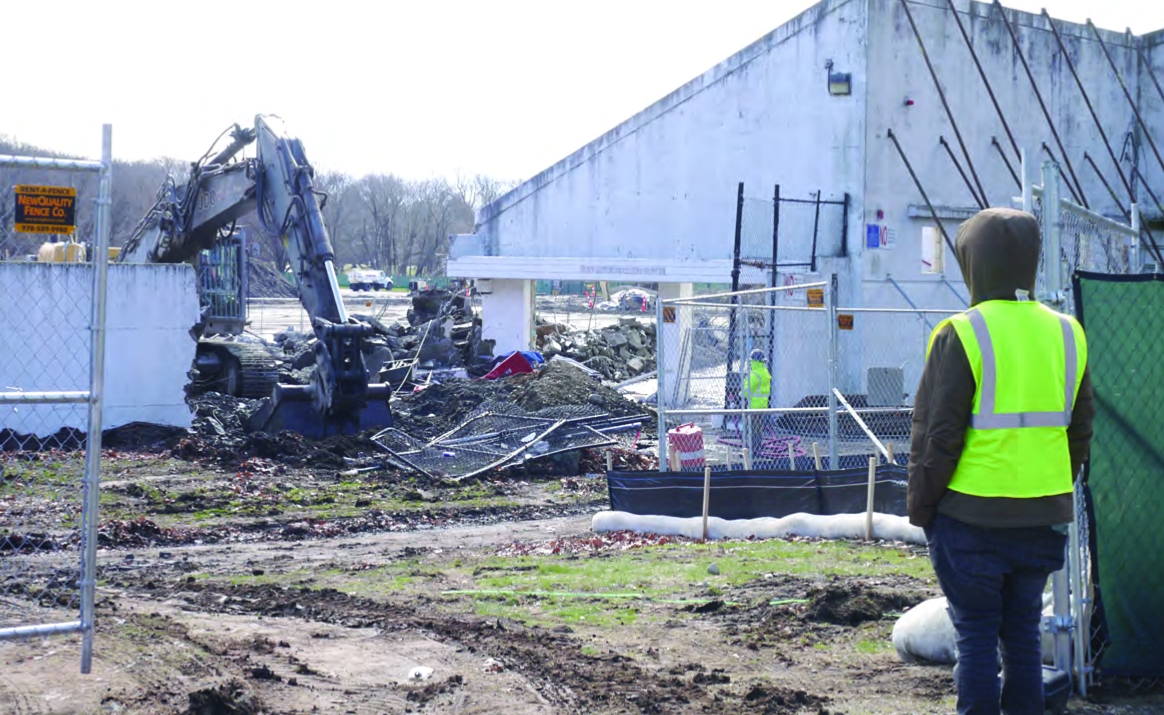
An excavator removes a section of wall next to the west grandstand at George Robert White Schoolboy Stadium Tuesday.Members of Franklin Park Defenders, a group led by the Emerald Necklace Conservancy and residents from the neighborhoods around Franklin Park, contend that the city’s plan to lease White Stadium to Boston Unity Soccer Partners for use by a professional women’s soccer team amounts to privatization of public park land.
The soccer team owners and City of Boston officials say the stadium, built with funding from the George Robert White Trust, belongs to the Boston Public Schools and therefore is not subject to a state law barring the transfer of public parkland to private entities.
Both sides made their arguments in court during a trial that ended March 20 and are awaiting a decision from Suffolk Superior Court Judge Matthew Nestor.
The city has begun demolition on the site in anticipation of starting construction. The eastern grandstand, which was damaged in a fire and has been closed for years, has been demolished. The city plans to build a new grandstand with facilities for Boston Public Schools athletes, who will be able to use the stadium when it’s not in use by the soccer team.
The western grandstand is also undergoing demolition. The exterior wall of the grandstand will remain standing, but the interior space, which currently holds locker rooms and classrooms for Boston Public Schools students, will be rebuilt as locker rooms and facilities for the soccer team.
The city and BUSP plan to make both grandstands higher than the existing structure to accommodate crowds of up to 12,000.
Nestor advised the city and the team that they could move forward with the construction at their own risk.
As
the trial got underway earlier in March, Nestor ruled against two of
the main charges made by Franklin Park Defenders. One charge in the
group’s lawsuit maintained that the city erred in entering into a
financial agreement with the BUSP because the George Robert White Fund,
the charitable trust that built George Robert White Schoolboy Stadium
for Boston schoolchildren, prohibits co-mingling of public and private
funds for joint undertakings.
Nestor ruled that the plaintiffs lacked the legal standing to pursue that claim.
The
other charge Nestor ruled against was the plaintiffs’ request to
include evidence that the request for proposals process in which BUSP
was the only bidder was flawed. While Franklin Park Defenders found, in
the process of discovery, that the city communicated extensively with
BUSP members about the RFP in the months before it was issued, in effect
ensuring that the RFP was written to favor BUSP over any other
potential bidder, Nestor ruled that the Defenders’ original complaint to
the court did not make any claims relative to the RFP process.
The judge also barred the plaintiffs from arguments against the BUSP plans to sell alcohol and route auto traffic in the park.
That
left the plaintiffs to argue on their core contention that the
arrangement between the City and BUSP constitutes a privatization of
public parkland, which, under Article 97 of the Massachusetts
Constitution, requires the approval of the Legislature. BUSP and the
city have not sought nor obtained approval from the Legislature for the
project.
Nestor has not said when he will issue a ruling in the case.
City officials expressed confidence in their defense.
“For 40 years, White Stadium has been crumbling and students have paid the price,” Wu spokesperson Emma Pettit said in a
statement provided to news media. “The only question in this case is
whether White Stadium is a school facility that the city is allowed to
renovate, or whether it is intended only to be parkland that happens to
have a decrepit structure, as the Emerald Necklace Conservancy wrongly
contends.”
The Emerald Necklace Conservancy vowed in a statement to continue fighting for the public interest.
“We
were glad to have our day of court, and look forward to the judge’s
decision. As we wait, we will continue working to build support for our
community-led vision of a truly public White Stadium,” the statement
read in part.
Beyond
the legality of the city’s plans for the stadium, abutters have raised
concerns that the demands on parking and traffic will place an undue
burden on the Roxbury, Dorchester and Jamaica Plain neighborhoods
bordering Franklin Park.
While
BUSP says it will use the park for 20 games between late March and
early November of each year, the city plans to ban parking in Franklin
Park and restrict parking within a mile radius of the park to residents
with permits on game days. Such restrictions could cut into the weekly
schedule of festivals, free concerts and other events that commonly take
place in the park. The city’s contract with BUSP includes a carve-out
for June 19, but not for the Saturday during which Black Bostonians have
typically celebrated the Juneteenth holiday.
Other
events, such as cross-country meets, the Boston Athletic Association
Half Marathon, the Boston Area Music Soul Festival, Caribbean Carnival,
Playhouse in the Park and the Dominican and Puerto Rican festivals,
could be subject to the soccer team’s schedule.
Additionally,
events such as church festivals, festivals at the Museum of the
National Center for Afro-American Artists and other outdoor events held
in the surrounding neighborhoods could be impacted by the parking ban.
“If
[BUSP] goes forward, we’ll lose access to the area around the stadium
and in the neighborhood,” said Louis Elisa, a plaintiff in the suit and
president of the Garrison Trotter Neighborhood Association. “It’s not
just going to be game days. They’ll need to do events to make the
stadium profitable.”


