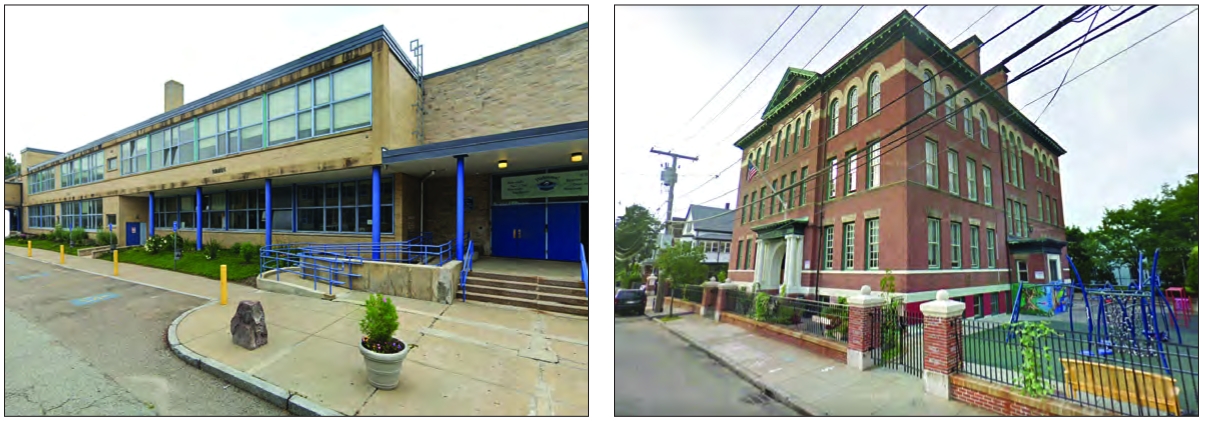
The Paul A. Dever School (left) and Roger Clap Elementary School are slated to merge with other schools. In a data-driven pursuit of “high quality seats,” the Boston School Committee voted on March 20 to close or uproot six schools. Two have alternative education programs. It takes effect June 2026.
“We’re making the hard but necessary decisions to right-size our district and best serve students,” said Mayor Michelle Wu one day earlier in the 2025 State of the City Address.
Alternative education programs serve students with exceptional challenges. Dispersing specialized services across the district was one stated goal.
Boston primarily relies on three datapoints to justify school closure: the utilization rate, an experience score and building capacity for certain services.
Utilization is the percentage of potential seats filled.
The four-point experience score counts categories of a rubric. A good gym, library, cafeteria and auditorium, combined can contribute towards one point, while staff lounges, lactation spaces and administrative rooms count towards another.
Both aspects of special education are considered. The quality of space for substantially separate instruction is evaluated in the rubric, while the “continuum of services” datapoint counts schools’ capacity for inclusion.
Boston is navigating legal and fiscal imperatives.
A
key memo last May said Boston Public Schools is “shifting our
specialized programs to be shared equitably across school communities.”
It reads, “where possible, we will be situating specialized classrooms
within schools” where students are “integrated with their peers for a
portion of the day.”
Laws
and regulations promote educating students with disabilities in the
least restrictive environment. The capital’s commitment has long been
contested.
In 2022,
BPS agreed “building options for students in the least restrictive
environment must be the foundation of special education in every
school.”
“Enrollment
decline at the secondary level,” the memo states, is “concentrated”
where specialized programs exist. Community input asked BPS to increase
its “market share” among school aged children. Funding follows
enrollment.
School
committee members acknowledged closures consistently displace
marginalized people most. A few seemed torn. The vote was 5 to 1.
For
Superintendent Mary Skipper, BPS’s “footprint is too big” and schools
are “outdated and deteriorating.” Closures will “put us in a better
position to serve our students and families, especially those with
highest needs,” she said. “Students [will] move into higher quality
learning environments.”
The
change could save $10 - $20 million, before relocating “highly
specialized programs,” which BPS wrote, “may mitigate any cost savings.”
One
school closing, Excel High, operates where South Boston High School did
for decades. Until 2011, Excel was one of three in the building.
Combined enrollment exceeded 1,000. In 2025, the sole occupant’s
enrollment is 301.
Such
emptiness echoes busing-era boycotts. Enrolled with 1,744 students in
1974, South Boston High School’s 1975 attendance averaged 400, the Globe
reported. Busing haunts the building.
Now,
demographic decline surrounds it. Save Charlestown, Boston’s whitest
neighborhoods have fewer school-aged children, according to the city’s
2020 census breakdown. Fifteen percent of Boston is under the age of 18,
compared with 28% in 1970.
Excel
High School Principal Nachelle Gordon testified that competitive
private colleges accepted her graduates. She highlighted Excel’s
talented scholars and artists. Provided sufficient support, she will be
“at peace with the closing.”
“It’s
no secret that there are systems in place” hampering Excel’s struggle
against “negative narratives,” Gordon testified. “If closing Excel is a
steppingstone to dismantling those systems and providing better
opportunities and facilities to our students, then so be it.”
Excel
High School has a Vietnamese SEI and the accelerated intervention
program. Twenty-eight percent of students have special needs and 15%
need substantially separate education.
Forty-two percent of students live within 2 miles.
Another
alternative program, Community Academy, will cease offering diplomas.
Fifty-nine percent of Community Academy’s 58 students have disabilities.
It will still serve students transitioning out of BPS, and in from
hospitalization or DYS.
Later,
Stephen Alkins said that “our alternative education options have grown.
Now, students have more to choose from.” The School Committee member
called for more thinking about BPS’s alternative education plan.
Three
elementary schools will close or merge: Dever, Roger Clap and Winthrop.
Merging schools are destined for the Lilla G. Frederick near Grove
Hall. Some school communities testified they exemplify inclusive
education.
Paola Lugo,
a mother of four from Dorchester, said in Spanish, “As parents, we are
concerned.” With three kids attending Clap Elementary, she expected
“this change will have a huge impact.”
Yanery
Diaz, whose son attends the Dever, praised the school. “The Dever
community is truly united,” she testified. It has “a lot of humanity.”
Nicole
Livingstone, a teacher at the Dever, urged BPS to “not accept the
mediocre plan put before you.” BPS was closing “the only school that is
full inclusion from Pre-K to 6,” she said.
Gabriella Antignano, the Dever’s family liaison, felt “blindsided.”
Many students are experiencing homlessness and, she said, “we feel excluded and powerless.”
Madison
Morley, a teacher from Dorchester, refuted underutilization claims.
“Our space was given away by the district,” she said. With context,
Morley argued, the Dever is “actually over enrolled.”
Dermont
Kiernan, a father of two Clap Elementary students, said his family
chose that school knowing facilities were limited. “The people and the
programs make the kids feel like they belong.”
Genet
Milari, who works at the Roger Clap school, asked for multi-year
transitional funding to maintain services. “Some of our highest needs
students come from out of district placements and [substantially]
separate communities,” she said.
Benjamin
Diaz, a single father, credited the Roger Clap Elementary School with
how his daughter “exceeded in her education.” He said, “I really believe
in the small classroom size.”
Over
seven years at the Dever, Alexandra Orlinsky has seen “academic and
social emotional leaps and bounds.” For her, “the Dever is better
together.”
Maria
Barbosa, a Mattapan mother of two Clap students, is for the merger. She
only asked for funding. “More than one teacher is needed per class,” she
said, “we are an inclusion school.”
Cheryl
Buckman of South Boston is a Dever Elementary parent and alum. She
opposed closure. Dever students, she said, “felt heard and accepted.”
Turnaround work at the school, she lamented, will have been in vain.
Haval
Abdulrahnan is a parent of two Dever Elementary students. He called it
the “cornerstone of our community” that provides the “care, stability
and support” students “need to thrive.”
VP
of the Harbor Point Community Task Force, Abdulrahnan said “breaking up
this school would break the strong foundation we have built together”
and “weaken the fabric of our neighborhood.”
For
first grade teacher Zoila Alvarado, “the Dever is a mindset: an
attitude about doing education right.” Its “walls don’t just house
classrooms, they house dreams, ambitions and a culture of excellence.”
School
Committee Chair Jeri Robinson accepted the fate accompli. “Change is
hard. It’s often not welcome, but it is often inevitable.” She reasoned
some “loving communities … are not improving student outcomes.”
Thanks to the merger, BPS will “create a dual language Cape Verdean pathway” at the Frederick, Skipper said.
The sixth school closing, Mary Lyon High School, is located in Brighton.
In 2020, BPS closed two schools with alternative education programs, West Roxbury Academy and Urban Science Academy.


