(above)
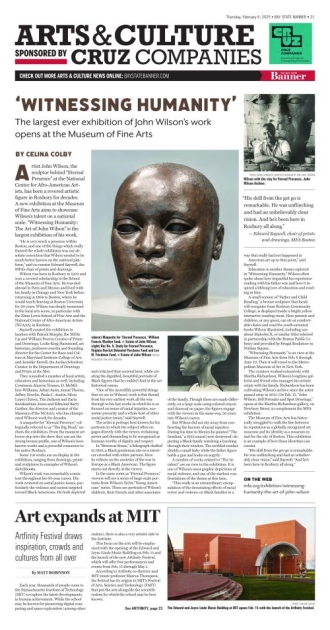
Maquette for ‘Eternal Presence,’ William Francis Warden Fund, © Estate
of John Wilson; (right) Roz No. 9, Study for Eternal Presence, Virginia
Herrick Deknatel Purchase Fund and Lee M. Friedman Fund, © Estate of
John Wilson

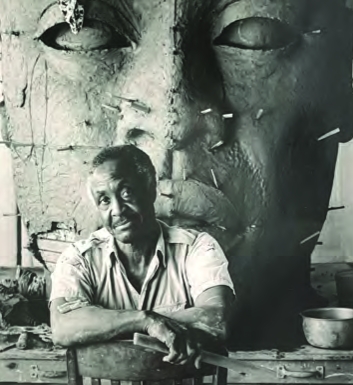
Wilson with the clay for Eternal Presence, John Wilson Archive.
The largest ever exhibition of John Wilson’s work opens at the Museum of Fine Arts
Artist John Wilson, the sculptor behind “Eternal Presence” at the National Center for Afro-American Artists, has been a revered artistic figure in Roxbury for decades. A new exhibition at the Museum of Fine Arts aims to showcase Wilson’s talent on a national scale. “Witnessing Humanity: The Art of John Wilson” is the largest exhibition of his work.
“He is very much a presence within Boston, and one of the things which really framed the whole exhibition was our absolute conviction that Wilson needed to be much better known on the national platform,” said co-curator Edward Saywell, the MFA’s chair of prints and drawings.
Wilson was born in Roxbury in 1922 and won a coveted scholarship to the School of the Museum of Fine Arts. He traveled abroad in Paris and Mexico and lived with his family in Chicago and New York before returning in 1964 to Boston, where he would teach drawing at Boston University for 20 years. Wilson was deeply immersed in the local arts scene, in particular with the Elma Lewis School of Fine Arts and the National Center of Afro-American Artists (NCAAA) in Roxbury.
Saywell curated the exhibition in tandem with Patrick Murphy, the MFA’s Lia and William Poorvu Curator of Prints and Drawings; Leslie King Hammond, art historian, professor emerita and founding director for the Center for Race and Culture at Maryland Institute College of Art; and Jennifer Farrell, the Jordan Schnitzer Curator in the Department of Drawings and Prints at the Met.
They consulted a number of local artists, educators and historians as well, including Constanza Alarcón Tennen, D. McMillion-Williams, Jabari Asim, Jamal Thorne, Jeffrey Nowlin, Paula C. Austin, Silvia Lopez Chavez, Tito Jackson and Zaria Karakashian-Jones and Edmund Barry Gaither, the director and curator of the Museum of the NCAAA, who has championed Wilson’s work for decades.
A maquette for “Eternal Presence,” colloquially referred to as “The Big Head,” anchors the exhibition. From the moment art lovers step into the show they can see the strong bronze profile, one of Wilson’s bestknown works and a powerful connector to his native Roxbury.
Some 110 works are on display in the exhibition, ranging from drawings, prints and sculptures to examples of Wilson’s sketchbooks.
Wilson’s work was remarkably consistent throughout his 60-year career. His work centered on social justice issues, particularly the violence and racism targeted toward Black Americans. He both depicted and criticized that
societal bent, while creating the dignified, beautiful portraits of
Black figures that he couldn’t find in the art historical canon.
“One
of the incredibly powerful things that we see in Wilson’s work is this
thread from his very earliest work all the way through to his last works
in which he is so focused on issues of racial injustice, economic
precarity and a whole host of other social justice issues,” said
Saywell.
The artist is
perhaps best known for his portraits in which the subject often engages
directly with the viewer, reclaiming power and demanding to be
recognized as humans worthy of dignity and respect.
In
“Streetcar Scene,” a lithograph drafted in 1945, a Black gentleman sits
on a streetcar crowded with white patrons. Here he reflects on the
anxieties of the war in Europe as a Black American. The figure stares
out directly at the viewer.
In
the same room as “Eternal Presence,” viewers will see a series of
large-scale portraits from Wilson’s 1970s “Young Americans” series.
These are portraits of Wilson’s children, their friends and other
associates of the family. Though these are made differently, on a large
scale using colored crayon and charcoal on paper, the figures engage
with the viewers in the same way, 30 years into Wilson’s career.
But Wilson did not shy away from confronting the horrors of racial injustice.
During
his time in Mexico he painted “The Incident,” a 1952 mural (now
destroyed) depicting a Black family watching a lynching through their
window. The terrified mother shields a small baby while the father
figure holds a gun and looks on angrily.
A
number of works related to “The Incident” are on view in the
exhibition. It is one of Wilson’s most graphic depictions of racial
violence, and one of the starkest confrontations of the theme at this
time.
“This really is
an extraordinary encapsulation of the devastating effects of racial
terror and violence on Black families in a way that really had not
happened in American art up to that point,” said Saywell.
Education
is another theme explored in “Witnessing Humanity.” Wilson often spoke
about how impactful his experience reading with his father was and how
it inspired a lifelong love of education and reading in him.
A
small version of “Father and Child Reading,” a bronze sculpture that
locals will recognize from Roxbury Community College, is displayed
inside a bright yellow interactive reading room. Here parents and
children, or any guest, can sit on comfortable chairs and read the
youth-oriented books Wilson illustrated, including one about Malcolm X,
or similar titles selected in partnership with the Boston Public Library
and provided by Frugal Bookstore in Nubian Square.
“Witnessing
Humanity” is on view at the Museum of Fine Arts from Feb. 8 through
June 22. Then it will travel to the Metropolitan Museum of Art in New
York.
The curators
worked extensively with Martha Richardson, Wilson’s longtime gallerist
and friend who manages his artistic estate with his family. Richardson
has been cultivating Wilson’s archive since the artist passed away in
2015. On Feb. 15, “John Wilson: Self Portraits and Spot Drawings,” opens
at the Martha Richardson gallery, on Newbury Street, to complement the
MFA exhibition.
The
Museum of Fine Arts has historically struggled to walk the line between
its reputation as a globally recognized art museum and its identity as a
museum in and for the city of Boston. This exhibition is an example of
how those identities can coexist.
“His skill from the get-go is remarkable.
He was unflinching and had an unbelievably clear vision,” said Saywell. “And he’s been here in Roxbury all along.”
ON THE WEB mfa.org/exhibition/witnessinghumanity-the-art-of-john-wilson