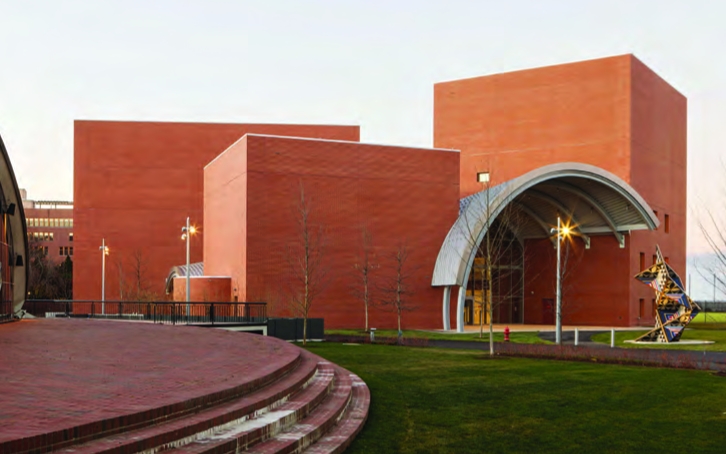
The Edward and Joyce Linde Music Building at MIT opens Feb. 15 with the launch of the Artfinity Festival. Artfinity Festival draws inspiration, crowds and cultures from all over
Each year, thousands of people come to the Massachusetts Institute of Technology (MIT) to explore the latest developments in human achievement. While the school may be known for pioneering digital computing and space exploration (among other realms), there is also a very artistic side to the institute.
This focus on the arts will be emphasized with the opening of the Edward and Joyce Linde Music Building on Feb. 15 and the launch of the new Artfinity Festival, which will offer free performances and events from Feb. 15 through May 1.
According to Artfinity co-director and MIT music professor Marcus Thompson, the festival has its origins in MIT’s Festival of Arts, Science and Technology (FAST) that put the arts alongside the scientific realms for which the school may be best known.
“This
time,” Thompson said, “we are doing a festival of arts of all kinds …
as a means of … celebrating the human dimension and the human spirit.”
As
the community at MIT is diverse, so too are Artfinity’s offerings,
which include a series of film screenings on March 7 and 8 and
student-produced works that will be shown on campus Feb. 28 through
March 16, an ekphrastic poetry contest (in which each poem responds to a
work of art in MIT’s collection) and the festival finale, during which
designer Es Devlin will be presented the 2025 Eugene McDermott Award in
the Arts. Thompson will be performing March 15 with the Boston Chamber
Music Society, for which he serves as artistic director.
In
addition to celebrating the fact that more than 50% of undergraduates
are enrolled in arts courses, Thompson is also excited about the opening
of the Linde Building.
“The
new music building is in the heart of the campus,” he pointed out,
noting that the facility includes large areas dedicated to non-Western
music, including African drumming and Balinese Gamelan. He noted that
this “is further evidence of the centrality of the arts at MIT and in
the lives of our students.”
For
Thompson, Artfinity represents “the first time the focus has been only
arts” and “demonstrates the focus on the huge variety of arts
experiences at MIT.”
Among
Thompson’s colleagues who are encouraging the institute’s artistic
focus are music professors Natalie Lin Douglas and Miguel Zenón. When
not teaching at MIT, Douglas is artistic director for the artist-led
Kinetic Ensemble, which will be participating Feb. 17 through 22 in
performances that, she said, “celebrate human invention, cultural
heritage and the natural world,” and that, thanks to MIT’s advanced
technology, will involve surround sound and other immersive elements.
“It’s
an exciting time for the arts at MIT,” Douglas said, citing Kinetic’s
contribution as “just a small part of a larger movement recognizing the
importance of fostering arts and creativity at the Institute.” As art
sparks innovation, Douglas sees it as very much in keeping with the
Institute’s mission.
“It also strengthens community,” she added, “which is essential for a campus to thrive.”
While
Zenón admits that many students are not aware of MIT’s music program
even after enrolling, he sees how many become involved as soon as they
learn about it and feels confident that Artfinity will encourage more
artistic involvement and appreciation.
“A
lot of people do not see MIT as a bastion for music or the arts in
general,” said Zenón, who will be performing his Grammy-nominated
musical exploration of the immigrant experience called “Golden City” on
March 14, premiering “Summit” with the MIT Brass Ensemble at Artfinity’s
opening concert on Feb. 15 and appearing with Kinetic on March 22,
“[but] there is a really deep tie between the natural sciences and the
arts, particularly music.”
Even
many of Zenón’s colleagues in other departments participate in music
and use the realms of creativity and improvisation that are so integral
to the art form in their projects.
“I
am hoping this [festival] will cement that idea,” Zenón said, “and make
it less weird to think of MIT and the arts in the same sentence.”
ON THE WEB
Learn more at arts.mit.edu/arts-festival