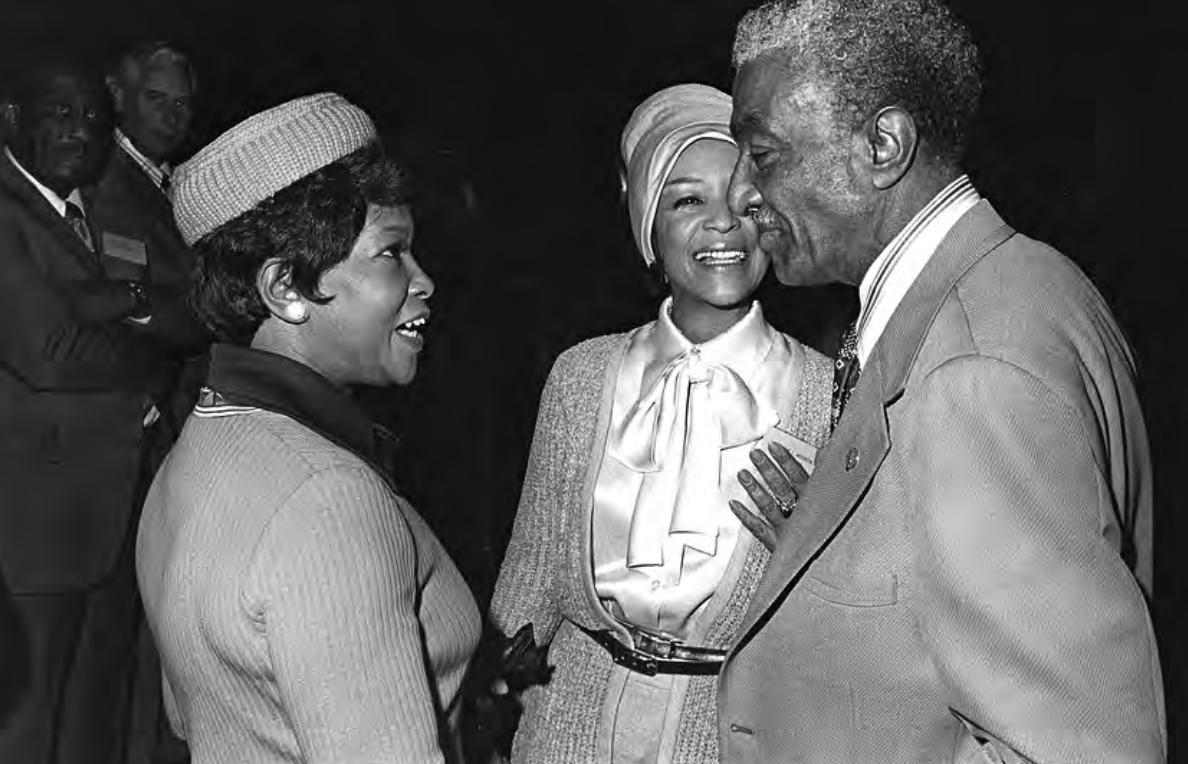
Addie
Wyatt (left), Bernadine C. Washington (center) and Congressman Ralph H.
Metcalfe at the Chicago Urban League’s Annual Luncheon, February, 1976. Addie L. Wyatt, a trailblazing leader in union organizing and civil rights, left an enduring legacy that reshaped the labor movement and advanced social justice.
Born in Brookhaven, Mississippi, in 1924 and raised in Chicago, Wyatt grew up witnessing the systemic inequalities that African Americans faced in the workplace and beyond.
Wyatt’s career in the labor movement began in the 1940s when she worked in a meatpacking plant in Chicago. Hired as a typist, she was soon forced to work on the production line, where she experienced firsthand the unsafe conditions, discrimination and exploitation faced by workers, particularly Black women. Wyatt’s resolve to challenge these injustices led her to join the United Packinghouse Workers of America (UPWA), an interracial union known for its progressive stance on racial and gender equality.
Her passion for justice and her ability to organize workers quickly propelled her into leadership roles. In 1953, Wyatt became the first Black woman to hold a senior office in a major American labor union, serving as the vice president of her UPWA local. She played a pivotal role in negotiating contracts that improved wages, safety conditions and benefits for workers, often bridging racial and gender divides within the labor movement.
She once said, “I was fighting on behalf of workers, fighting as a Black, and fighting as a female.”
Wyatt’s activism extended beyond union halls. She was a key ally in the Civil Rights Movement, collaborating closely with Dr. Martin Luther King Jr.
and other leaders. She worked with the Southern Christian Leadership
Conference (SCLC) and was an instrumental force behind the 1963 March on
Washington for Jobs and Freedom, where economic justice was a central
demand.
Wyatt became
an ordained minister in 1955. A year later, she and her husband, Rev.
Claude Wyatt, founded the Vernon Park Church of God in Chicago, which
she served in for most of the rest of her life. She faced opposition
from many in the Church of God community who condemned labor union work
as immoral and unlawful.
In 1962, Eleanor Roosevelt appointed her to serve on the Commission on the Status of Women.
As
co-founder of the Coalition of Labor Union Women (CLUW) in the 1970s,
Wyatt advocated women’s rights in the workplace, championing policies
such as pay equity, maternity leave and protections against workplace
discrimination. Her work underscored the intersection of labor rights,
racial justice and gender equality, inspiring a generation of activists.
Wyatt’s
achievements garnered widespread recognition. She was named one of Time
Magazine’s Women of the Year in 1975 and received numerous accolades
for her contributions to labor and civil rights. Yet, her greatest
legacy lies in her unwavering belief that workers, regardless of race or
gender, deserve dignity, respect and a voice.
Wyatt’s story is a testament to the power of grassroots organizing and the transformative potential of intersectional activism.