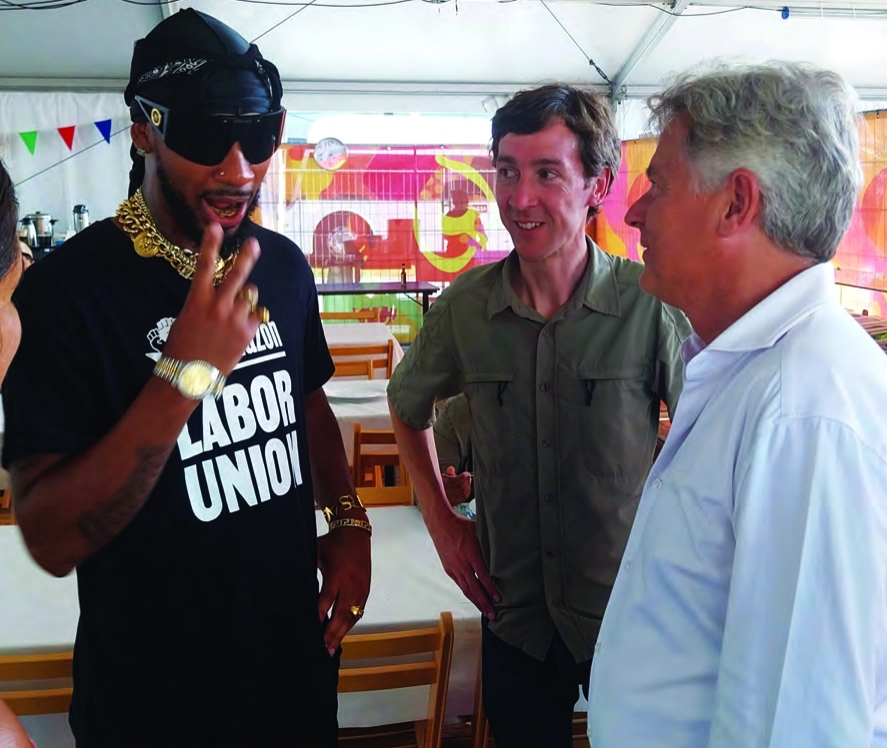
Labor organizer Chris Smalls, far left Chris Smalls, a former Amazon warehouse worker turned union organizer, has become a powerful symbol of modern labor activism
In a time when corporate giants wield vast influence, Smalls’ determination to fight for the rights of workers has reinvigorated discussions about labor rights, racial equity and corporate accountability.
Born in Hackensack, New Jersey, Smalls worked as a supervisor at Amazon’s Staten Island warehouse, JFK8. His journey into labor activism began in 2020 when he raised concerns about unsafe working conditions amid the COVID-19 pandemic. Smalls and his colleagues feared for their safety as the virus spread, but they felt their concerns were ignored by Amazon’s management. In response, Smalls organized a walkout to demand better protections for workers.
Rather than addressing the workers’ grievances, Amazon fired Smalls, citing a supposed violation of quarantine protocols. The termination was widely perceived as retaliatory and drew national attention to the challenges faced by workers in one of the world’s most powerful corporations. Undeterred, Smalls turned his termination into a rallying point, launching a grassroots effort to unionize the workers at JFK8.
In 2022, after months of organizing, Smalls and his team (including colleague Derrick Palmer) achieved a historic victory. The Amazon Labor Union (ALU), which he co-founded, won a union election at JFK8, making it the first Amazon facility in the United States to unionize. The win was groundbreaking because of Amazon’s size and anti-union stance and because it was achieved through a worker-led, independent union rather than an established labor organization.
Praising his work, Sen. Bernie Sanders, I-Vermont, said, “All over this country people are working crazy hours, with terrible working conditions, inadequate wages, poor benefits … and what you have done is to take on one of the most powerful corporations in America owned by the second-wealthiest guy in this country.”
Smalls’ organizing efforts defied expectations and highlighted the power of grassroots activism. He leveraged social media, local community connections and a deep understanding of workers’ needs to build solidarity.
“We don’t need millions of dollars,” Smalls said. “We just need the peoples’ power and the power of the community behind us.”
The ALU’s success also underscored the challenges faced by Black workers, who disproportionately hold low-wage, highrisk jobs in industries like warehousing and logistics. Smalls has been vocal about how race and class intersect in these struggles, stating, “We are the underdogs. We are the forgotten ones.”
Smalls
continues to advocate broader labor reforms. He has testified before
Congress and engaged with policymakers to push for stronger labor
protections and corporate accountability. His efforts have drawn praise
from progressive leaders and grassroots activists who see his work as a
blueprint for modern organizing.
Smalls’
story is one of resilience and determination, proving that even in the
face of a corporate behemoth, workers can unite and demand change. His
fight for justice at Amazon has inspired a new wave of labor activism,
making him a pivotal figure in the ongoing struggle for workers’ rights.