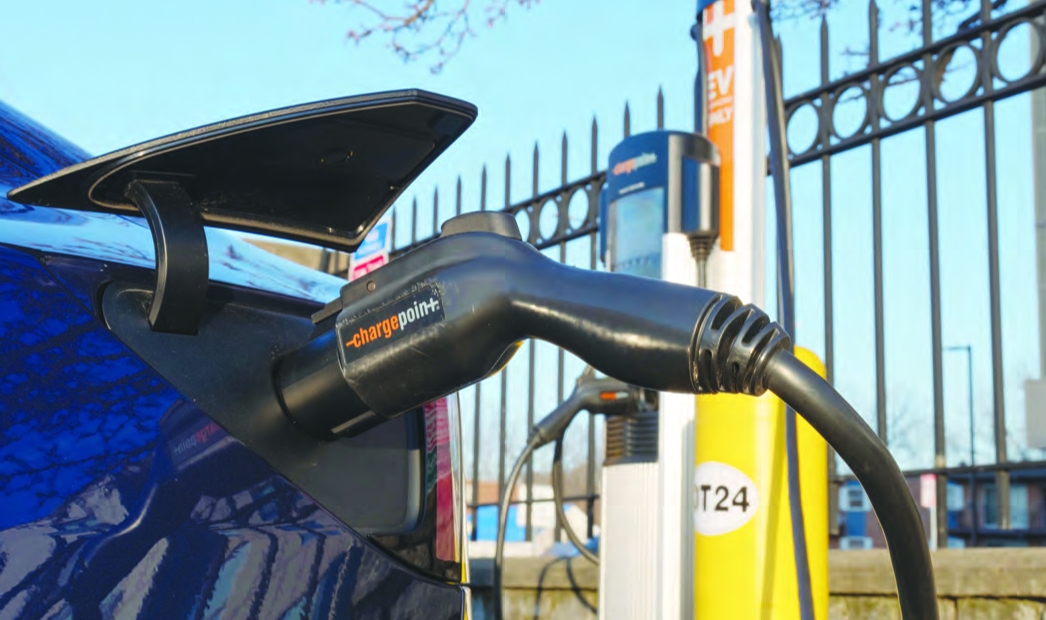
A car charges at an
electric vehicle charging station in a municipal lot off Mattapan Square
in March, 2024. Throughout 2024, city and state efforts looked to grow
access to EVs and charging stations. 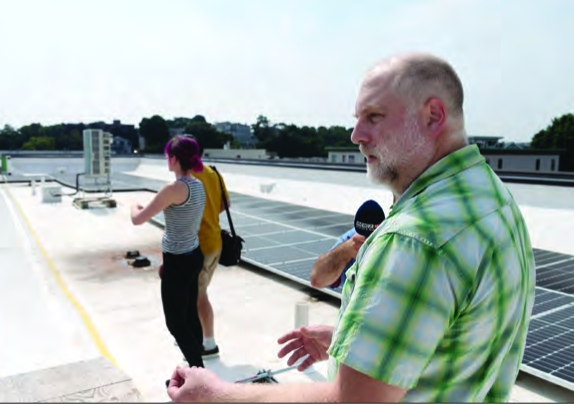
Andy
Toomajian, business development manager at Revision Energy, shows off
the solar array on the roof of the Kenzi an all-electric affordable
housing development in Roxbury. The Kenzi is the first building taller
than four stories in the city to use technology other than a diesel
generator for backup energy needs and came as part of series of efforts
to expand an increase access to green technology in 2024.
Electric vehicle access, coastal resilience among 2024 initiatives
With rising sea levels and increasing urban heat temperatures, in Boston and Massachusetts, 2024 saw efforts to expand green technology and climate protection, especially with an equity lens in environmental justice communities across the state.
New green technology efforts aim to bring better energy efficiency
Throughout 2024, efforts across the city and state pushed for greater adoption of technology to address the causes and impacts of a changing climate.
In Dorchester, a partnership between the city and National Grid, announced in February, will see a large-scale pilot program geothermal heat pump installed at the Franklin Field Apartments, bringing clean heating and cooling to the public housing complex.
In cold weather, the heat pump, which will replace an aging boiler at the apartment complex, will use underground piping to move relatively warmer air from underground through a system that produces more heat that is pumped through the building.
In summer months, it works in reverse, moving warm air from inside into the ground, cooling the space in the building.
The system comes as part of a broader effort in the Boston Housing Authority to make the city’s public housing stock greener. As part of her State of the City address in 2023, Boston Mayor Michelle Wu announced the city’s goal to make Boston’s public housing fossil-fuel-free by 2030.
The
housing authority has said it wants to prioritize community members who
otherwise might be priced out of green-technology improvements.
“It’s
really important as we go forward that low-income communities,
communities of color, non-English speakers and other populations are not
at the back end of the implementing green technologies and planting
healthier energy solutions,” said Joel Wool, deputy administrator for
sustainability and capital transformation at the BHA in a February
interview.
And
large-scale heat pumps may become more common across New England.
National Grid broke ground on another pilot program in a neighborhood in
Lowell in 2023. Eversource started one of its own in Framingham in
2022.
Efforts to bring
cleaner energy to lower-income community members aren’t limited to the
Franklin Field Apartments. Near Nubian Square, the Kenzi, a new
affordable housing development which opened in June, is the first
mid-rise building in the state — and perhaps in the country — to be
fully electric, even with its back-up power systems.
Generally,
all-electric midrise and high-rise buildings — those taller than four
stories — have a diesel generator to supply back-up power if the
electricity goes out. Even when the power is on, that generator has to
be tested regularly.
At
the Kenzi, however, roof-top solar panels fill two
industrial-refrigerator-sized cabinets of batteries that will power
elevators, some lighting, fire alarms and the building’s community room
in the case of a blackout.
Maria
Chavez, an energy analyst with the Union of Concerned Scientists, who
wasn’t affiliated with the project, said in a July interview that she
sees the Roxbury development as an important step forward for clean
energy transitions.
“I
feel like it could be a model for future projects and deployments,” she
said. “We really need progressive policy that can potentially replicate
this model for other and multifamily housing.”
As
the technologies expand and become available, community efforts are
looking to make sure residents of color are included in the growing
workforce.
In
November, The American City Coalition hosted its Roxbury Worx
Conference, an annual gathering bringing together a collection of
organizations working to connect community members with jobs in
burgeoning science and technology fields, including green technology
jobs.
The gathering came amid efforts from other groups to develop a diverse clean technology workforce.
The
conference was held at Roxbury Community College, which has made
efforts of its own to open jobs in green technology fields to its
students.
In November,
RCC, alongside the state’s Department of Energy Resources, announced
federal investment into the development of an energy auditor training
program focused on small- and medium-sized commercial buildings.
RCC already has a program focused on energy auditing for residential buildings.
Students
in the program will learn to identify how a building’s energy use is
working and how it could be improved, the kind of work that will be
increasingly important as buildings in Boston stare down next year the
first benchmarks under the Building Emissions Reduction and Disclosure
Ordinance, city legislation signed in 2021, that requires buildings of a
certain size report and reduce their emissions.
The
program will start at RCC and at Greenfield Community College in
western Massachusetts, with goals to develop a curriculum that can be
shared with other schools across the state.
For
a developing field that generally has good, stable pay while also
taking steps to help address greenhouse gas emissions and climate
change, it’s important that the students RCC serves have a chance to be
involved.
“It’s an
opportunity that doesn’t happen a lot for folks in high poverty areas
and students of color to get in on the ground floor,” Pina said.
And
over the summer, the Boston professionals’ chapter of the National
Society of Black Engineers ran a six-week course for 13 local high
school students to expose them to options in socalled “green-collar”
jobs. And in May, Governor Maura Healey announced a Climate Careers
Fund.
For people of
color working in the field, one area for growth would be improved
supplier diversity goals, with benchmarks not just focused on diversity
generally, but broken down with specifically targeted goals around
individual groups like businesses of color, separate from women-owned
businesses, separate from veteran-owned businesses.
Overall,
it’s a space that has seen progress but still has room to grow, said
Kerry Bowie, executive director of Browning the Green Space, a local
nonprofit focused on advancing diversity, equity and inclusion in the
climate technology sector.
“Generally,
I think we’re doing stuff, but I also think there’s a lot more that we
can be doing,” said Bowie, in a July interview.
City, state continue to push for electric vehicle access
And
electric vehicles continued to be featured prominently among city and
state efforts in 2024, with work to increase access to both the vehicles
and related infrastructure like chargers.
One
major focus is on-street charging options. In July, Wu announced city
contracts with vendors to install new EV chargers under two pilot models
— under one, the chargers will be owned by the city; under the other,
the chargers will be owned and operated by private operators with
permission to install them on public rights-ofway. The plan was first
announced in July 2023.
A city goal aims to get an electric vehicle charger within a five-minute walk of any resident in the city.
A
Sept. 4 meeting of the state’s Electric Vehicle Infrastructure
Coordinating Council also tackled the topic, with presentations from
three companies on on-street charging infrastructure projects across the
state.
Those
on-street chargers are considered a key priority, especially in cities
like Boston where many residents might not have access to a garage or
driveway to charge — a limitation that might prevent them from
purchasing an electric vehicle.
“If
I can’t charge a car, there’s no use, right? So that’s one major
hurdle. Can we do better in terms of providing public charter
infrastructure?” said Justin Ren, a professor of operations and
technology management at Boston University.
Josh
Ryor, assistant secretary of energy in the state’s Executive Office of
Energy and Environmental Affairs, said that boots-on-theground efforts
will largely be handled by individual municipalities, but the state is
looking to provide financial assistance, including by directing $11.25
million in funding to the quasi-public Massachusetts Clean Energy Center
to create a program supporting municipal efforts to expand on-street
charging.
Getting the
benefits of electric vehicles to the largest number of travelers is also
a priority. In October, the city received $4 million in funding to
purchase or retrofit school buses serving Boston Public Schools
students.
That latter
approach — taking existing diesel buses and replacing the engine with
battery-electric component — may be able to help make more buses
fossil-fuel free sooner, while limiting waste of other components, said
Jackie Hayes, BPS deputy director of transportation.
“We
want to really look at it from a scale perspective,” she said. “There
is a tremendous amount of waste in throwing out the shells of these
buses when we could be repurposing them.”
During her campaign, Wu promised to electrify the entire fleet of 750 school buses by 2030.
State
efforts are also aiming to connect more drivers — especially those who
see more time on the road — to electric vehicles. Under a new rebate
program, the state is aiming to make EVs more appealing to taxi and
rideshare drivers.
With
the rebates, the drivers can get up to a $6,500 rebate from the state
for the purchase of a new electric vehicle and up to $2,500 for a used
EV.
“What will make
this program so effective is that it provides resources to our highest
mileage and most public-facing drivers who work hard to help all of us
get around safely and conveniently,” said Rep. Jeffrey Roy, who chairs
the Massachusetts Joint Committee on Telecommunications, Energy and
Utilities, at a Nov. 12 press conference.
Resilience efforts look to tackle coastal resilience, urban heat
But
Massachusetts and cities across the state are also working to tackle
the impacts that communities are seeing or expect to see soon.
Throughout
2024, Boston and other nearby municipalities continued work on coastal
resilience efforts aimed at increasing coastal resilience and protecting
the coast from rising sea levels and the worse storms.
In
many cases, the name of the game is “green infrastructure,” solutions
that look to use nature-based solutions to address climate challenges,
rather than building things like sea walls. Those solutions — think
restoring coastal wetlands that are naturally better at protecting
shorelines or expanding and raising grass-reinforced beach dunes — can
be cheaper and more effective.
“In
many instances, nature has been facing these challenges for a long
time, and she’s been doing a better job than us,” said Mariama
White-Hammond, the city’s thenchief of energy, environment and open
space, in a January interview.
That
work has also required inter-municipal collaboration. Across the
Chelsea and Everett town line, the two cities have joined together to
limit the impacts of rising sea levels and storms that threaten to flood
through the Island End River, impacting thousands of residents,
schools, health centers and a produce distribution hub that serves all
of New England and parts of Canada.
That
project not only crosses that municipal boundary but is occurring in
tandem with eight other efforts along the Mystic River, which feeds the
Island End River. Without any one of the projects, flooding may still
impact the areas that any one of the projects is trying to protect.
Similarly,
broad efforts are targeting urban heat impacts. An effort through the
Boston Region Metropolitan Planning Organization called “Neutralizing
Onerous Heat Effects on Active Transportation,” or NO-HEAT, is looking
to make walking, biking and public transit users cooler as they attempt
to navigate four municipalities in the Greater Boston area.
It’s an effort that leaders see as an opportunity to make it easier to move through the spaces that are most impacted by heat.
“Our
least walkable areas are also those that are most prone to heat risk,”
said Tom Skwierawski, chief of planning in Revere, one of the
municipalities involved.
Though
not part of the NO-HEAT project, the city of Boston has taken similar
steps, with the installation of 30 green roofs — again, a nature-based
solution — one that puts plants on bus shelters along the 28 bus route
from Mattapan, through Dorchester, into Roxbury. The new shelter roofs
will help cool riders as they wait for the bus.
Ed
Gaskin, executive director of the Greater Grove Hall Main Streets
organization and an advocate for local green infrastructure, said the
shelters are a start, but he’d like to see a broader plan that will
tackle environmental needs — especially in communities like his that see
disproportionate climate impact — in a cohesive manner.
“Without an overall plan,
you just have a bunch of one-off stuff,” he said. “One-off is better
than nothing, but at the end of the day, the greening of the bus
shelters isn’t going to make that much of a difference.”
Climate leaders brace for a second Trump administration
The
tail end of the year was marked by eyes turning to 2025 and the
incoming presidential administration of a reelected Donald Trump, and
thoughts on how his second term in office will impact conservation and
environmental efforts.
In
his first term, Trump rolled back nearly 100 federal environmental
rules. Throughout his campaigns and time in office, he has waffled on
how he describes climate change, sometimes calling it a hoax and other
times saying the environment and issues like clean air are important to
him.
As he has
announced his nominees for various cabinet positions, Trump tapped Lee
Zeldin, a former New York representative, as his choice to head the
Environmental Protection Agency, a choice that is expected to lead to
scaled-back climate change regulations if approved.
To head the Department of Energy, Trump has nominated Chris Wright, who heads the fracking company Liberty Energy.
Trump’s
second term comes on the heels of a Biden-Harris administration that
issued unprecedented federal investment into climate and conservation in
the United States.
“That
has made so much of the work possible in infrastructure at the city and
state level,” said Hessann Farooqi, executive director at the Boston
Climate Action Network, in a November interview.
Expecting
the absence of that support, local climate and environmental groups and
officials said they are battening down the hatches as they prepare for
reduced federal investment.
That’s
increasingly important, those leaders said, as Massachusetts and the
world see rising temperatures and an increasingly abnormal climate and
weather phenomenon. The National Oceanic and Atmospheric Association
found that summer 2024 was the hottest on record in the northern
hemisphere.
On Nov. 6,
the day following the presidential election, temperatures in Boston
neared 80 degrees. Historically, on average, the high temperatures for
early November hover in the high 50- degree range.
“We
have made progress [over the past four years], but in a moment where we
really need to really lean in, we’re going to be dialing it back on the
federal level,” said Britteny Jenkins, vice president of environmental
justice at the Conservation Law Foundation, in November.
But
while local climate and conservation leaders weren’t eagerly
anticipating the impact Trump’s return to office might have on local
efforts, the overwhelming sentiment was that work in Boston and
Massachusetts will continue, even without federal support.
In
the wake of the election, Brian Swett, Boston’s chief climate officer,
said that cities and states leading the charge on climate efforts has
largely been the norm — with the past four years as the outlier.
“Elections
don’t change the fact that climate change is the existential threat to
Boston’s survival for the long term, and we need to address it, and
we’re making progress on doing so,” he said.


