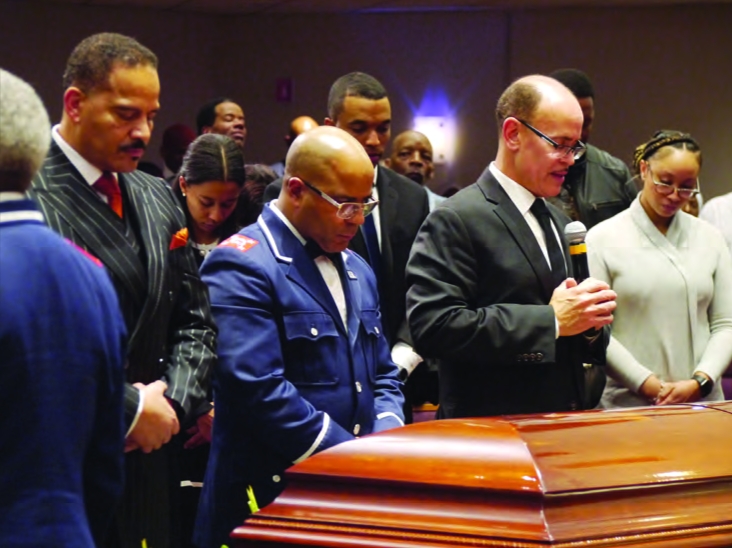
Mustafa
Farrakhan, Randy Muhammad and Ishmael Muhammad pray over the casket of
Minister Don Muhammad at the Morningstar Baptist Church.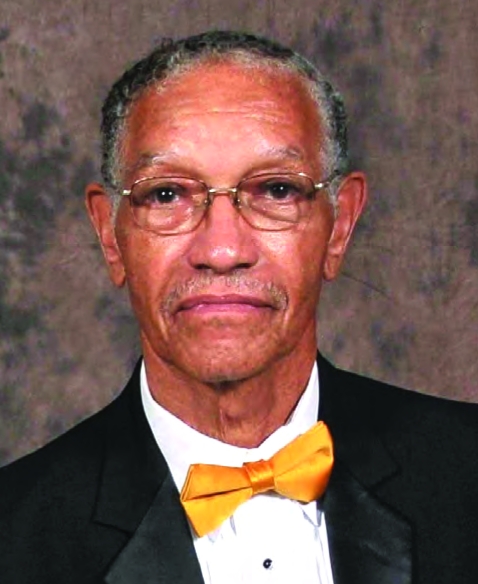
Minister Don Muhammad
Boston’s Black clergy members expressed shock and outrage after a 1992 incident at the Morningstar Baptist Church after a dozen young men barged into a funeral service for a rival gang member, fired gunshots and stabbed three people.
Minister Don Muhammad dispatched a detachment of the Fruit of Islam to the Blue Hill Avenue church, marching them from the Grove Hall location of Muhammad’s Mosque No. 11 to the Mattapan sanctuary.
The young men, many of them rescued from prison or life on the streets by Minister Don’s mission of redemption, stood straight and tall during the rescheduled funeral.
“They came in and protected us,” Rev. John Borders said, speaking during a memorial service for Muhammad at Morningstar on a snowy, wind-whipped day. “When I stood to preach, they were standing on each side.”
Muhammad died Dec. 17 at age 87. Borders, fellow clergy, Nation of Islam members and others recalled Muhammad as a leader to whom they turned for wise counsel and protection during the many decades he spent at the helm of the Roxbury mosque.
The protection he extended to Morningstar ruffled some feathers among brothers in the Nation of Islam and congregants at Morningstar. But Muhammad wasn’t interested in interdenominational conflicts.
“Minister Don realized this wasn’t about the Nation of Islam,” recalled his son, Don Straughter at the Dec. 20 service. “This wasn’t about the churches. This was about people helping each other.”
Muhammad was also remembered for his key role brokering peace between community factions, whether community activists, clergy, elected officials or gang members.
It was Muhammad’s work with gang-involved and incarcerated young men that first caught the attention of local law enforcement and led to a unique role of the Nation of Islam in the so-called “Boston Miracle” that attracted national attention in the 1990s for the 79% drop in gang violence.
But
that alliance was long in developing. Muhammad was outspoken in
criticizing police after Boston cops shot and killed unarmed Black men
in a string of shootings in the early 1980s. The election of Raymond L.
Flynn to Boston City Hall in 1983 brought new leadership to the city and
a new police commissioner, Francis M. “Mickey” Roache, who knew
Minister Don from his work in the Community Disorders Unit.
Despite
outside criticism, the alliance between the Nation of Islam and law
enforcement – which grew to include State Police, state prosecutors and
the U.S. Attorney’s Office – yielded results. Alongside the Boston Ten
Point Coalition of Christian clergy, Minister Don and his Nation of
Islam acolytes worked the projects, streets and schools to intervene in
gang disputes and maintain peace.
Embracing
the view expressed by Rev. Jeffrey Brown that “we’ll never arrest
ourselves out of this situation,” Minister Don led efforts to find
alternatives to gang life while interceding to resolve conflicts between
factions.
Nearly
unheard of in other cities, it was common in Boston to see Nation of
Islam members under Minister Don join with police brass like Area B
Commander William “Billy” Celester and the mayor at press conferences,
responding to outbreaks of violence or pushing for more state and
federal resources to address youth violence.
However,
Minister Don’s close relationship to civic powers did not prevent him
from speaking out over incidents like the police converging on the
Mission Hill projects to search for a non-existent Black suspect after
the murder of Carol Stuart by her husband Charles, whose lies set off a
brutal manhunt.
Muhammad
was also an ardent believer in economic self-sufficiency for African
Americans, promoting business development and investment in the Black
community.
The unusual
nature of Minister Don’s prominence in Boston civic life was apparent
in a 1990 appearance at Harvard University’s Institute of Politics,
where he addressed a packed auditorium during a fall seminar. Some
students came out of curiosity, some to question the Nation of Islam’s
fraught relationship with the Jewish community.
Muhammad’s
forthright presentation of the Nation’s peaceful philosophy, his
message of economic empowerment and rescuing young people from lives of
despair won him sustained applause at the end of the hour.
Born
Don Straughter in Beckley, West Virginia in 1937, he moved from the
heart of coal country to Boston at age 17 to work with his brother,
Justice, in dry cleaning. Shortly after arriving in Boston, Straughter
met his soonto-be wife, Shirley Upshaw, who came to Boston from Halifax,
Nova Scotia. They were married within a year of meeting each other.
The
couple joined the Nation of Islam as part of Mosque No. 11 on Intervale
Street, which was then headed by Louis X, a Roxbury native formerly
known as Eugene Walcott, who
later took the name Farrakhan. During Farrakhan’s leadership of the
Roxbury mosque, he and Muhammad forged a decades-long close
relationship.
When
Farrakhan sought in 1981 to revive the Nation of Islam after several
years during which the organization was dormant, he relied heavily on
Muhammad to build out the organization, recalled Mustafa Farrakhan, the
NOI leader’s son.
“He
was a hero in the Nation,” Farrakhan said during the service at
Morningstar. “He was one of the pillars my father depended on to rebuild
the nation.”
Over the
decades, Farrakhan tapped Muhammad to train ministers across the
country and, from time to time, to negotiate conflicts NOI mosques had
with local authorities. On one such occasion, Muhammad held negotiations
between New York’s Mosque No. 7 and then New York Police Commissioner
William Bratton, with whom Muhammad had worked in Boston when Bratton
was on the Boston Police Department command staff.
“This
was a great statesman, a diplomat,” said Minister Rodney Muhammad, who
now leads Mosque No. 11. “He was respected from the streets to the
suites.”
Muhammad is
survived by his five children — Yvette Muhammad, Cheryl Straughter, Don
Straughter Jr., Shirley Straughter Carrington and Brian Straughter — as
well as 20 grandchildren and 11 great-grandchildren.
Family members recalled Muhammad’s kindness and his love for his wife, Shirley, who passed away last year.
Brian Wright O’Connor contributed to this report.