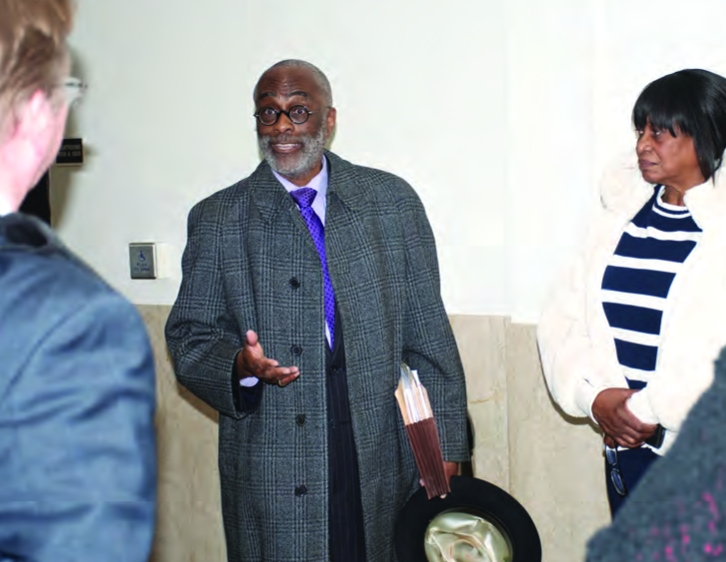
Attorney
Joseph Feaster speaks with staff from the Edgar Benjamin Healthcare
Center following a status conference in Suffolk County Superior Court on
the receivership at the Mission Hill nursing home, Dec. 19. Following,
Justice Anthony Campo, who presided over the conference, ruled to extend
the receivership by six months alongside requiring increased reporting
on the process of the receivership to the court and the state
government.The receivership at the Edgar Benjamin Healthcare Center will continue until June, under a Dec. 19 Suffolk County Superior Court decision, with continued funding from the state but increased requirements around financial oversight.
Following a status conference regarding the facility, which was put under court-appointed receivership in the spring, Justice Anthony Campo ruled to extend the receivership of the facility — a process under which the administrator of the center is removed and replaced with a court-appointed individual — for six months.
In the same decision, Campo required Roxbury attorney Joseph Feaster, who is serving as receiver, to provide monthly receipts and disbursements, as well as interim reports on conditions at the facility, all at the request of the attorney general and Department of Public Health that had sought greater insight into financial set-up of the facility.
But he rejected other requests from the state. In a Dec. 18 affidavit, Leslie Darcy, the chief of the Mass- Health Office of Long-Term Services and Supports, said that the normal process to pay receivership costs is through the facility’s finances — the state has been providing advances — but Campo ruled that those fees, as well as the accounting expenses and
funds to pursue lawsuits to collect debts owed to the center, which
Feaster has requested, be paid by the state.
Campo
wrote that the court had misgivings that granting the request would
derail progress that the facility has made since the start of the
receivership.
In his
order, he wrote that the court recognized the strides the facility has
taken since April but that “there is considerable work yet to be done.”
During
the status conference Campo said the requests both parties made
described his role as finding a balance to keep everyone happy and the
facility on track.
“I just want all the players to be satisfied so we give the facility the best chance to succeed,” he said.
The
facility was put into receivership in April, following a
month-and-ahalf-long fight led by staff and community members to keep it
open after the previous administrator, Tony Francis, announced in
February that he intended to close it by the middle of the summer.
Francis,
at the time, credited the need to close to “insurmountable financial
difficulties” but supporters of the facility were quick to point out a
number of instances of alleged financial mismanagement — including
botched cryptocurrency investments and personal loans from Francis to
the facility at 12% interest rates — that left the Edgar Benjamin
repeatedly unable to pay its employees.
Since
Feaster took over as receiver the center has hired a new administrator
and other staff to improve operation, cleaned and renovated spaces in
the facility, worked to increase its census from about 70 to 84
residents and pursued money from various sources that it had failed to
collect under its previous administration.
The
financial aspects of the receivership have become a point of contention
between the facility and the state, with the attorney general’s office
and Department of Public Health looking to wind down major payments to
the Edgar Benjamin as well as get greater insight into how funds are
being spend and when and how the receivership might end.
Prominently,
the center has received nearly $313,000 in advances on MassHealth
payments, which the state initially wanted to begin to recollect, in
$50,000 increments beginning in January. During the status conference,
Mary Freeley, head of the attorney general’s Elder Justice Unit, said
that the state would voluntarily postpone recouping the funds until
April.
What those advances were intended to support has become a pointed question as the state pursues recouping the advanced funds.
In
her affidavit, Darcy, who has overseen the advances in her role with
MassHealth, described the payments as an effort to support the facility
in making its obligations to pay its employees.
In
April, when the attorney general’s office and the Department of Public
Health officially signed onto the request for a receivership, the state
listed multiple instances of missed payrolls — and the risk of employees
consequently not showing up to work — as a prominent reason that they
eventually supported the receivership, after months of declining to
pursue it.
But Feaster
has framed the state-provided funds as an important element to
stabilize the facility as he looks to determine if it can be operated in
the long term.
Similarly,
he said the requested funds to pay for accounting services and legal
suits the center wants to pursue to collect on funds from other entities
that it never received — the state opposed the funding, but Campo
granted both — will be important to get the Edgar Benjamin on more solid
financial footing.
In
the status conference, he said those lawsuits intend to go after
instances of “financial irregularities” and inappropriate expenditures
during the previous administration of the center. He gave examples of
credit card payments, travel, investments in cryptocurrency and
triple-payments to employees.
The state’s response and hesitation to support, he said, has left him disappointed.
“I
thought that we were in this together to try to save a facility that
cares for our seniors,” Feaster said. “If you have a situation whereby
support from the Commonwealth may make that happen, when I see limited
risk financially on the part of the Commonwealth, it should happen.”
Feaster
said the efforts to recoup that funding could threaten to destabilize
the progress the facility has made. The delay to recoupment in April, he
said, won’t do much to help.
“The
results aren’t going to change,” he said. “If it started in January, it
would be painful. That’s not going to change much before April. It’s
the same income stream that we have.”
Previously,
as part of a report in his role of receiver filed at the start of the
month, Feaster said the state should consider putting a lien on the
Edgar Benjamin building, which the center owns without a mortgage, or
that the state could pursue some of the debts the Edgar Benjamin is
looking to collect, and recoup some of the funds that way.
In
his order, Campo made no mention of either alternative solution but
said that if repayment of the advanced funds is still an issue in early
April — a year from the start of the receivership, and when he scheduled
the next status conference — then the court would conduct a hearing to
determine future measures.
But
the state has identified the delay in recoupment as a point of concern
regarding the authority of Mass-Health. In statements at the status
conference, Freeley said funds like this are not intended to be given
and left for long periods of time.
In
her affidavit, Darcy said that neither Mass- Health nor any other
agency in the Executive Office of Health and Human Services has the
authority to make a long-term loan to a provider without approval from
the Legislature. Similarly, the additional funds for the accounting and
legal actions that Feaster requested would require statutory
appropriation from the House and Senate.
Additionally,
the state requested that Feaster submit information about all the
options the facility has to move out of receivership, whether that means
longer-term stability and operations with its current administration,
sale to another entity or closure.
Feaster
said in an interview that he objects to the task because he is
currently only considering the steps required to keep the facility open.
“I
can’t tell you about a plan for plan that I don’t have,” Feaster said.
“They’re saying, ‘Well, I want a plan.’ Well, you’re not going to get a
plan for something which I’m not considering, because right now this
institution is doing what it’s supposed to do.”
Despite
his objections, it’s a task Feaster will have to tackle. In his
decision, Campo asked for information on all options under consideration
for continued operation of the facility as part of a larger report due
ahead of the status hearing scheduled for the beginning of April.
The
most recent steps around the Edgar Benjamin come following the passage
of statewide legislation aimed at reforming the long-term care sector.
That bill, passed at the end of August and signed by Gov. Maura Healey
in September, strengthens the Commonwealth’s oversight of long-term care
facilities — something Feaster has said was missing for the Edgar
Benjamin in the run-up to his appointment as receiver.
“[In
the legislation] they’re talking about greater oversight,” Feaster said
during the status conference. “Our contention is oversight wasn’t
there, and that’s the reason why we are where we are right now.”
In
that time, Francis, the former administrator, failed to file financial
statements with the federal government and engaged in actions that
raised concerns of financial mismanagement, which Feaster has said the
state did nothing about.
The
new legislation takes actions like giving the attorney general the
authorization to file civil actions regarding abuse and mistreatment of
patients, creates requirements that the Department of Public Health
inspect each facility annually to assess services and compliance. It
also establishes a fund to support development of staff, in a sector
that has faced shortages that have limited care.
Feaster
said the law could take important steps to make sure that similar
situations are less likely to occur, but only if implemented properly.
His frustration with how he views the actions of the attorney general
and the Department of Public Health don’t inspire confidence, he said.
“The
legislation that was passed by the Legislature and signed by the
governor, with regards to addressing that long-term care is
forward-thinking if it comes to fruition,” he said. “Right now, it’s a
piece of paper. If it’s operationalized in the same way that I’m dealing
with the various Commonwealth departments right now, I don’t feel too
optimistic that it’ll be implemented in such a way that we will benefit
with the long-term care facilities like the Benjamin.”


