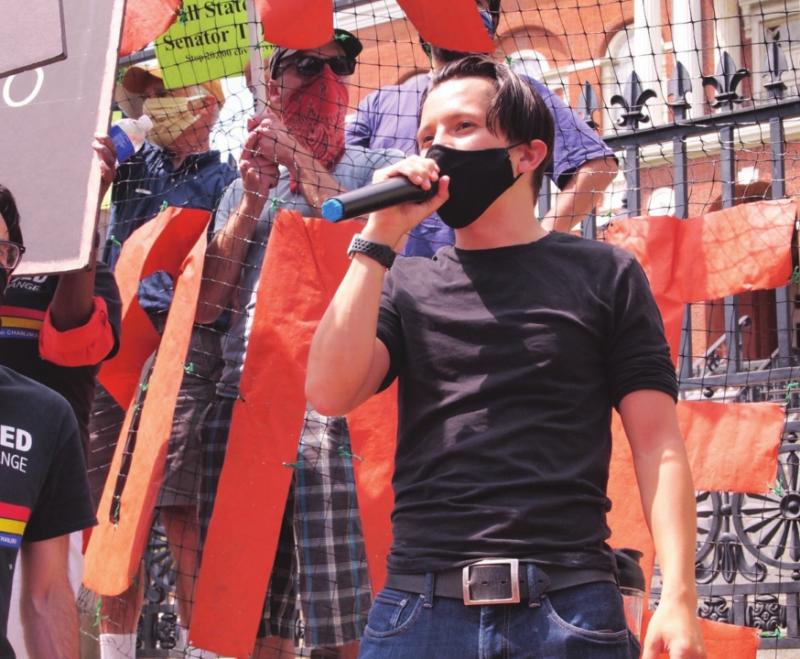
Right To The City organizer Andres Del Castillo addresses reporters at the State House.
Activists say tide of 20k evictions looming
Governor Charlie Baker’s statewide eviction moratorium is now set to end on October 17, he announced last Tuesday. But while the ban prevents no-fault evictions from flooding the courts during the COVID-19 emergency, organizers say the state could see over 20,000 eviction cases immediately after it ends.
The day after the announcement, protesters from City Life/ Vida Urbana, Right to the City Boston, Dorchester’s Not for Sale, Lynn United for Change and more gathered in front of the State House to demonstrate their support for the COVID-19 Housing Stability Act, which aims to protect renters from no-fault evictions for a year after the state of emergency is lifted, and stabilize landlords as well.
Following their caravan demonstration through the city on July 18, City Life/Vida Urbana launched demonstrations in Lynn, Springfield and Jamaica Plain on Wednesday morning and the groups converged in Boston at the State House between 1:30 and 2:00 p.m.
The State House steps were crowded, already occupied by Cosecha protesters in tents for over a week.
“We’re standing in solidarity with the movement that is already here,”
Helen Matthews, communications manager at City Life/ Vida Urbana, said
of the Cosecha protesters, who are fighting for legislation that
provides drivers’ licenses regardless of immigration status.
“We’re trying to negotiate the space so that it’s clear that we’re in solidarity with each other, not competing,” Matthews said.
Cosecha
demonstrator Irma Lemus Amaya said, “Both City Life/Vida Urbana and
Cosecha are connected. We both need licenses and housing.” Other Cosecha
demonstrators said driver’s licenses protect them from the risk of
contracting COVID-19 on public transportation.
Members of both organizations spoke on the steps about the need for tenant protections.
“Mass
evictions are not an option we can tolerate,” Isaac Simon Hodes,
director of Lynn United for Change said during the demonstration. “The
law says that during the 12 months we need for a recovery, there should
not be rent increases or no-fault evictions. And we know there are many
landlords who support this, because they don’t want to evict anyone
during a pandemic,” he said.
The
Small Property Owners Association, a Cambridge-based group that fights
against rent control, agrees with this sentiment but does not agree with
the legislation City Life/Vida Urbana supports. The group engaged in a
counterprotest, holding “Zero Rent is Robbery” signs in front of the
eviction protesters. Some of the counterdemonstrators shouted over Hodes
as he spoke. SPOA Executive Director Skip Schloming called the Housing
Stability Act “drastic” and “outrageous.”
The
Housing Stability Act creates a fund for property owners, in addition
to a forbearance process, which allows owners to miss or reduce mortgage
payments for a limited period of time. The funds will be distributed
“with priority given to low- and middle-income renters and homeowners
affected by the COVID-19 crisis,” the text of the bill reads.
But Schloming says the measure will not adequately protect landlords from the financial damage caused by non-paying tenants.
“They
put it in there to make it look nice. It catches people’s eye but it’s
never going to get to small landlords,” he told the Banner.
When
it comes to housing security in Boston, evictions are not the only
thing that organizers are worried about. Andres Del Castillo, senior
organizer at Right to the City Boston, says that communities also cannot
afford the rent they were paying before the COVID-19 crisis. Del
Castillo says he expects the crisis to worsen after the state of
emergency is lifted.
“We’re
going to see a massive rent increase overnight,” he told the Banner.
“We need protections for tenants on a state level to relieve pressure
from homeowners.”
Del
Castillo also said that information accessibility is still low for
Spanish-speakers, though hearings in the Legislature and City Council
meetings have translators.
“Most
of them aren’t being interpreted, and when they are, it is not
simultaneous,” he said, noting that this causes Spanish-speaking viewers
to fall behind in the conversation.
As
the Legislature attempts to decide on several housing and police reform
bills in the short time before July 31, activists are applying pressure
from several avenues, including an open letter to the governor and
Senate president organized by Homes For All Massachusetts.
“Up
to 20,000 eviction cases are expected immediately after the current
moratorium ends … according to landlord advocates and estimates from the
state’s Housing Court system,” the letter reads.
There are 89 legislators who already support the bill.