Noah Hicks leads the Ride for Black Lives on Centre Street in Jamaica Plain
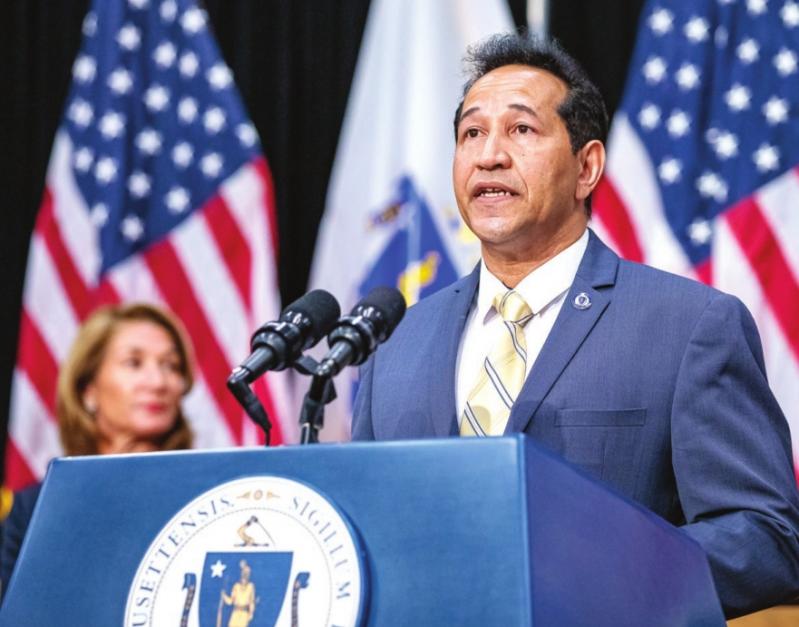
Massachusetts Legislative Black and Latino Caucus Chairman Carlos Gonzalez.
Legislature has until Friday to reconcile two bills
The Massachusetts House of Representatives passed their version of a police reform bill early Saturday morning by a 93-66 vote, after three days of debate, marked by mounting concerns over qualified immunity, no-knock warrants and internal investigations.
The House bill covers the Massachusetts Black and Latino Legislative Caucus’ four core priorities: Creation of an independent body to investigate, certify and decertify police; limitations on excessive force; creation of a commission for comprehensive civil service review and establishment of a commission on structural racism.
“In the end, it was a firm and united Massachusetts Black and Latino Legislative Caucus demand for change that led to this historical vote to pass this legislation,” said MBLLC chairman Carlos Gonzales in a statement.
The bill covers the main points of the Senate’s police reform bill, but with a few key differences. First, qualified immunity is limited in two different ways. Because both bills establish a process for police officers to become certified and decertified if they commit certain infractions, the House bill ties qualified immunity to decertification. Qualified immunity would no longer protect police from lawsuits if
the act in question results in them being decertified and removed from
the force. The Senate bill removes protections only when a person’s
civil rights are infringed upon.
Second,
while the House bill promises bias free policing, defined in the bill
as “policing decisions made by and conduct of law enforcement officers
that shall not consider a person’s race, ethnicity, sex, gender
identity, sexual orientation, religion, mental or physical disability,
immigration status or socioeconomic or professional level.” It does not
explicitly ban racial profiling.
The
governor, the Senate and the House have all established commissions
through recent legislation that monitor the police state wide.
“[The
House bill] establishes a civilian-led, with police representation,
independent body that will oversee the decision-making process of
investigations outcomes and discipline,” Rep. Gonzales told the Banner.
“This takes it out of the hands of the Executive Office of Public Safety
which is where the governor had it, and where the Senate has it,” he
said.
Two of the
commission members would be appointed by the attorney general, and the
commission will report decertification and other police complaint data
to the attorney general.
The
House bill contains more specific limits on no-knock warrants, the same
type used when Breonna Taylor was killed in her home in Louisville,
which allows police to enter a residence without warning or identifying
themselves. The House voted to adopt Rep. Liz Miranda’s amendment, which
adds that if a no-knock warrant is issued by a judge, the officer must
attest that there are no children or elderly in the home. The amendment
passed narrowly, 83 to 76. The Senate bill also requires a judge’s
signature on such warrants.
Though
the Senate bill received support from the Massachusetts ACLU, the House
bill has seen opposition since the vote. Carol Rose, executive director
of the Massachusetts ACLU said in a statement that the bill “does not
reflect the fierce urgency that deadly police violence against Black
people demands. Instead, it reflects the depth of entrenched opposition
to necessary police reform,” she said.
Rose said that the bill misses the mark because it does not help victims of violence hold police accountable.
Both
the House and the Senate bill cover the same major points – a
commission on certifying and investigating police, limiting use of force
and other possibly violent tactics, and preventing racial profiling –
but when reaching a consensus, the specifics vary.
The board of each bill’s commission is completely different despite each of them pursuing the same goal.
“I
think the time is now the moment is here, and there should be nothing
in the way that should keep us away from getting something to the
governor,” Rep. Gonzales said.
The session will end Friday, and legislators anticipate a final bill being signed that day.