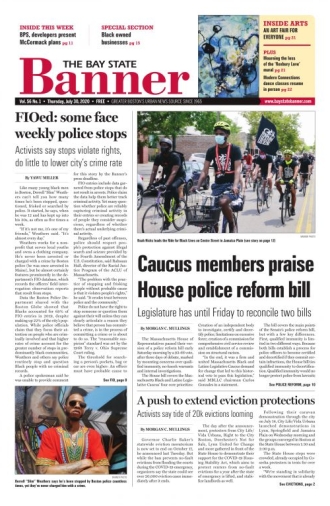
Derrell “Slim” Weathers says he’s been stopped by Boston police countless times, yet they’ve never charged him with a crime.
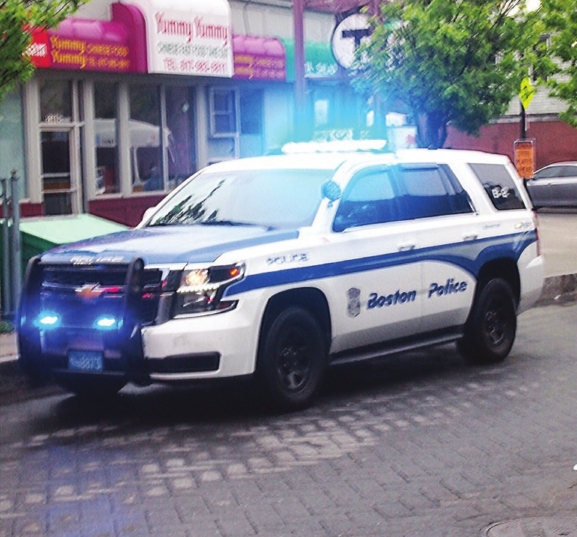
Of those stopped by police in Boston last year, 69 percent were Black.
Activists say stops violate rights, do little to lower city’s crime rate
Like many young black men in Boston, Derrell “Slim” Weathers can’t tell you how many times he’s been stopped, questioned, frisked or searched by police. It started, he says, when he was 12 and has kept up into his 30s, as often as five times a week.
“If it’s not me, it’s one of my friends,” Weathers said. “It’s almost every day.”
Weathers works for a nonprofit that serves local youths and owns a clothing company. He’s never been arrested or charged with a crime by Boston police (he was once arrested in Maine), but he almost certainly features prominently in the department’s FIO database, which records the officers’ field interrogation observation reports that result from stops.
Data the Boston Police Department shared with the Boston Globe showed that Blacks accounted for 69% of FIO entries in 2019, despite making up 22% of the city’s population. While police officials claim that they focus their attention on people who are criminally involved and that higher rates of crime account for the greater number of stops in predominantly black communities, Weathers and others say police routinely stop and question Black people with no criminal records.
A police spokesman said he was unable to provide comment for this story by the Banner’s press deadline.
FIO entries include data garnered from police stops that do not result in arrests. Police claim the data help them better track criminal activity. Yet many question whether police are reliably capturing criminal activity in their entries or creating records of people they consider suspicious, regardless of whether there’s actual underlying criminal activity.
Regardless of past offenses, police should respect people’s protection against illegal search and seizure provided by the Fourth Amendment of the U.S. Constitution, said Rahsaan Hall, director of the Racial Justice Program of the ACLU of Massachusetts.
“The problem with the practice of stopping and frisking people without probable cause is that it violates people’s rights,” he said. “It erodes trust between police and the community.”
Police do not have the right to stop someone or question them against their will unless they can clearly articulate a reason they believe that person has committed a crime, is in the process of committing a crime or is about to do so. The “reasonable suspicion” standard was set by the 1968 Terry v. Ohio Supreme Court ruling.
The threshold for searching a person’s pockets, bag or car are even higher: An officer must have probable cause to arrest
before they can legally do so. The probable cause standard is enshrined
in the Fourth Amendment, which bans illegal search and seizure and has
its roots in 17th-century English common law.
Yet, Weathers says, “They search us all the time,” he said. “They don’t give a reason for stopping you. They don’t apologize.
They
just tell you, ‘Get the f--- out of here.’” The same level of scrutiny
does not seem to apply to whites, who account for 44.5% of the city’s
population yet make up just 25% of stops recorded in the FIO database.
“I’ve
seen cops deal with white people,” Weathers said. “I know it’s
different. The police speak in a respectful way. They act reasonable.
That never happens with my people.”
In 2017, Weathers says, his car was surrounded by more than 10 police cruisers at Warren and Dale streets.
“They
came out of nowhere,” he said. “They searched us and pulled us out of
the car. They had no reason to. There was no probable cause.”
Violations
of the Fourth Amendment occur on a daily basis, youth advocates say,
when officers stop, question and search young Black men and women in
Boston’s neighborhoods.
“Nearly
everyone I work with has been stopped,” says Toni Golston, a
15-year-old youth organizer who works with The Center for Teen
Empowerment and has herself been stopped and questioned. “It’s very
belittling. The police assume we’re criminals.”
While
Weathers, Golston and many other young Bostonians seem familiar with
the Fourth Amendment, it’s unclear to what extent Boston Police are.
When police engaged in Operation Clean Sweep in August of last year — an
action aimed at moving homeless people from the area near the Suffolk
County House of Corrections — they cordoned off Atkinson Street and
ordered pedestrians there to provide identification before being allowed
to exit, according to a WBUR report. Officers then ran checks for
outstanding warrants and made 18 arrests.
The
mass detention of people in the area without any clear evidence they
were breaking laws appears to be a violation of their constitutional
rights. Yet when asked by an officer whether he should keep his body
camera on, the officer in charge, Captain John Danilecki told the
officer to leave his camera on.
“We
got nothing to hide,” Danilecki told the officer. “Because the ACLU
might subpoena these records and we want to show them we’re doing
everything by the book.”
Rather
than driving down crime, the aggressive policing black teens and adults
are subjected to may actually be driving up crime statistics, Rahsaan
Hall says.
“There are
studies that show cities that have greater investments in violence
prevention have reductions in violent crime,” he said. “Instead of
spending $414 million on policing with significant amounts of that going
to overtimes so police and deliver evidence to court, they could spend
money on programs and practices that produce the effect of reducing
crime.”
Hall cited
summer jobs, youth programming and street workers as areas in the city
budget that are underfunded while the police budget continues to
increase.
Gang database
As
much as activists question the efficacy of the FIO database, the
department’s gang database is even more problematic, criminal justice
reform advocates say. Under the department’s rule 335, police have the
power to designate as a gang three or more people who frequent an area
and individually or collectively engage or have engaged in criminal
activity. In 2019, Boston police listed 5,300 people as active or
inactive gang members or affiliates in the city. While Chicago, a city
of 2.7 million people, lists 59 gangs in its database, Boston police
have identified 160 active and inactive gangs here.
Under
the department’s scoring system for determining whether an individual
is gang-affiliated, simply being seen in contact with someone police
consider a gang member results in two points. After just three such
contacts, documented through FIOs, the individual is entered into the
database, notes Carl Williams, a criminal defense attorney in Boston.
“They
see you on the streets, they think you’re in a gang, they roll up on
you and take your ID and then you’re one step closer to being in a
gang,” Williams said.
A
listing in the gang database can have long-term consequences for
Bostonians, whether or not they’re gang-involved. In one case
highlighted in the news media in 2018, an East Boston teen identified as
gang-involved by school officials was deported after Boston police
shared information with federal immigration officials.
Police
are under no obligation to tell people whether they’re in the database
and there’s no provision for having one’s name removed from the list.
Weathers
doesn’t know whether he’s in the gang database, but he says he has
never been in a gang. As a youth organizer, he talks to people in rival
groups in neighborhoods throughout Boston and works to resolve conflicts
peacefully.
“I get along with everyone,” he said.Everyone, that is, except the police.