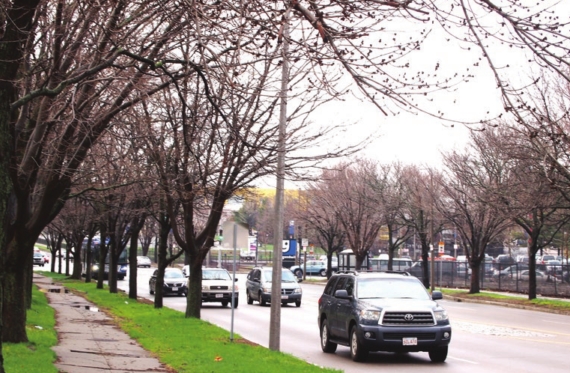
Activists say the city’s proposed changes to Melnea Cass Boulevard will widen the throughway at the expense of pedestrians
Neighbors want pedestrian access
Eight years ago when the administration of Thomas Menino announced plans to significantly widen Melnea Cass Boulevard and remove more than 200 trees from the parkland lining the throughway, neighborhood activists asked the city to reconsider the plans.
This year, the Walsh administration appears poised to move forward with modified plans that would add in left-turn lanes, add shoulders to the boulevard and shift from a single, two-way bike lane on the north side of the road to one-way lanes on either side.
The city dropped plans to add in dedicated bus rapid transit lanes, which would have necessitated a greater widening of the entire length of the boulevard.
At a meeting held Monday at the Marriott Residence Inn on Melnea Cass Boulevard, members of the group Friends of Melnea Cass Boulevard questioned the original intent of the city, which is banking on $25 million in federal funds promised for the project.
“We quickly understood that the point was to spend $25 million no matter what the neighborhood wants, no matter what the needs are,” said South End resident Yvonne Lalyre.
The land Melnea Cass Boulevard now occupies was originally cleared of housing in the late
1960s to make way for an aborted inner belt highway project. More than
2,000 housing units were demolished for the planned roadway, which would
have arched from Interstate 93 at Massachusetts Avenue through the
Fenway, Kenmore Square, Central Square in Cambridge to Somerville, where
it would connect again to 93.
After
a coalition of neighborhood activists from Boston and Cambridge
defeated that plan, along with a plan to extend Interstate 95 through
Boston, Melnea
Cass Boulevard was designed, along with 400 tree plantings, to bring traffic from 93 to Columbus Avenue.
The
Lower Roxbury and South End activists who met Monday say the city’s
plan for the reconstruction of the boulevard would have a negative
impact on an area that is a heat island — a section of the city where
the lack of tree cover produces heat in excess of the city average by as
much as 20 degrees on hot summer days.
“In
this day and age, to take out 100 trees — it just doesn’t make any
sense,” said Dudley Square resident Caroline Toth. “The city has already
identified Lower Roxbury as one of the largest and hottest heat
islands.”
The tree
removals will be necessitated by the road widening in some areas and the
creation of separate bike paths on either side of the road.
Friends
of Melnea Cass Boulevard member Alison Pultinas said the overall plan
does little to address residents’ concerns that about pedestrian access
and bicycle safety.
“When you look at the plan, it resembles a highway,” she said. “There’s nothing in the plan that’s about lowering speed.”
At
Washington Street, for instance, where a left-turn lane will be added,
the street will be widened from 58 feet to 82 feet, Pultinas noted.
Overall, pavement will be increased by 18 percent and the roadway will
lose a quarter of its green space. While some new trees will be planted
in the narrowed strips between paved surfaces, Lalyre said it would be
decades before any of them mature.
“Little trees will take 20 years to do the job a mature tree does,” she said.
City
officials plan to release a request for proposals for work on the
boulevard in December. The project is expected to take four years to
complete.


