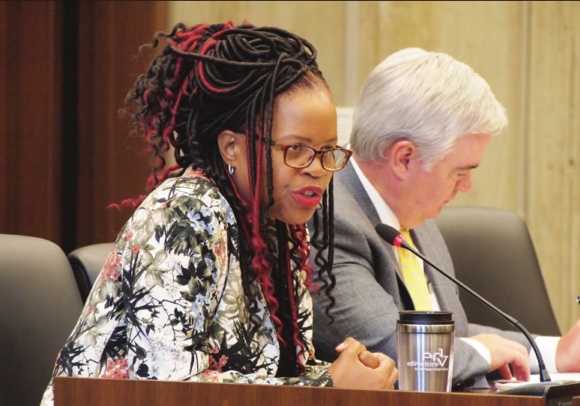
Kim Janey
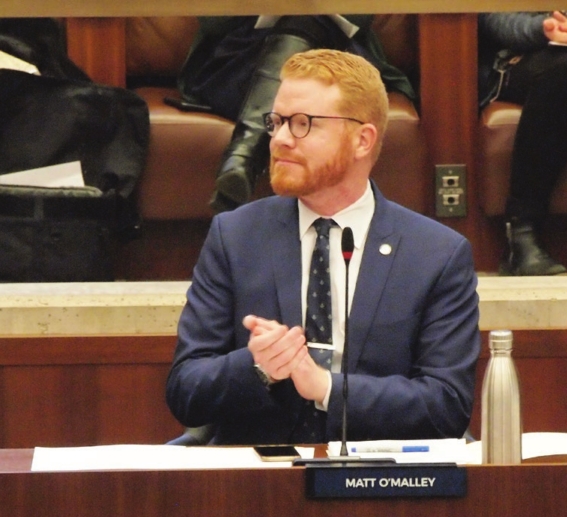
Matt O’Malley

Lydia Edwards.
Two main factions appear to divide body as contenders aim for 7 votes
Before the dust settled on the Nov. 5 election, Boston City Council members were busily working on the first agenda item for the coming year: who the next council president will be. After three weeks of wrangling, the body appears split largely along race lines, with a majority of the white councilors backing District 6 Councilor Matt O’Malley and mostly black and Latino members backing District 7 Councilor Kim Janey and District 1 Councilor Lydia Edwards.
The latter two say they support each other, and each is willing to bow out if the other gets to the seven votes needed to seal the presidency.
“I don’t see Kim as anything other than a friend,” Edwards said. “If she grows, I grow.”
Janey and Edwards claim six votes in their coalition of supporters.
O’Malley, who at 40 is the longest-continuously-serving member of the body, also says he has six votes.
“I’ve been approached by several colleagues who think that my experience and vision and temperament would be good,” he told the Banner. “I’m confident that we’ll be figure this out. It’s obviously a little early.”
Several City Hall sources reached by the Banner said those supporting O’Malley include councilors Frank Baker, Annissa Essaibi-George, Michael Flaherty, Edward Flynn and Andrea Campbell. Of those, only Essaibi-George confirmed she’s supporting O’Malley. The others did not return phone calls for comment.
Councilors typically vote on the presidency during their first meeting in January.
Essaibi-George said O’Malley’s experience as the longest-serving councilor on the body is a plus.
“What I’m excited about and what I think Matt brings to the table is representing the body as a whole with his long-term experience on the council,” she said. “I think the council’s work will continue to be forward-thinking and progressive.”
Voters this year elected four new members, two of whom will be people of color and all four of whom were endorsed by progressive coalitions and groups. For the first time ever, the council will be majority women, and a majority of the members identify as people of color.
Rent control, gang database
Aside from the vote on the council presidency, ideological fault lines could divide the council next year as it grapples with key issues that emerged in forums and debates during the campaign season, such as housing, criminal justice reform and education.
Right To The City Vote Boston, an organization that advocates for the re-imposition of rent control, did not endorse at-large Councilor Michael Flaherty, Essaibi-George, Baker or Campbell.
Asked
by the Boston Coalition for Education Equity whether they would support
changing the admissions requirements to Boston’s Exam Schools — which
currently include the controversial ISEE test — Essaibi-George, Flaherty
and O’Malley said they would not. Baker and Campbell did not respond to
the group’s survey.
On
an ACLU of Massachusetts survey that asked candidates, among other
things, whether they would support closing down Boston Police
Department’s gang database, which has come under fire for erroneously
listing people of color as gang members. Essaibi-George said she would
support reforming the database, but not closing it. O’Malley, Baker,
Flaherty and Campbell did not answer the ACLU survey.
Karen
Chen, a member of the Right to The City Vote Boston, said voters in the
city supported more progressive candidates over moderates and have
elected the most progressive council in recent history.
“The
voters are demanding for the city council to take more progressive
stands,” she said. “The Boston voters came out to vote for stronger
tenant protections. The voters are asking the city council to play a
role to bring back rent control and to regulate the housing market.”
NAACP
Boston Branch President Tanisha Sullivan said she is hopeful the
council will pick a president who represents the body’s diversity.
“After
generations of a council that lacked diversity in its membership and
leadership, it is our hope that the next leader of the council will be
someone who not only reflects the racial and gender diversity of the
city but is also a leader on pressing racial equity issues like housing,
economic justice and participatory governing,” she said.
Who
leads the council matters, because the president has the power to
decide which colleagues lead which committees and, therefore, who gets
to take the lead on the issues such as housing, education and criminal
justice.
O’Malley said he would like the body to be “a strong independent voice” that works collaboratively with the mayor.
“I’m excited about this new council and looking forward to working with its new members.”
Edwards said it’s important that the council president work well across difference.
“We
can be a white majority or black majority, but if you do not know how
to build coalitions, it’s just folks waiting till they get on top and
play us-versus-them,” she said.
Elected school committee
Regardless
of who is city council president, Boston Coalition for Education Equity
member Lisa Green noted, “The new city council will have 10 of 13
members in support of restoring Bostonians’ right to vote for at least
some School Committee members.”
Annissa
Essaibi-George and District 8 Councilor-elect Kenzie Bok told the
coalition they oppose allowing voters to choose school committee
members. Essaibi-George favors modifying the current system to allow
city councilors to pick four school committee members and the mayor to
pick five.
Other
councilors and councilors-elect said they favor either a fully elected
committee or a hybrid committee with elected and appointed members.


