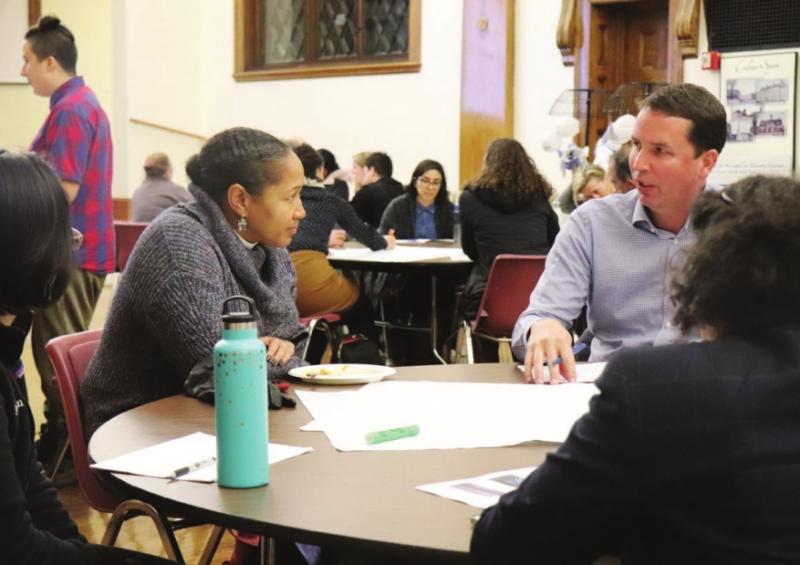
The Rev. Mariamma White Hammond (center) listens during a roundtable discussion at the Codman Square Health Center.
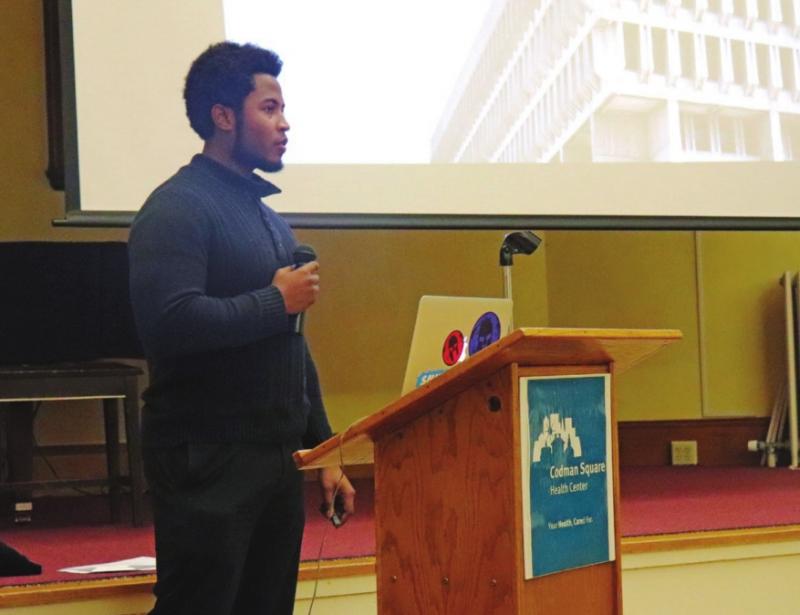
Greenovate
outreach manager David Corbie says low-income people of color are the
least likely to be prepared for the impacts of climate change.
Environment Dept. launches Greenovate Boston
As the City of Boston moves ahead toward its environmental goal of carbon-neutrality, a city department has launched a program to make sure climate change preparation and activism is being made accessible to Boston’s residents of color.
Working under the City of Boston’s Environment Department, Greenovate Boston held a
roundtable discussion event last Wednesday evening to talk about racial equity and climate change. About 20 people gathered in the Great Room at the Codman Square Health Center in Dorchester for a presentation from Greenovate community leaders on how climate change affects people of color.
“A lot of times when we think of climate change, we think of it as something that is far removed from us,” said Greenovate Boston
leader Rochelle Higgins. “Especially in low-income communities, climate change is something that is very far from their minds and thoughts. They’re thinking how to make ends meet, how to provide for their families. But climate change is happening now and it’s impacting all of us.”
Sharon Amuguni, one of the discussion facilitators, explained that the effects of climate change have a harder impact on populations who are already vulnerable.
For
example, when it comes to extreme heat waves and air pollution, she
said, it’s the neighborhoods with very little green space that fare the
worst — in Boston, those neighborhoods are predominantly black, Hispanic
or Asian.
The same goes for extreme precipitation and flooding.
“The
areas that will see a heavily increased amount of flooding seem to be
areas such as Roslindale, Mattapan, Dorchester and Jamaica Plain, just
to name a few,” Amuguni said, pointing to a flood map of Boston.
“Imagine our work commutes, our transit commutes, with that much rain.”
David
Corbie, Greenovate Boston’s outreach manager, said that in the event of
a climate emergency or natural disaster, it’s low-income people of
color who are less likely to be prepared.
“How
can somebody who is in poverty or makes a certain income, how can they
really prepare for climate change?” Corbie said. “If I’m somebody that
is making $15 an hour or $10 an hour, what is my likelihood of being
able to … prepare my family for a coastal storm? If there is extreme
heat or if there is extreme cold, or if there is a huge snowstorm, what
does that do to somebody, how can they rebound from that?” The
Greenovate team said that green solutions like clean energy and
energy-efficient homes should be made accessible to low-income
communities of color as well.
“To
address racial equity, this means addressing basic questions like
renewable energy expense and the cost,” Amuguni said. “How do we make
sure that everyone can afford it? What if updates to my house increase
the likelihood of gentrification in my neighborhood?” After the
presentation, attendees broke into small groups to discuss what
communities can do to prepare and what solutions Corbie says he loves
the smallgroup discussion format because it allows all attendees to get a
chance to meet and hear each other’s ideas.
“It’s
not so incumbent upon city staff being there to have the discussion,”
Corbie said. “It’s more on community members taking interest and being
passionate and then wanting to bring it to their communities because
they see the value, and the impact that climate change is going to
have.”
Dorchester
resident Judy Rose, who attended the event, said she felt it was her
obligation to learn more about how she can help to lessen the effects of
climate change in her own community, which she described as vulnerable.
“I’m
glad it’s happening … and that the conversation is brought to the inner
city of Boston for people of color to learn and be a part of the change
that we want to see,” Rose said. “If we’re not informed, we are
vulnerable, and we need to be less vulnerable and take action for
ourselves as well.”
Eileen O’Grady writes for The Scope, a project of Northeastern University’s School of Journalism.


