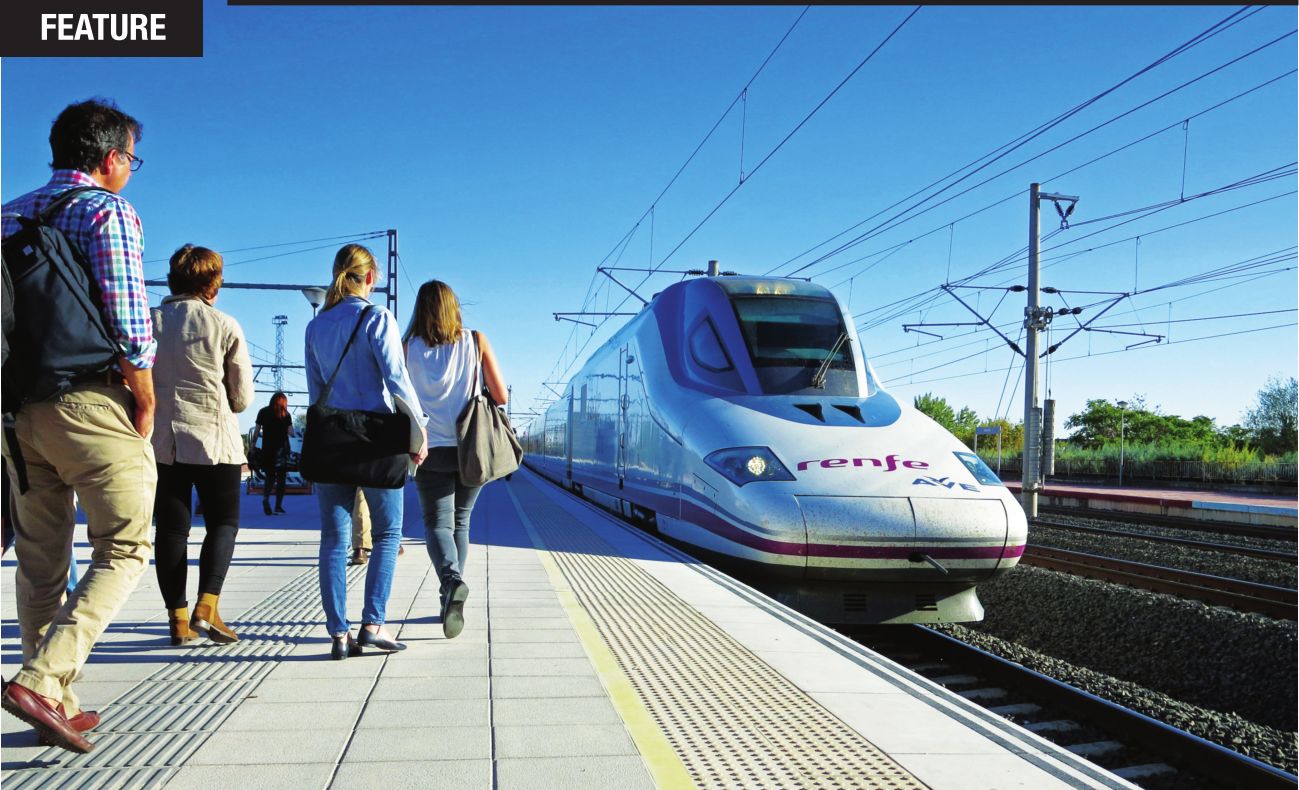
As 110 mph trains approach reality, 220 mph seems possible
Springfield may not be a suburb of Chicago, but efforts are afoot to make practical, daily commuting between the two cities – and other Illinois cities – a reality. And it would only take a rail system almost three times as fast as current high-speed trains, at a cost nearly equal to the entire fiscal year 2019 state of Illinois budget.
“If you could get the Chicago to Springfield trip down to less than two hours with hourly service, that will completely change people’s view on traveling,” said Rick Harnish, executive director of the Midwest High Speed Rail Association (MHSRA). “Not only will they switch from car to train, but they will also travel more often, and it will really change Springfield’s position in the world economy.”
The MHSRA is pushing for commitments to implement 220-mile-per-hour passenger rail service throughout the Midwest. The Illinois portion of the ambitious plan would involve the construction of an all-new, electrified 220-mile-per-hour backbone rail system, upgrades to existing tracks for frequent 90 miles-per-hour service, upgraded or new passenger rail stations, and new locomotives and passenger cars capable of operating at speeds exceeding those experienced by drivers at the Daytona 500.
This isn’t the 79-mile-per-hour “high-speed” rail that’s currently being expanded on several of Amtrak’s Illinois routes. This is ultra-highspeed rail, and the MHSRA says it could mean fast, easy access to all parts of Illinois that would revitalize small and medium-sized cities in the state.
The association claims the higher speed rail service would mean a $13.8 billion annual increase in business sales in Chicago alone, $1.9 billion in annual time savings versus driving or flying, a $6.4 billion reduction in annual vehicle miles traveled and 2,615 fewer automobile accidents per year with 43 fewer traffic deaths. The system would also reduce CO2-equivalent emissions by 3.3 million metric tons each year, according to the MHSRA.
“I rode these kinds of trains in Turkey recently. Vietnam is building one. Morocco’s and Saudi Arabia’s will open this year. Spain and France have already connected an area bigger than the Midwest. And China has a large network,” said Harnish, who added that California is already working on its own super-high-speed rail system. “The trains are so smooth at speed that water on tables doesn’t move. You have noise similar to an airplane because air is whizzing by that fast, but because the track has to be so precise, the train itself is incredibly smooth and quiet.”
Harnish said the cost to get 220-mile-perhour rail passenger service up and running in Illinois would be between $20 billion and $25 billion for the all-new precise, electrified backbone tracks and upgraded Chicago Metra lines that would bring the service directly from Chicago to Kankakee, Champaign- Urbana, Decatur, Springfield and St. Louis. Upgraded 90-mile-per-hour tracks would serve Bloomington-Normal, Peoria, Alton, Carbondale, Macomb, Quincy, the Quad Cities and Rockford. An additional $8 billion would be needed to build or upgrade passenger rail stations, Harnish said.
The fiscal year 2019 budget passed in May by the Illinois General Assembly totals $38.5 billion. It includes a $50 million appropriation to the Illinois Department of Transportation (IDOT) for rail service. The agency may use $20 million to pay bills related to all rail projects in the state that are eligible for reimbursement by the Federal Railroad Administration. The remaining $30 million will be placed in escrow and used over the next 20 years to maintain high-speed track on the Chicago to St. Louis rail corridor, according to IDOT spokesman Guy Tridgell.
Harnish said a public-private partnership supplemented by passenger
fares is the recommended way to fund the ultra-highspeed rail proposal,
and no one expects that this would happen overnight.
“One
of the things we are asking the state to do is to look really
extensively at how much do you have to come up with every year to make
this work,” Harnish said. “Federal involvement is a key part of the
picture, which means we really need to think about this bigger than just
Illinois.”
Once the
infrastructure is in place, Harnish said, the new higher-speed rail
service would generate an operating surplus because the trains would be
used more, carry more passengers, require fewer overnight stays by train
crews, and become the go-to method of inter-city transportation.
Tom Schatz, the president of Citizens Against Government Waste, disagrees.
“It
is a very difficult project and one that is highly unlikely to be
successful. Taking Amtrak as an example of national passenger rail, it
was supposed to be profitable and never has been,” Schatz said. “So it
makes it really easy to see why a more expensive, higher speed system is
also highly unlikely to be profitable.
“I
remember President Obama when he came back from Europe said ‘this is
great, let’s do it.’ It is something that sounds like it would work but
is extremely diffficult in the U.S. because of geography and
population,” Schatz said. “It costs more because the current
infrastructure has to be redone in order for high-speed rail to succeed.
If that had been done about 20 years ago it probably would have been
less expensive, although probably still unsuccessful.”
Schatz
said the skyrocketing costs the state of California is experiencing
with its super high-speed rail project are an example of what could face
Illinois if this state chooses to go down that path. He added that
maintaining and improving current transportation methods is a better
alternative.
“There
are a lot of other options for people to get from one place to another,”
Schwatz said. “You have buses, regular trains, highways. Airlines are
relatively inexpensive compared to what they used to be.”
A
220-mile-per-hour High-Speed Rail Preliminary Feasibility Study,
prepared by the University of Illinois for the Illinois Department of
Transportation in September 2013, estimated the price tag for the
fasterspeed passenger rail system in Illinois would be between $22
billion and $39 billion. The study concluded that the high-speed rail
system could be operationally profitable, with those profits transformed
“through debt and equity to cover from five percent to 23 percent of
the total construction cost.... A public-private partnership with
substantial investments of public funds should be explored to make the
high-speed rail system a reality,” the report stated.
The
U of I report estimated that the ultrahigh-speed rail system would take
passengers from downtown Chicago to Champaign in approximately 45
minutes, to Springfield in one hour 18 minutes, and to either downtown
St. Louis or Indianapolis in two hours. The report estimated the annual
ridership of the system to be between 8 million and 15 million people
with trains running every half-hour during peak times and hourly during
other times.
The
220-mile-per-hour backbone envisioned by the MHSRA would run along
interstate highway corridors where several established freight railroads
currently operate. The railroads are noncommittal when it comes to the
proposed higher-speed passenger service.
“Special
considerations are necessary for high-speed rail service on Norfolk
Southern rail corridors,” said Norfolk Southern Corporation director of
public relations Susan Terpay. “Passenger trains operating in excess of
79 miles per hour require their own dedicated tracks. Passenger trains
operating in excess of 90 miles per hour require their own private
right-of-way.”
“Norfolk
Southern is pleased to assist states planning for dedicated high-speed
rail and will work with planners to insulate those corridors from
interference with and from Norfolk Southern freight corridors,” Terpay
said.
The Union Pacific Railroad has its eyes set on the ongoing 79-mile-per-hour upgrades.
“Right
now we are focused on completing the Illinois High-Speed Rail Program
between Chicago and St. Louis, which will provide an efficient, fluid
passenger and freight operation,” said Union Pacific Railroad media
relations director Kristen Smith.
Amtrak
has operated passenger rail service in Illinois since 1971 and is also
concentrating on the present when it comes to high-speed rail.
“We
already have here in the Midwest some of the highest speed services
outside the northeast, where we are routinely going 110 miles per hour
in parts of Michigan and Indiana,” Amtrak spokesman Marc Magliari said.
“We have plans through the Illinois DOT to reduce travel times on the
Chicago-to-St. Louis route too.”
“The
kinds of services that would be going ultra-high speed would be like
building new interstate highways. It can be done, but it would take
separate infrastructure,” Magliari said. “The existing infrastructure,
because it is shared with freight trains, and because of its curvature,
is not designed to do the higher speeds that the MHSRA is advocating.”
Congressman
Rodney Davis has been a supporter of the ongoing 79-mile-per-hour
high-speed rail upgrades, and the Chicagoto-St. Louis Amtrak route cuts a
large swath through his central Illinois district.
“I
believe that we first have to finish the project that we’ve started,”
Davis said. “But if we are ever going to have ultra-high-speed rail,
we’ve got to have somebody start thinking about it now.
“At
one time there were a lot of folks who thought high-speed rail between
Chicago and St. Louis was going to be a pipe dream, but it’s a corridor
that I think is actually working,” Davis said. “Many other high-speed
rail projects are way over budget, but it’s working in Illinois.”
Davis
realizes 79-mile-per service is an entirely different proposition from
propelling passengers at almost triple that speed. He’s not necessarily
an advocate of ultra-high-speed rail, but does support a thorough
investigation of the possibility.
“That
discussion on ultra-high-speed rail I don’t think ever starts too early
because this is an opportunity to begin planning ahead for what’s going
to work, what’s best,” Davis said. “I took a 200-mile-per-hour train
from Paris to Brussels for a meeting at NATO headquarters last summer,
and that service is well-recognized in many countries. It’s a service
that if we could move it forward in a cost-effective manner, and the
passenger ridership would allow it, we ought to think about it.”
IDOT
is the lead agency in the state’s highspeed rail infrastructure
development along the 284-mile-long Chicago to St. Louis corridor.
“Construction
on Chicago to St. Louis is nearly complete,” said IDOT’s Tridgell. “The
remaining work includes installing fence on the south end of the
corridor near Alton, upgrading crossings and installing fence in
Springfield, and finishing construction of a new bridge over the
Kankakee River near Wilmington.”
Tridgell
said IDOT continues to work with Amtrak to install the software
necessary for Positive Train Control implementation on the new
locomotives that began to be put into service last year, and passengers
should soon experience slightly faster speeds.
“We
anticipate maximum speeds will increase from the current 79 miles per
hour to 90 miles per hour by the end of this year,” Tridgell said.
“There are currently no plans to implement speeds higher than 110 miles
per hour in Illinois. Should federal funding become available in the
future, the department would consider moving forward with preliminary
engineering and environmental studies. But, again, nothing is planned at
this time.”
If
current passenger trains can run 110 miles per hour, why can’t they just
go faster? Besides the problem with track construction and geometry,
the MHSRA’s Harnish said simple physics is at work.

“The
220-mile-per-hour trunk line has to be electrified,” Harnish said.
“Diesel locomotives are actually electric locomotives where they carry
their power plant with them. You get to the point where the power plant
has to be too big to go with you as you get faster and faster. That
break point appears to be about 125 miles per hour.”
“The
locomotives and cars have to be much lighter and safer, and our safety
regulations in this country are way out of date,” Harnish said. “The
European trains are actually much safer in addition to being lighter and
less expensive to build and operate. So it really does mean moving to a
modern standard for trains.”
Railroad
crossing safety is another issue, one which Harnish said could be dealt
with by locating the majority of the ultra-high-speed rail track close
to interstate highway rightsof-way. And speaking of interstate highways,
Harnish said those multilane, controlled-access roads first developed
in the 1950s demonstrate that where there’s a transportation will,
there’s a way.
“We
haven’t done something on this scale since we built I-55.” Harnish said.
“But we did in fact build I-55 and I-72 and I-57, so it’s something we certainly can do.”
Let’s
assume that 220-mile-per-hour passenger rail service becomes a reality
in Illinois at some point in the future. What do current passenger train
riders think of the idea? A recent visit to the Springfield Amtrak
station, where dozens of passengers waited for a train that was already
45 minutes late, elicited mixed reactions to the prospect.
“I
would probably use it more, but at my age I don’t know if that’s going
to be a possibility because I don’t know how far in the future that’s
going to be,” said Joliet resident Wilma Bass, who has done a lot of
train travel recently in Illinois and Texas. “I would probably travel
more by train. Joliet has that kind of service now, they just don’t have
the train to go with it.”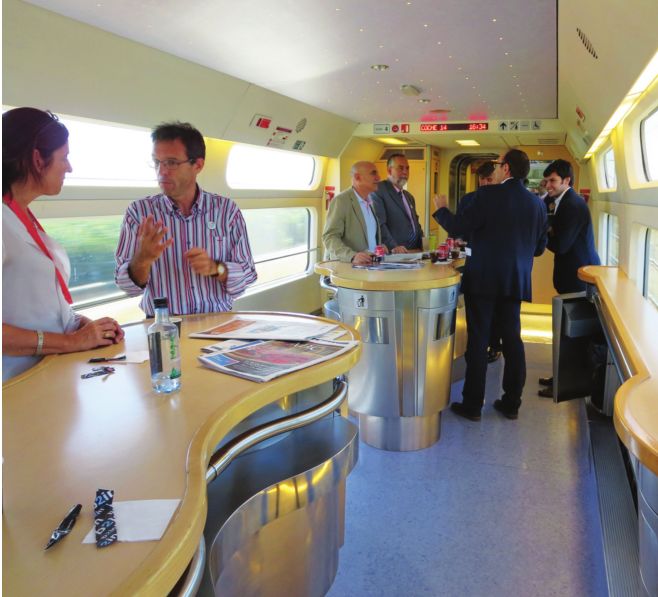
“We
have a fast-paced world and people are always in a hurry to get
somewhere and the generation coming up now is very young and they can’t
wait to go different places, so I’m sure this could be a big benefit for
them,” Bass said.
Owen
Peters, a volunteer with the Rails and Trails Program, a partnership
between Amtrak and the National Park Service, is a frequent train
traveler on the St. Louis to Chicago route.
“Long
distance trains going 220 miles per hour is fine, you’d get there
faster, but this particular route, I don’t think so,” Peters said.
“How
are they going to make all of the stops they currently make? There’s a
lot of stops, and going 220 miles per hour, you slow the train down,
offload passengers, it doesn’t seem feasible to me.”
“The
tracks have been upgraded on this route to 79 miles per hour and it’s
smoother and faster, but the trains still aren’t getting here on time,”
Peters said. “High-speed trains might be in the future, but on this
particular corridor, I’m not so sure they’d work.”
Diane Buttitta of Des Plaines, who travels periodically by train, has safety concerns about increasing train speed.
“The
advantage would be taking less time to go from place to place,”
Buttitta said. “The disadvantage would be the severity of injuries if
there was a crash at the higher speed.”
Breahna Koprek, a Decatur native who lives in Chicago, travels frequently by rail.
“It’s cheap but it takes an awfully long time and there’s a lot of stopping involved,” Koprek said.
She summed up the feelings of many of the waiting passengers about potential 220-mile-per-hour passenger rail service.
“If I could get someplace quicker that would be nice,” Koprek said.
David Blanchette is a freelance writer from Jacksonville and is also the co-owner of Studio 131 Photography in Springfield.


