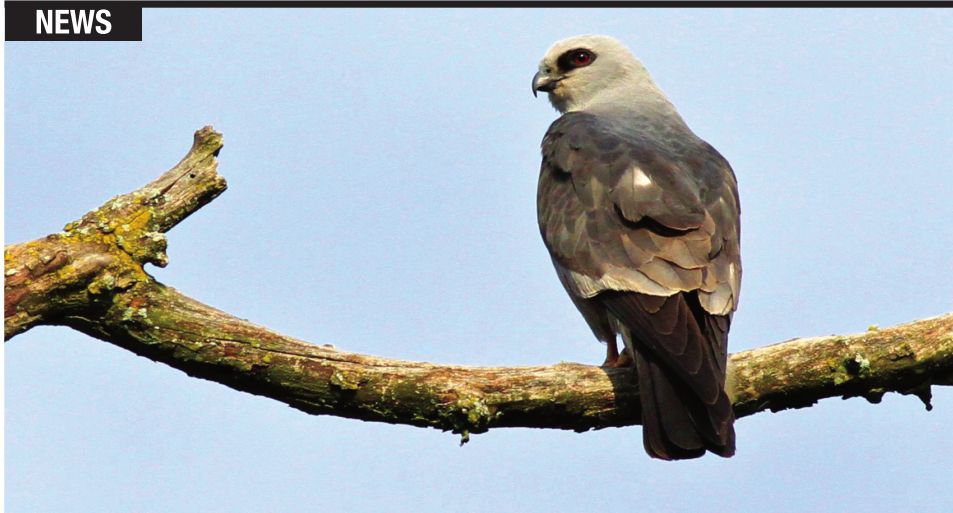
It’s a Mississippi kite, on Glenwood Avenue
As birds go, Mississippi kites are not classic beauties.
They are gray, like pigeons or seagulls.
One of the smaller members of the raptor family, Mississippi kites are, by definition, birds of prey, although they stick mainly to June bugs and other insects. Be careful: The birds are known for swooping down, divebomber style, on humans (or pets) who get too close to nests. They sometimes execute barrel rolls in mid-flight for no apparent reason.
“These birds have sharp talons,” authorities at Altus Air Force Base in Oklahoma warn in an article titled “Five Things To Know About Mississippi Kites” posted on the base’s website. “There were six incidents last year, so you definitely don’t want to mess around if these birds are in your vicinity.”
Visions of Alfred Hitchcock notwithstanding, a pair of Mississippi kites that has nested far outside the birds’ expected range is causing a sensation in Springfield, where the two kites are nurturing a chick in a sweet gum tree on the 2400 block of South Glenwood Avenue. Bird watchers have come from as far away as Charleston and Jacksonville to get a peek at a species that, as the name implies, is more common in southern regions.
David Bohlen, zoologist at the Illinois State Museum, says this is the first known instance of Mississippi kites in Springfield.
Records date to the mid-19 th century.
“It’s the first nest ever, as far as I know,” Bohlen said. “There’s lots of people watching it. They might have nested here long, long ago, but there’s no records of it. ... I’m sure there’s been 50 people there to see it.”
While the female stays with the hatchling, her mate often perches in a dead sycamore across the street, apparently standing watch. Dennis Oehmke, a local birdwatcher who’s become a Glenwood Avenue regular since the kites arrived in late spring, says a third Mississippi kite, apparently a young male, recently made an appearance. “It showed up and hung around for awhile, but I didn’t see it today,” Oehmke says.
The appearance of a third bird isn’t necessarily unusual. Young Mississippi kites sometimes frequent the nests of breeding pairs and help out by chasing off interlopers or even incubating eggs, but that hasn’t been documented on Glenwood Avenue. Mississippi kites usually lay between one and three eggs, but just one chick has been spotted so far.
The presence of Mississippi kites, which feed on Japanese beetles, is good news for gardeners. Oehmke says that males will pull the wings, heads and legs from insects, then give remaining parts to mates which in turn feed the morsels to hatchlings.
The birds have nested in southern Illinois, including along lower reaches of the Illinois River, Bohlen says.
“Down there, they usually nest in the swamps and the woods,” Bohlen said. “Here, this is right in the city. … It’s hard to say where these birds came from.”
While rare in northern regions, a pair of Mississippi kites have nested in Rockford in recent years, and there have been sightings as far north as Wisconsin. Experts say that the birds have expanded their range in recent years and have proven adaptable to suburban life. A nesting pair has been found in New Hampshire.
Mississippi kites are social birds that fly in flocks, hunt together and tend to nest in groups, and so the solitary outpost on Glenwood Avenue is unusual for more than just the unexpected geography. The birds spend winters in southern South America. Bohlen figures the Glenwood Avenue birds will be here until late July or August before departing for winter homes.
The kites are monogamous, and creatures of habit. Dubbed the Bloom School kites to denote a nearby school, the Mississippi kites that chose Rockford for a nesting site in 2008 returned for at least five years, according to a 2013 column in the The Daily Herald, a suburban Chicago newspaper.
Local kite fans have fingers crossed. “They might come back to the same site next year,” Oehmke said.
Contact Bruce Rushton at [email protected].


