New book combines Bill Crook’s art with his old-soul perspective
Bill Crook has
been drawing for over 40 years, filling sketchbooks of his pen and ink
illustrations that he says, “explore the interests of my heart.”
Bill
is a native of Springfield and has earned a reputation as an
outstanding artist. People easily recognize Bill, often seeing him
sketching at a site in Springfield, creating his drawings of a building,
a street corner or an entire block. Every year since 1979 he has sold
his art at a booth at the Old State Capitol Art Fair. He draws a steady
stream of patrons.
In
1982 Crook self-published an oversized book of his illustrations. He
planned to someday publish another book, and since 2009 he has been
scanning his works, some from the past and some neverbefore-seen. The
result is Springfi eld, Illinois: A Pen and Ink Artist Looks at his Hometown, filled with 185 of his illustrations and covering 145 pages.
The drawings alone would make this a wonderful book. But Crook has added narrative to
accompany the illustrations. Crook admits, “I never really considered
myself a writer, but I decided to trust my instincts.” His thoughts,
memories and reminiscences bring the sites alive with information about
the historical background of a building, its owners, construction
materials and uses throughout the years. Crook says, “I wanted to weave
in my personal history with Springfield.” Readers will enjoy his views
and his illustrations – and learn a lot of Springfield history.
The book is divided into 22 sections, each devoted to a theme.
Book signing Dec. 8
A
book signing, including Bill Crook reading from his book, will be held 7
p.m. Dec. 8 at the Pharmacy Gallery, 711 S. Fifth Street. Springfield, Illinois: A Pen and Ink Artist Looks at His Hometown, 145
pages, was published by Prairie Press, printed by Frye-Williamson. $29.
The book is available at Prairie House Custom Frames, 2833 S. Sixth,
and Books on the Square, Washington Street just off Fifth Street, and
the Pharmacy Gallery.
In
“Lost Springfield” Crook “mourns” the losses of “the city’s most
architecturally significant structures that have been demolished during
my lifetime.” These include the old Lincoln Library, torn down in 1974
and replaced by a modern structure at the corner of Capitol Avenue and
Seventh Street, Hotel Abraham Lincoln, which stood on Capitol Avenue and
Fifth Street and was imploded in 1976, and most recently the YWCA.
He
shares his own memories of sites that have been long gone, such as the
old First Methodist Church (corner of Capitol and Fifth), “where I
attended my grandmother’s funeral,” or the Roxy Theatre (on Fifth
between Capitol and Jackson Streets), remembering sitting “as a teenager
in the audience for James Bond Thrillers.”
As
one reads Crook’s descriptions and looks at the illustrations, it is
easy to begin reminiscing and fondly remembering one’s own experiences
growing up in Springfield.
The
longest section in the book illustrates natural areas in and around the
city. There is also a section called “Portals,” which he describes as
“major entry points to the city,” such as the State Fair entrance at
Peoria Road and Sangamon Avenue.
His
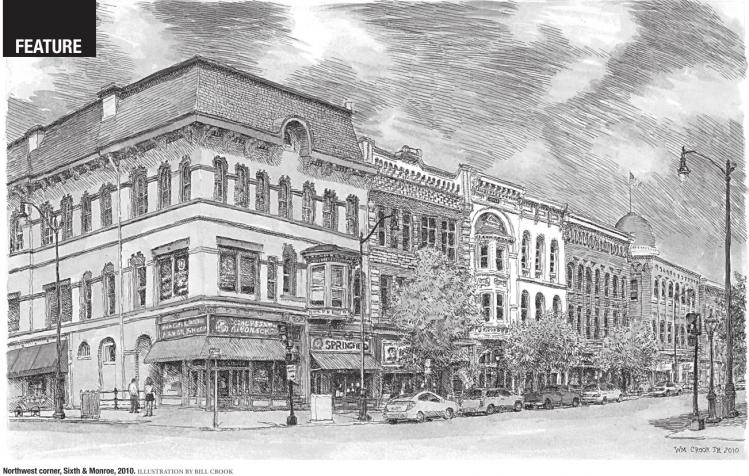
favorite intersection is Sixth and Monroe, to which he devotes an
entire section of sketches and stories. Crook writes, “This area has not
only retained its distinct architectural style but has seen robust preservation projects.”
Crook wasn’t always an artist.
After
graduating from Springfield High School in 1967, he spent a few years
in various parts of the country. It was in Mexico, where it was “warm,
sunny and beautiful,” that he did some painting. He had done cartooning
of political and satirical subjects while working in graphic design in
Portland, Maine, getting some of his work published in a magazine run by
author Richard Grossinger.

But,
it wasn’t until he moved back to Springfield at the age of 24 that he
started some sketches, the first one being the Culver Castle that stood
at Ninth and Madison before it was demolished in October 1982 for the
expansion of St. John’s Hospital. Colonel James Culver (1852-1911) was a
leading contractor and owner of the Culver Marble and Stone Co., known
for large stonework structures.
Crook
started drawing signs and making graphics of scenes around Springfield,
especially of his two favorite topics, nature and old architecture. In
the 1970s his pen and ink sketches were becoming better known,
especially after several newspaper stories covered Crook’s work.
A
degree at Sangamon State University and then a master’s in painting
from Illinois State University led to teaching art at the Jacksonville
Correctional Center from 1990-2001 and teaching art classes offered in
various towns through Lincoln Land Community College.

Crook
says he is always amazed when he walks through the State Capitol to see
so many of his works hanging in offices. He attributes that to Randall
Witter, of lobbying firm Cook-Witter, Inc., who in 1987 commissioned him
to create 250 numbered and signed sketches that were distributed at the
annual holiday party of Third Rail, the organization of Illinois
lobbyists. The sketch was called “The Rail,” a view of the Capitol
railing where lobbyists, citizens and reporters can often be seen
talking to legislators during session days. Interest in Crook’s work led
to more commissions and sales.
Today,
Crook continues to sketch, has added writing to his interests, and
appreciates his hometown and the many areas that create wonderful places
to set up an easel or sit on a step and sketch the scene before him.
Cinda
Klickna taught English in District 186 and is the immediate past
president of the Illinois Education Association. She, like Crook,
appreciates the many historical sites in Springfi eld and remembers many
of the buildings now gone.