
Krohe’s clever prose makes mid-Illinois history almost fun
James Krohe Jr., Corn Kings & One-Horse Thieves: A Plain-Spoken History of Mid-Illinois. Carbondale: Southern Illinois University Press, 2017.
This
work of solid history, entertainingly told, is mistitled, or rather
mis-subtitled; it should read: “A Witty and Profound Account of Life in
Central Illinois from Prehistoric Times to the Present.” The author,
James Krohe Jr., is well known to readers of this publication as a droll
commentator on doings in the greater Springfield area, broadly defined.
The
reference to “One-Horse Thieves” is taken from an 1865 letter by Robert
G. Ingersoll, the prominent 19th-century orator-atheist-politician from
Peoria: “I was at Springfield several weeks during the sitting of the
Legislature, and I suppose a more scaly set of one-horse thieves and
low-lived political tricksters never assembled on earth.”
Krohe’s
low opinion of central Illinois politicians crops up regularly
throughout this 300-page volume. Republican Congressman Leslie Arends
“never let principle interfere with politics.” In recounting how a new
state school for the blind was funded, Krohe remarks sardonically: “The
General Assembly seldom passed up a chance to discharge its obligations
to its dependent citizens
on the cheap.” He describes an open-air tabernacle in Springfield where
revival meetings were held by the “baseball-playing, hokum-peddling,
‘polygonal preacher’” Billy Sunday: it “stood at First and Adams
Streets, only one block from the Satan’s den that was the Illinois
statehouse.”
In treating the infamous
Springfield race riot of 1908, he observes: “The gambling halls and
opium dens and whorehouses frequented by white men were untouched by the
mobs, while many of the black businesses that were ravaged (such as
barbershops) were eminently respectable by the standards of a town that
was home to the General Assembly.” Though Chicago is widely regarded as
Illinois’ most corrupt locale, Krohe believes central Illinois has
caught up with it: “in a political sense, ‘mid-Illinois’ in the 2000s is
metropolitan Chicago.”
Krohe
ably describes for a general audience the “wrenching transformations”
as the region “moved from Indian country to European- American frontier
to industrial heartland to colonial outpost of a global service
economy.” Covering economic, political, social, religious and
intellectual developments, he enlivens his sprightly narrative with
sketches of colorful characters (like the Swedish preacher Erik Janson
of Bishop Hill), little-known facts (the Mormons’ gigantic second temple
at Nauvoo was in use for less than a month), amusing anecdotes (“The
state police memorably described the situation around the capital as
‘quiet except for a few scattered bombings’”), and clever asides (“It is
doubtful whether antebellum Illinois’ hogs or its drunks did more damage when let loose; towns passed ineffectual ordinances against both.”).
Krohe’s
prose bristles with ingenious figures of speech and turns of phrase.
“Springfield and Bloomington are like a rascal uncle and his scout
leader nephew.”
“A hog’s ability to convert raw corn into pork makes the animal something of a genius.”
“At
the Ariston Café in Litchfield, travelers could eat dinner served on
white linens, which was like pumping gas while wearing a tux.”
“Paving mid-Illinois’ roads was like reforming its sinners – neither ever stayed reformed for long.”

Written
with wry detachment, streaked with affection, Krohe’s book is no
exercise in regional cheerleading. The result of the “wrenching
transformations,” he concludes, “was a mid-Illinois that by many
measures was dull, complacent, cautious, and bland.” Even by Illinois
standards, it “can seem like a backwater,” for “the economic, social,
and political centers of Illinois have shifted well to the northeast.”
It was not always thus: the region enjoyed a heyday between the Civil
War and the Great Depression.
Krohe
laments that “for most mid- Illinoisans most of the time, the real
history of the region has been not a matter of pride or
self-identification or curiosity but indifference.” To illustrate his
point, he cites the destruction of
Indian villages and campsites, of Galesburg’s “Log City,” of mills and
dams, of commercial potteries, of the top works of coal mines and mining
gob piles, of huge military installations, and of immense ordnance
factories. He deplores Springfield’s historical amnesia about “the
origins of the city’s ongoing experiment in municipal socialism or the
inter-union violence that sparked gun battles between miner factions in
the streets of the capital in the 1930s.”
Krohe
laments not only what has been forgotten but also what has been “merely
overlooked.” He cites the example of the Lincoln Legals project, whose
staff unearthed thousands of documents illuminating Lincoln’s long
career as an attorney, making possible “major scholarly advances not
only in Lincoln studies but also in the history of mid-Illinois and the
Midwest.” In a second edition of his fine book, he might also deplore
the virtual suspension of the Lincoln Papers project, that for years had
scholars successfully excavating mountains of documents at the National
Archives in search of new letters written by and to the 16th president.
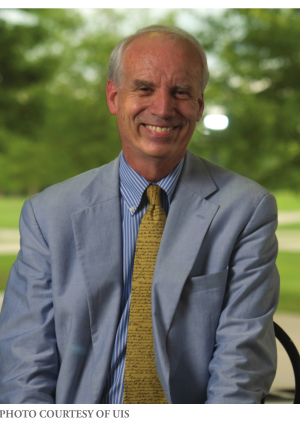
Michael
Burlingame is the Chancellor Naomi B. Lynn Distinguished Chair in
Lincoln Studies at University of Illinois Springfield. He is author of
the two-volume Abraham Lincoln: A Life (Baltimore: Johns Hopkins University Press, 2008).


