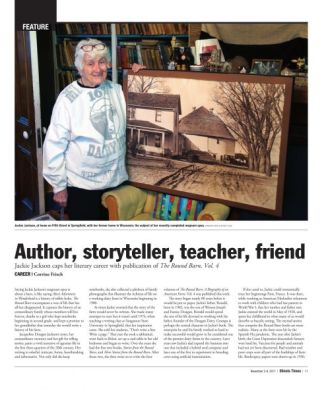
Jackie Jackson caps her literary career with publication of The Round Barn, Vol. 4
Saying Jackie Jackson’s magnum opus is about a barn, is like saying Alice’s Adventures in Wonderland is a history of rabbit holes. The Round Barn encompasses
a way of life that has all but disappeared. It captures the history of
an extraordinary family whose members will live forever, thanks to a
girl who kept notebooks beginning in second grade, and kept a promise to
her grandfather that someday she would write a history of his farm.
Jacqueline
Dougan Jackson’s notes, her extraordinary memory and her gift for
telling stories, paint a vivid narrative of agrarian life in the first
three-quarters of the 20th century. Her writing is colorful, intricate,
funny, heartbreaking and informative. Not only did she keep notebooks,
she also
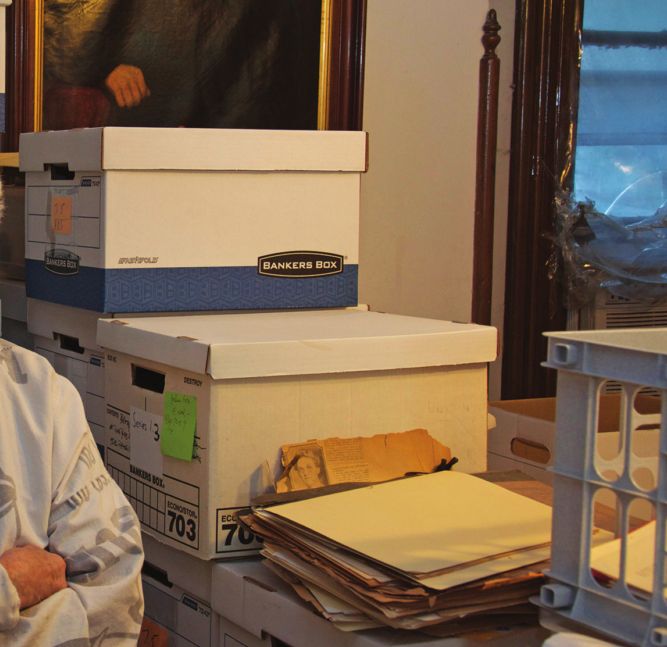
collected a plethora of family photographs that illustrate the richness
of life on a working dairy farm in Wisconsin beginning in 1900.
At
times Jackie worried that the story of the farm would never be written.
She made many attempts to start but it wasn’t until 1976, when teaching
a writing class at Sangamon State University in Springfield, that her
inspiration came. She told her students, “Don’t write a line. Write a
page.” That year she took a sabbatical, went back to Beloit, set up a
card table in her old bedroom and began to write. Over the years she had
the first two books, Stories from the Round Barn, and More Stories from the Round Barn. After those two, she then went on to write the four volumes of The Round Barn: A Biography of an American Farm. Vol. 4 was published this week.
The
story began nearly 80 years before it would be put to paper. Jackie’s
father, Ronald, born in 1902, was the son of Wesson Joseph and Eunice
Dougan. Ronald would spend the rest of his life devoted to working with
his father, founder of the Dougan Dairy. Grampa is perhaps the central
character in Jackie’s book. The enterprise he and his family worked so
hard to make successful would grow to be considered one of the premier
dairy farms in the country. Later years saw Jackie’s dad expand the
business into one that included a hybrid seed company and later one of
the first to experiment in breeding cows using artificial insemination.
If she cared to, Jackie
could romantically trace her beginnings Paris, France. It was there,
while working as American Methodist volunteers to work with children who
had lost parents in World War I, that her mother and father met. Jackie
entered the world in May of 1928, and spent her childhood in what many
of us would describe as bucolic setting. The myriad stories that
comprise the Round Barn books are more realistic. Many at the farm were
hit by the Spanish Flu pandemic. The year after Jackie’s birth, the
Great Depression descended; farmers were hard hit. Vaccines for people
and animals had not yet been discovered. Bad weather and poor crops were
all part of the hardships of farm life. Bankruptcy papers were drawn up
in 1930, but never filed. Also part of farm life, however, were good neighbors and an abiding faith in God.

Grampa
had always felt he was called to be a minster. He was raised in the
Methodist faith, and had a lifelong aversion to smoking and drinking,
both of which he considered serious sins. But at an early age, he began
to lose his hearing. It soon became clear that a deaf preacher would
face insurmountable barriers. So he turned to his other strong suit --
farming. Jackie insists that The Round Barn is not her memoir,
that it is a memoir of the farm. Within that framework W.J., Jackie’s
grandfather, looms as the central character of the book. Like the barn,
he stands at the center. Life on the farm radiates from him. He was
clear on what he felt his family’s life there should encompass, and on
the silo of the barn, he painted his “aims for the farm” for all to see:
1. Good Crops
2. Proper Storage
3. Profitable Live Stock
4. A Stable Market
5. Life as Well as a Living
In a series of articles for the magazine Hoard’s Dairyman, Grampa
expounded on the last aim. He urged people to “enjoy the simple
pleasures – the sweep of the landscape, the open sky, the forest and the
field and stream, as well as all animate life. … In
the home we have an abundance of light, some inexpensive art, music and
literature, and withal, a home spirit.” He must have taken his aims to
heart, because in 1925 he was named a “Master Farmer,” one of 23 Midwest
farmers so honored.
When
he died in 1949 Jackie felt remorse that she had not yet kept her
promise to write a book about the farm. Life had intervened. After
graduating from Beloit College in 1950, Jackie married, and she and her
husband move to Ann Arbor to receive graduate degrees from the
University of Michigan, she in Latin and he in English. They live on the
outskirts of town in what she describes as “shanties,” and what others
called graduate student housing. She’s taking a full course load and
playing cello in the university orchestra. She realizes she is homesick.
The end of the semester approaches and she comes to terms with how her
life has changed. She describes how she feels in this beautiful passage:
There
has been another clock within her. She didn’t set it nor place it
there. It’s been geared not to hours but to cycles; the daily precession
of milking and bottling, feeding and cleaning, the yearly procession of
planting, cultivating, harvesting. It’s been set to sun, moon, heat,
cold, wed, dry. But now if there’s a heavy spring freeze, she puts on a
coat without sensing the loss of crisp that might result from too-late
planting. If the sky lowers black, she takes an umbrella without feeling
the sway of the hay wagon racing to reach the barn before the
cloudburst. Her dailiness is now this class, that lecture, the next trip
to the stacks. This was true before, too, but the steady
throb of the milking machine was the heartbeat of the dailiness, the
Greenwich underneath that all the other clocks were timed to. It was the
ground she’d stood on, the air she’d breathed. She has no special
moment, no epiphany to explain the realization of loss that comes over
her. She only knows that something elemental is gone and has been gone
for some time. That it’s probably irretrievable, unless she changes the
path she’s treading.
It
would take almost 20 more years, four children, and a divorce before
that “something elemental” would return to her. It came as a result of
her father’s illness and a longremembered promise to Grampa.
In
1967 Jackie’s dad, Ronald, fell ill and was in the hospital for several
weeks. She traveled to Beloit many time to sit by his bedside and take
what some would call an oral history, asking him to tell her stories
about the farm and family. One of those stories was one of the earliest
Jackie had written as a child and would find decades later in an old
brown notebook. It is a tale about a girl and her blue-ribbon calf at
the local 4-H fair. While the girl in the story is a top prize winner,
Jackie’s real-life fate was not so glorious. She and her brother, Craig,
both entered calves in the fair. Craig’s calf behaved, but Jackie’s
bolted and she found herself face down in the show ring with the calf
having headed for the barn. The story of the successful girl, Jackie
said, was a way of “licking her wounds.”

Beginning in 1950 Jackie saw her life turn from farm girl to scholar
to wife and mother. In 1970 she began one of the most important turnings
in her life. She moved with her four daughters, Damaris, Megan, Elspeth
and Gillian, to Springfield, Illinois, to be part of an educational
experiment on the prairie called Sangamon State University. W.J. had
described an educated person, as a person who has taught “her mind to
think, her hand to act, and her heart to feel.” With these arrows in her
quiver, Jackie would begin to teach others how to embrace these goals.
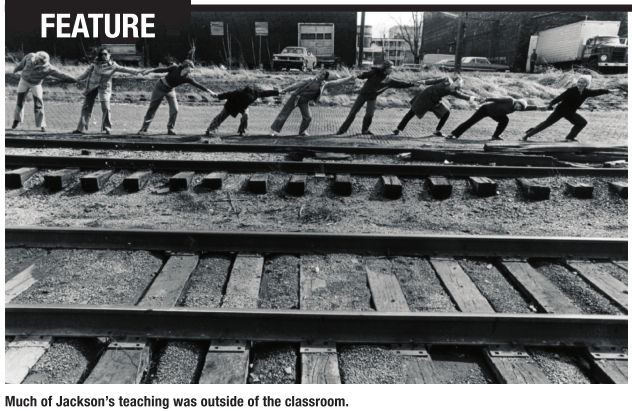
Jackie found her true
calling in teaching when she became a part of SSU. It was the perfect
proving ground. Established as a two-year university for juniors and
seniors, the school had an open admissions policy and, for the first two
years, no grades. This liberal learning philosophy encouraged
independent study programs. The plan called for recruiting the finest
and most innovative teachers to begin what was, in fact, an experimental
idea. The initial faculty comprised 45 pioneering professors. Many of
them are still among Jackie’s closest friends. Over the course of her
career one of the course of her career
one of her greatest pleasures was co-teaching with her colleagues. The
focus was to be on establishing a public affairs university with
corresponding colloquia sessions on local, national and international
affairs. Its other emphasis was to graduate superior elementary and
secondary teachers.
Jackie’s
degree from the University of Wisconsin was in Latin. At SSU she taught
courses in English literature, perceptual writing, and a history of
children’s literature (everyone who took this class left having written
their own children’s book). When it comes to children’s literature,
Jackie had the credentials. Starting in the early 1960s, Little
Brown and Company has published several of her children’s books (see p.
15). She also taught in the genres of fantasy and mystery, and the
aspects of women’s liberation.

Because
SSU was a junior and senior university and because it offered so many
night classes, most students at the beginning were adults. Jackie
recalls a writing class she taught at night. She imagined her students
having worked all day, making evening arrangements for their families at
home while grabbing a quick bite for themselves, then rushing to be at
class on time. Knowing that such a frazzled pace would not encourage
creativity, the first thing she did after all her students were at their
desks was to turn out the lights. And then she played Mendelssohn’s
Rondo Capriccioso Opus 14. At the end of the
piece, students were relaxed ready to write. Jackie herself grew up in a
musical family. She played the violin, but when both of her sisters
played that same instrument, they encouraged her to learn the cello. She
went on to play in more than one symphony orchestra.
Jackie
Jackson could not be described as shy. She may have met a few strangers
but they weren’t strangers for long. When she meets someone, she is
engaged in that person’s interests and eager to share her own. Her
outgoing personality often turned into opportunities for her students.
Jackie planned summer field trips to England and Scotland. One of the
books she had taught in her fantasy class was Richard Adams’ famous Watership Down. She
remembers biking in the country to find Mr. Adams’ house. He opened the
door upon her knock. She introduced herself and asked if her students
might come back to see the setting of his book. He invited her in for
tea, and later her students were privy to a private tour of the down,
led by Adams himself. She also arranged a visit with C. S. Lewis’
stepson, and a trip to the Black Museum at Scotland Yard, and an Oxford
pub visit with Colin Dexter for her students studying mystery writing.
For 20 years, beginning in
1975, Jackie produced a radio show on WSSR, later WUIS. “Reading,
Writing and Radio” was an outreach program to elementary school children
across central Illinois. Students in 90 classrooms were given radios to
listen to the program. SSU faculty and experts from many fields were
recruited for programs on a variety of topics. Pen pals were established
across communities. Every class visited the radio station. And in the
spring, they attended a Jamboree. Jackie remembers it as “the liveliest
day on campus,” and suspects that many of the children later attended
SSU.
One of Jackie’s books, The Endless Pavement, was
the first dramatic performance at the Sangamon Auditorium Theater.
Bemoaning the fact that the automobile seemed to have taken over our
lives, Jackie envisioned a world where people were ruled by their cars
and only dreamed of using their legs to get somewhere. She fondly
remembers dozens of children in toy cars zooming around the stage.
After
she retired from teaching, Jackie has concentrated on what she loves –
writing and her family. She has six grandchildren and two
great-grandchildren. In her big house on Fifth Street (rumored to have
been visited by Abraham Lincoln) Jackie has hosted a writers group for
years. Many members of the group have gone on to have their work
published. She has been the Illinois Times poet for more than 12
years. When John Knoepfle gave up that post, then editor Roland Klose
approached Jackie. “I’m not a poet,” she told him, to which he replied,
“But I want you and I know you can do it.” The poems are enriched by the
rich life Jacqueline Jackson has lived. She has shared this wellspring
in a series of “Liberty” chapbooks.
Agingpoem #1
when tradepeople waiters ushers and such start calling you “young lady Then you know you’re getting old
Jackie
Jackson is 89 years old. When I expressed my disbelief of this fact,
she joked that on a recent trip to London, her older sister Pat, 92,
chided her for not keeping up with group.
Corrine
Frisch is a freelance writer. She has known Jackie Jackson for more
than 20 years. She first met Jackie at Lincoln Library, Springfield’s
public library, when she was working as its PR director and Jackie was
presenting a children’s program.
Julie’s Secret Sloth – 1953. Julie hides a pet sloth in the house, right under the noses of her parents. Little Brown and Co. The Taste of Spruce Gum – 1966. Libby learns to appreciate the different qualities of life in New England. Little Brown and Co. Missing Melinda –
1967. Sisters Cordelia and Ophelia move to their uncle’s house, and
discover Melinda, a valuable antique doll. When the doll disappears, a
mysteryadventure ensues. Little Brown and Co.
Chicken Ten Thousand –
1968. Chicken 10,000 was just like chicken 9,999 until she escaped the
egg factory’s incubator and discovers what the life of a hen should be. The Paleface Redskins –
1968. Children on vacation in Wisconsin are upset when a Boy Scout camp
moves in, disturbing their idyllic summer. Little Brown and Co. The Ghost Boat –
1969. Five children are convinced that the rowboat they see moving
across the lake is propelled by the ghost of a dead fisherman. Little
Brown and Co. Spring Song – 1969. An ode to spring based on a traditional poem. Kent State University Press The Orchestra Mice –
1970. Clarissa longs for a musical life. She marries Sam Mouse and
together they teach their little mice to appreciate classical music.
Contemporary Press The Endless Pavement – 1973. Living in a time
when people are the servants of automobiles and ruled by the master auto
of the planet, Josette longs to leave her rollabout and try her legs.
Seabury Press Turn Not Pale, Beloved Snail: A Book about Writing Among Other Things –
1974. Using excerpts from her own writing and that of her children and
other authors, Jackson suggests a variety of approaches to learning to
write.
These books are currently out of print but are readily available from booksellers online.
Book Coming Out Party
Jackie
Jackson will host a Coming Out Party for the last volume of Round Barn
on Wednesday, Nov. 9, from 5 p.m. till 7 p.m. at First Presbyterian
Church, Seventh and Capitol Streets, in the Cook’s Lounge. Copies of the
Round Barn book will be for sale at a discounted rate. Other writers
will have their books available for sale. Volume 4 of “The Round Barn
Book” will also be available at Prairie Archives downtown, at Barnes and
Noble, and from Jackie herself. For more on the book, or to order, go
to roundbarnstories.com.