Fountains are a welcome addition to an yard
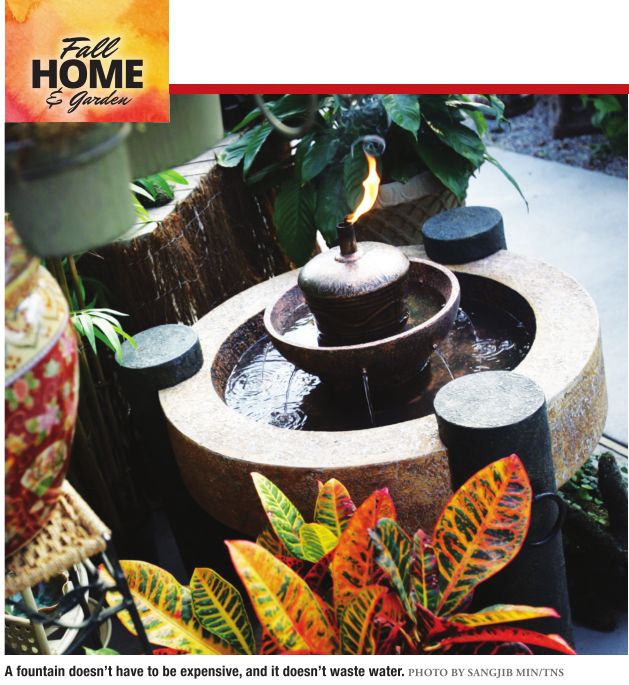
Fountains have been around
since Roman times. In the ancient world, they were purely functional,
employing springs or aqueducts to provide water for drinking, bathing
and cleaning to even the smallest villages. Modest, centrally located
and fed by gravity, public fountains were the focus of a simple communal
existence.
Fountains
went upscale when modern plumbing and pumping systems became widespread
in the late 19th and early 20th centuries. Removed from their
utilitarian origins, those burbling pools, jets and waterfalls became
status symbols and, in the public sphere, objects of civic pride. Cities
from Rome to Kansas City, Missouri, are admired and defined by their
many public fountains, and the Sunset Strip in Las Vegas was transformed
by the Bellagio Hotel’s spectacular display of rocketing, tumbling
water.
Perhaps because
of that perceptual shift, one of the biggest misconceptions about
fountains is that they’re pricey, says Michele Hoolihan, owner of
Fantasy Fountains Inc., a 60-year-old business in Newport Beach,
California. “A lot of people think they can’t afford a fountain, but
there are models for every budget and every type of home,” Hoolihan
said.
Another
incorrect assumption about fountains is that they’re water hogs.
Hoolihan countered, “A lot of the time we can tap into an existing
irrigation system to do a water feature.” Electricity consumption can be
minimal, too. “You might need just a small pump, and most of the
lighting we use is low voltage.”
All that cascading water is
recirculated, Hoolihan pointed out, so you’re not wasting it.
Evaporation is usually not much of an issue, either, she added.“With
many water features, you’re dropping water into the ground and
recirculating it, so you’re not giving it a lot of exposure to the sun.”
To
keep your carbon footprint small, shop for a solar-powered fountain.
They’re convenient, too: you don’t have to worry about placing your
fountain near a power source.
Solar power is also an excellent way of turning a birdbath into a fountain, which eliminates a potential source of mosquitoes.
“If
you have a birdbath, then you already know that the water gets stagnant
and is a breeding ground for mosquitoes,” according to online fountain
retailer Soothing Walls. “Constant flowing water will invite birds but
is unattractive to insects.”
The
biggest threat to a residential fountain’s well-being, according to
Hoolihan, is overzealous maintenance by its owner. Wellintentioned but
wrongheaded efforts can lead to disaster. “Some people like to put
bleach in the water, thinking that will kill things. The problem is that
it corrodes the components, the pumps and jets and nozzles. They can
break down quite quickly.”
Pleasing to the ear and eye When Hoolihan begins a consultation for a project, she first scouts the location.
“I look at it from the overall design perspective. I look at the
style of the home. Is it a natural setting? Is the house done in Tuscan
style?” Choosing a site is important. You don’t want your fountain to be
tucked away in a corner but in a place of pride. In Europe, fountains
are often the focal point of intersecting sightlines. You might want to
consider feng shui when placing your fountain; water is an ancient feng
shui symbol of wealth and prosperity.
According
to feng shui’s ancient rules, the best places on your property for a
fountain are its eastern portion (the health and family area), southeast
(the wealth and money area) and north (the career and life path area).
If
you’re not a feng shui adherent, there’s a more tangible benefit to be
derived from fountains: they’re an excellent source of negative ions.
The
health effects of negative ions are well known. A Columbia University
study of people affected by seasonal and chronic depression found that
negative ion generators were as effective as antidepressants. When
negative ions enter the bloodstream, they produce biochemical reactions
that increase levels of the mood chemical serotonin, which can help
fight depression and boost energy.
According to Psychology Today, even the sound of water has measurable health benefits.
“In
one study, when cancer patients suffering chronic pain were shown a
nature video that included 15 minutes of the sounds of ocean waves,
waterfalls and splashing creeks, they experienced a 20 to 30 percent
reduction in the stress hormones epinephrine and cortisol,” the magazine
says.
In another study, teens exposed to the sounds of water fountains at the dentist’s office experienced less anxiety.
Of course, the sound of a fountain has more practical uses, too.
Hoolihan recently completed a front yard koi pond project on a busy street in Corona del Mar, California.
“We put waterfalls on each side of the koi pond to help hide the street sounds,” Hoolihan says.
The length of the water’s fall and the depth of the pond receiving it will affect the volume of the sound, Hoolihan says.
If you’re worried that a fountain project might be out of your price range, consider going completely DIY. On its website, Sunset magazine
shows many attractive options. One impressive example used a few flat
stones the size of dinner plates, two large glazed pots, a bucket and a
small recirculating pump. The total cost was about $160.
Even if you use a contractor, an in-ground water effect doesn’t have to break the bank.
A
product called EPDM (ethylene propylene diene terpolymer, an extremely
durable synthetic rubber membrane) makes an effective pond liner. It’s
simpler to alter and more cost-effective than concrete. By using EPDM,
“We can come back later and change the style and shape when you have the
money to make it bigger or more elaborate,” Hoolihan says. “Your
fountain and pond can grow and develop as you do.”


