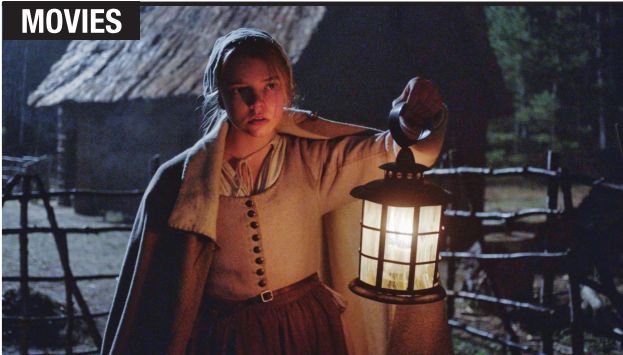
Likely to disappoint hardcore horror fans, Robert Eggers’ The Witch is a thinking-person’s fright flick, a work that has more to do with the stories of Nathaniel Hawthorne than anything that might have happened in the Blair Woods. There’s little in the way of gore at play here, as the writer/director is much more interested in the monsters that come to roost within us, those spawned by fear, ignorance and insecurity, all of which have a far greater impact than any composed of flesh and blood.
The setting is New England, circa 1630. A family, led by William and Katherine (Ralph Ineson and Kate Dickie), is banished from an established settlement, forced to make it on their own in the wilderness. The reason for their exile is kept purposely vague but the way in which the clan worships God seems to be at the root of it. Quickly building a modest home and farm area, the family settles in but not before William reminds his children – eldest daughter Thomasin (Anya Taylor-Joy), his son Caleb (Harvey Scrimshaw) and the twins Mercy and Jonas (Ellie Grainger and Lucas Dawson) to stay clear of the woods that border their home. They manage to follow this order, that is, until the woods visit them, as something takes baby Samuel while he’s in Thomasin’s care and flees back to the confines of the forest.
Thomasin and Caleb give pursuit and the trouble begins. Separated, the young woman manages to find her way home while the boy encounters something that will ultimately alter all of their lives. While initially a joyous occasion, Caleb’s return to the farm ultimately ignites a crisis of faith in everyone, with doubt growing more quickly in some than others, as false accusations hurled among the family members undercuts the sense of unity they’ll need to survive.
If there is a fault in the film it’s that Eggers employs a very long fuse where the film’s revelations are concerned. To be sure, he does a masterful job creating an authentic sense of place and fostering an ever-increasing sense of dread; however, the pay-off to all of this comes a bit slow and may frustrate those used to the usual beats a horror film employs. However, for patient viewers, a much richer experience is to be had as the themes Eggers tackles are as timely today as they were during the film’s setting. Paranoia and doubt end up pitting parents and children against one another, tearing apart not just the family but destroying the moral code each of them clings to.
All relative unknowns, the core members of the film’s cast all do exceptional work here, each fully buying into the movie’s premise. While the roles of the twins might be seen as minor, young Grainger and Dawson accord themselves well, giving realistic turns as the mercurial siblings while Scrimshaw provides a show-stopping moment as Caleb attempts to get his bearings after returning from the woods. Ineson and Dickie bring a lived-in feel to the relationship that exists and then deteriorates between husband and wife, while Taylor-Joy proves to be a young actress to watch as she captures to perfection the initial fear and ultimate ecstasy of leaving her childhood behind in order to become a woman.
One of the most powerful aspects of The Witch is the way it stays with you. A handful of Eggers’ shots – particularly one featuring a single character walking into the woods at film’s end – stay with you long after the film ends, haunting the viewer not simply with their aesthetic beauty but their thematic implications as well. This is what makes a horror film truly effective – not the sudden, momentary scares they contain, but the thoughts they plant in your mind, taking root and wheedling away at you as those fears displayed on screen are ones you harbor as well. The Witch proves to be a film of such power and as a result, refuses to be brushed aside like so many disposable features that are common to the genre.


