
As time for cooking disappears, Blue Apron appears
Cooking skills were once passed on from generation to generation through the oral tradition. The post-war years saw an increase in women working outside the home and an increasing reliance on convenience foods. My mother often served Swanson’s TV Dinners (I hated the Salisbury steak and carrots!), or a sack of McDonald’s hamburgers and fries my father had picked up on his way home from work.
My wife, on the other hand, grew up in the family kitchen, helping her grandmother and mother make meals from scratch, often with the vegetables and poultry raised by her grandfather. Her experience stood in stark contrast with that of the vast majority of our fellow baby boomers.
It is no secret that our reliance on fast food chains and processed foods has resulted in a sharp increase in health problems such as obesity and diabetes. Recent years have seen a dramatic reversal of this trend, as consumers increasingly seek out wholesome, preferably local, foods. As community farmers markets and CSAs proliferate, McDonald’s stock plummets. Yet, turning that box of farmfresh produce into meals requires both time and know-how. Even the most skilled home cooks struggle to make the time to cook a wholesome, from-scratch dinner, given parents’ and kids’ busy schedules.
Believe it or not, even in the Glatz house, we frequently had to eat on the fly during the years when my wife and I were both working in addition to shuttling our three kids between piano, soccer, chorus and horseback riding. (Confession: at least once a week our family meal consisted of spaghetti – or Kraft Macaroni and Cheese – topped with canned Chilli Man chilli. I can feel my late wife kicking me under the table for revealing this.)
Thus, our modern-day dilemma: how to provide our families with nutritious and appealing meals economically, on a short time frame, and often with minimal culinary training.
Given our need for speed, why not provide nutritious fast food, which supports local agriculture? If time is an issue, why not apply the Amazon.com model to grocery shopping? What if we were to eliminate the time it takes for meal planning and shopping, and have exactly the right amount of ingredients delivered to our doors with concise preparation directions?
St. Louis’s Gerard Craft is a James Beard Award-winning chef. He earned his accolades at the helm of Niche, a fashionable highend restaurant. He is also a family man. In an interview in the St. Louis Post Dispatch, he stated: “Although I’m a chef, I’m a really, really busy chef. We don’t get to cook at home as much as we want. We end up going to Chipotle.” “People are two things: really busy and really strapped for cash. Affordable options are hard to come by.” He feels “the future really is upscale chains.”
His new restaurant is Porano, a “fast casual” restaurant based on the
Chipotle concept; diners choose from five bases, eleven sauces, five
protein/vegetables and eleven toppings. In “The Eater,” Craft explains:
“The thing I really like about this food is that it’s still cooking.
We’re still doing all the sauces the same way we do for any restaurant
we open. The only thing ‘fast’ about it is the service.” As with his
other restaurants, Craft partners with local farmers for his meats and
produce. His entrees are under $10. Porano even offers Uber delivery.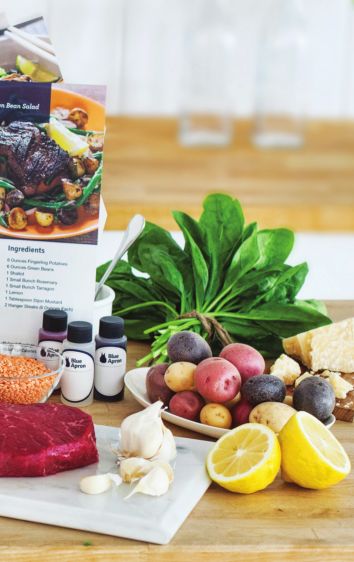
For
those who want to cook at home, despite a scarcity of time, online
shopping and home delivery is an option. Local retailer Hy-Vee offers
online ordering and free home delivery for orders over $100. Online
shopping is also a way of sourcing ingredients that may be hard to find
from local retailers. I recently needed pink peppercorns for a recipe. I
unsuccessfully searched three local stores. I was able to obtain them
from Amazon.com with overnight shipping.
Taking
home delivery a step further is Blue Apron. Blue Apron was founded in
2012 and is based on the CSA model. CSAs (“community-supported
agriculture”) provide subscribers boxes of fresh, seasonal produce and
meats on a regular basis. CSAs can help make the family farm viable and
are a wonderful resource for people who have the time and knowledge to
cook homemade meals. However, if you don’t know how to prepare mustard
greens, or if you are simply busy, your weekly box might go to waste.
Blue
Apron (as well as its main competitor, Plated) seeks to eliminate the
waste and bridge the knowledge gap. Subscribers receive weekly shipments
of everything needed to prepare family meals, along with detailed
instructions. According to Forbes, Blue Apron delivers 5 million
meals a month. Their revenue is expected to triple over last year’s.
Last year Blue Apron had contracts with 133 mid-sized family farms. It
has attracted prominent chefs to work on recipe development. Its
culinary managers include two chefs who have previously worked at New
York’s top-rated Michelin-starred restaurant Per Se.
Jacksonville
native Thad Morrow, ownerchef of my favorite Champaign restaurant,
bacaro, recently moved to New York to join the culinary staff. Explains
Morrow: “It was definitely a very tough decision to leave bacaro, my son
and my friends to take my new role as director of wine at Blue Apron.
But the idea of working with a company that is working to inspire people
all over the U.S. to learn about cooking and wine was very compelling.
When I found myself cooking Blue Apron meals at home with my son I knew I
had to take the leap. The idea that we can get people cooking at home
again with great ingredients that are fresh and sustainably sourced is
an extension of what I tried to do at bacaro. I joined Blue Apron
because we had a shared goal: get people thinking about where their food
comes from, and get them to experience the beauty of cooking and
enjoying wine with friends and family.”
Blue
Apron takes shopping and meal planning out of the equation. The only
outside ingredients required are salt, pepper and oil. Blue Apron
eliminates waste. All ingredients are measured and bagged. No longer
will the unused half head of Napa cabbage wither in the refrigerator.
Blue Apron provides an international culinary education of sorts.
Current offerings include Trinidadian Chicken Curry (with Coconut Grits
and Collard Greens) and Sumac-Roasted Sweet Potato and Farro Salad (with
Pickled Onions and Hazelnuts). The Blue Apron website features an easy
signup process. Subscribers can choose from a two-person option
(ingredients and recipes for three meals a week for $59.94) or a family
plan (two or four meals per week for four persons for $69.92 and
$139.84.) Shipping is free, weeks can be skipped and the subscription
can be canceled at any time.
Accompanying
convenience, however, is the environmental impact of packaging and
transportation. Money spent on meal kit subscriptions is pulled out of
the local economy. And according to fastcompany. com, if people “don’t
move past the meal kits, there is a distinct possibility that many of
our family’s food traditions will end with us and instead will be
decided by a well-meaning executive chef in an industrial kitchen.”
My
wife once put together a business plan for a daily home-cooked dinner
pickup/ delivery service she would call Nana’s Kitchen. In the end, we
decided it would require more energy and business acumen than we
possessed. Instead she became the Illinois Times food columnist.
Peter
Glatz, a Chicago native, spent his summers during college and dental
school in Springfield working on his in-laws’ 20-acre organic produce
farm.


