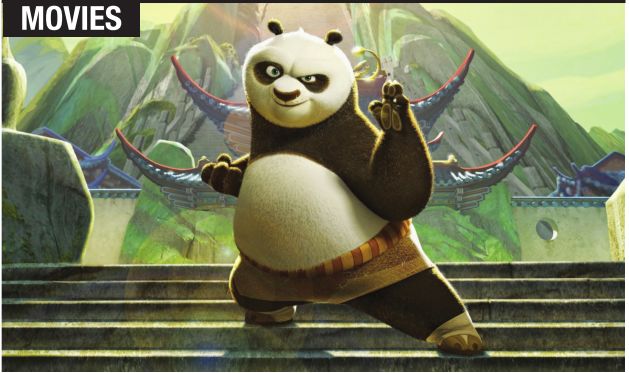
By the time the third entry in most film franchises is released, much of what made the movies in question distinctive and fresh has gone by the wayside. There’s a labored quality to what’s on the screen, and what was once inspired has become an exercise in “been there, done that.” Dreamworks’ Kung Fu Panda 3 proves to be a pleasant, surprising exception to this rule. A fun, vibrant sequel that’s the perfect counterpoint to the darkly themed second entry, this series shows no sign of slowing down, as the tale of martial arts master Po takes an unexpected turn rife with possibilities.
Things get off to a rousing start as we see the wise tortoise Master Oogway (voice by Randall Duk Kim) preparing for a wellearned rest in the netherworld known as the Spirit Realm. Alas, his respite is not to be, as Kai (J.K. Simmons), a yak with an attitude and self-esteem issues, defeats Oogway and steals his Chi, something he’s been doing for quite some time in the Spirit Realm, having defeated thousands of other noble warriors and stolen their powers as well. There is a method to Kai’s madness, as he needs all of this Chi to escape to the mortal world where he will track down Po (Jack Black), who the fates have said will better him.
This is the last thing our beloved blackand-white warrior needs. Master Shifu (Dustin Hoffman) has dubbed him the new teacher of the Furious Five – as always Tigress (Angelina Jolie), Monkey (Jackie Chan), Viper (Lucy Liu), Mantis (Seth Rogen) and Crane (David Cross) – and if that weren’t enough of a change, he’s just been reunited with his biological father, Li (Bryan Cranston). This, of course, does not sit well with his adoptive father, Mr. Ping (James Hong), who comes to feel more abandoned when Po informs him that he’ll be traveling with Li to visit a secret mountain refuge, the location of the village of his birth.
The script by series vets Jonathan Aibel and Glenn Berger is great fun as it turns many franchise conventions on their heads. Once he meets the panda village, Po is encouraged to eat, eat and eat some more, avoid exercise and not get out of bed until well past noon. A great deal of the series’ success and our continued affinity for Po is due to Black’s exuberant vocal rendering of the character, and he’s obviously having a grand time here. As Po revels in his newfound life of sloth, the actor brings the necessary enthusiasm and then some, making it easy for us to share in his happiness.
However, there’s more at play here than elaborate physical gags – most of which succeed to great effect – as Po is forced to find his true path and master his own Chi, as he knows Kai will ultimately find him for their ultimate throw down. Not only must he integrate his newfound panda skills with all that Shifu has taught him but he also must come to terms with all he’s experienced and learned from both of his fathers. Only by finding a sense of harmony between all of these aspects in his life will Po be able to realize his true potential.
Obviously, this is hardly a fresh premise but it’s all pulled off with such imagination and wit, it’s likely that audiences are apt not to care. As directed by Jennifer Yuh and Alessandro Carloni, the animation on display is of the same quality as parts one and two. There’s a beauty and fluidity to this series that makes it stand out from other films of its ilk, while the imagination used in staging the elaborate fight sequences is such that they require repeat viewings in order to appreciate all that’s on display. After the success of the first Panda in 2008, Dreamworks announced that was the first in a series of six films. At the time this seemed overly ambitious, yet with the consistent quality of these movies, I’m more than eager to stick with Po on his journey to enlightenment.
Contact Chuck Koplinski at [email protected].