When sleep is elusive, consider sleep hygiene
You’re lying in your nice cozy bed at night, covered in flannel and down, surrounded by quiet and darkness, a spouse snoring contentedly by your side and somehow still sleep won’t come. The digital clock stares you down – a confrontation with red numbers the diurnal world doesn’t usually see: 2, 3, 4 AM. What do you do?
First of all, you’re not alone. According to the New York Times, up to 30 percent of adults experience insomnia at one time or another. Acute insomnia is short term, brought on by novel life stress – financial/ career difficulties, relationship problems, changes in environment or schedule. It subsides when the problem does. Chronic insomnia, on the other hand, is sleeplessness or disrupted sleep three or more nights per week. It leads to problems in the daytime, such as lack of productivity at work. Though its causes are more complex, it is associated with chronic pain, clinical depression or anxiety, sleep apnea and the side effects of some medications. It can last long after the precipitating event (a job interview, relationship conflict, etc.) is over.
In order to form and sustain healthy sleep habits, the Ceneters for Disease Control recommends attending to “sleep hygiene.” This kind of hygiene goes beyond brushing, flossing or exfoliating; sleep hygiene means performing consistent routines and rituals before bed and making your environment conducive to sleep. Experts suggest thinking of sleep as a continuum, not a switch.
Wannabe sleepers should start with relaxing activities – for many that means reading or taking a bath. Some may need to release excess energy or tension by doing some light exercise or yoga. It is important to create a routine that is relaxing for you particularly – I for one have always found baths boring and tedious; I am much more apt to relax if I am doing something. Like taking an evening walk. Or drinking a glass of wine. However, though alcohol can relax people temporarily, more than one drink often leads to disrupted sleep
later on. We are also warned to stay away from caffeine, including
chocolate, late in the day. Lights should be dimmed before bed and
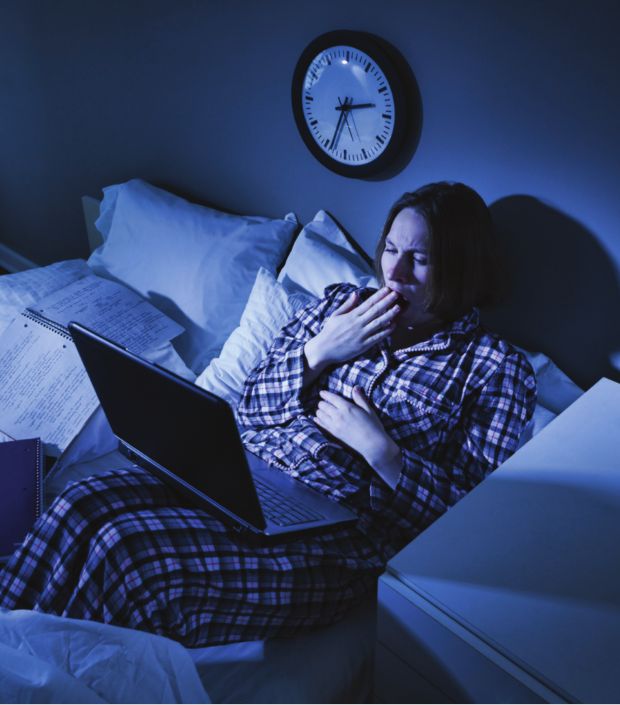
phones and laptops put away. Both interfere with the production of
melatonin, the hormone which prepares us for sleep.
Using
your bed only for sleep or intimacy will help you make soporific
associations – so cut out the work emails and Facebook. Keep your
bedroom dark, quiet (or use white noise if you prefer) and on the cool
side. Most of us have heard these suggestions before. But when we’re
losing sleep, we’re more likely to look for a pill than to try these
more proven, less expensive, less potentially addictive solutions. Why?
“People
often don’t want to do the work,” says Dr. Joseph Henkle, medical
director of the Sleep Lab at SIU School of Medicine in Springfield. When
it seems that those around us sleep so effortlessly, it can feel silly
or indulgent to put time and energy into forming our own healthy sleep
habits. But what investment could be more worthwhile? Dr. Henkle finds
that society undervalues sleep. If we prioritize it, he says, we will be
happier and more productive with a better quality of life.
Patients
who enter the sleep lab at SIU are mostly there because of problems
with sleep apnea – Dr. Henkle, a pulmonologist, estimates it accounts
for 90 percent of cases. This can be treated with medical interventions.
Other common medical causes of disrupted sleep are lung disease, heart
palpitations, fibromyalgia or thyroid or endocrine disorders. When
people come in with chronic insomnia that is not explained by a medical
condition, a sleep history is taken and problematic factors can be
examined. Patients are educated about and encouraged to eliminate
caffeine and nicotine (a stimulant) close to bedtime.
“We
are interested in changing behavior so that sleep is more likely to
come,” says Dr. Henkle. Obviously, sleep is not something that can be
guaranteed, no matter what changes a patient makes. “The harder we try,
the worse we make it. We just want to give patients some control.” When
insomnia is a long-term problem, people become fearful. Dr. Henkle
suggests setting your alarm and then turning your clock around so that
you don’t fixate on the hour. If your mind is racing when you’re lying
in bed, and you’re not able to calm down, he recommends getting up and
doing something boring – something not too stimulating for your mind or
body. So probably not reading self-improvement books about changing your
career or being a better parent. Maybe not marching in place trying to
meet your Fitbit goal. Note to self: something more monotonous. Then
when you start to feel sleepy, go back to your bed, don’t conk out on
the couch.
When I sign
off with Dr. Henkle, he leaves me with a greeting that so many
insomniacs would love to embrace, if only it were within reach: “Sleep
well.”
Contact Ann Farrar at [email protected].