I’ve long been ambivalent about New Year’s Eve celebrations. My parents and grandparents always threw a party, but it was far from a drunken debacle. To the best of my knowledge, alcohol was never served. Still, silly hats, noisemakers and other celebratory accoutrements abounded. The TV was inevitably tuned to catch the ball dropping in New York’s Times Square – midnight on the East Coast, but an hour before here. Which, of course, intensified the clock countdown for our own hourlater celebrations.
My mother tells me that as a toddler I’d stay up until the last guests had left and then awake as usual in the early hours of the morning. It wasn’t until I had children of my own that I fully understood how annoying that must have been.
But my earliest memories of New Year’s Eve celebrations are different. After I’d gorged myself on my mom’s classic 50s devilled dogs and her Swedish meatballs as well as the other goodies on the endless stretch of Nana’s dining room table, all I really wanted to do was to escape the party and isolate myself in my room. Not to be anti-social, but to reflect on the year past and think about the future. That may sound stuffy and/or pretentious, but it really was my mindset.
When my husband, Peter, and I first became a couple, my New Year’s Eve expectations changed again. Neither of us were enthusiastic about raucous New Year celebrations. We dreamed of a small log cabin in an unspecified wilderness. There’d be a light snowfall visible through the windows and a rustic, roaring fireplace with a plush rug in front of it. On the coffee table would be a bottle of warming wine, some artisanal cheeses and rustic bread… Well, I’m sure you can figure out the rest.
Sadly, that dream never materialized, though we still have hopes for the future. And as our three children matured, New Year’s Eve for Peter and me focused on keeping them safe and close to home.
Regardless of what kind of New Year’s Eve celebration you experience, I think New Year’s Day is best spent relaxing and refreshing yourself.
For some, that inevitably includes football. In my family it was all about watching the Rose Parade. Regardless, I like to make New Year’s Day meal preparation as simple as possible, as long as there aren’t too many pre-fab preparations or ingredients. That way, the
cook(s) can also have a fun, relaxing and delicious time. Eating legumes
(beans, peas, lentils, etc.) on New Year’s Day is thought to bring good
luck in more than a few countries and cultures. Nothing could be easier
or more delicious than a pot of beans on the stove flavored with onion,
garlic and herbs, perhaps enriched with smoky bacon or that Christmas
ham bone, simmering slowly as the enticing scent fills the house.
Or
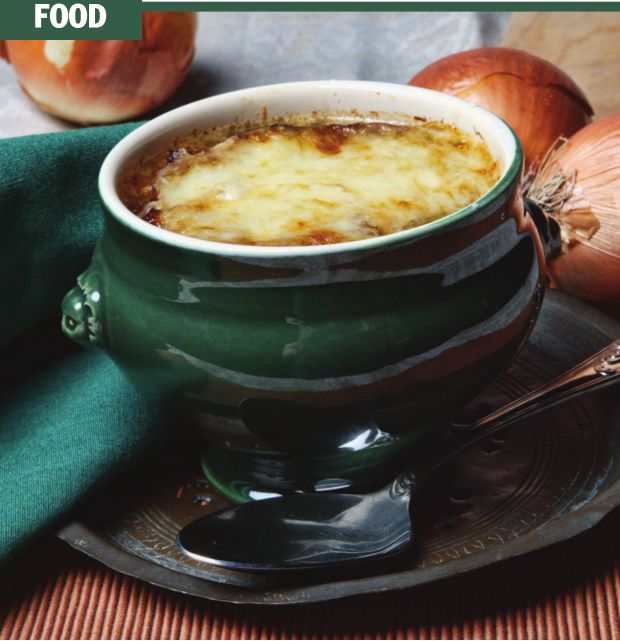
how about an equally enticingly fragrant pot of soupe à l’oignon
gratinée, aka French onion soup? In France it’s long been considered a
hangover remedy, something that late evening/early morning stragglers in
Paris’ Les Halles district would consume before stumbling into their
own beds for a few hours.
This
is probably my oldest recipe except for those inherited from my mother
and grandmother. When Peter and I were undergrads at UIUC we spent far
too much of our meager student budget in a tiny shop that initiated us
into the world of artisanal cheeses. One early, winter day there was a
woman – a real French woman! – handing out samples of soupe à l’oignon
gratinée. I’d had bowls of Americanized versions. They were good – it’s
pretty hard to screw up melted cheese on a big crouton, even if the soup
itself came from a box or can – but this was in a different league
altogether.
I learned
later that virtually all traditional French recipes for soupe à l’oignon
– gratinéed or not – call for beef or chicken stock. But the French
woman relied exclusively on cooking the onions very low and very slow
until they were richly caramelized. So no, it isn’t something that can
be made in minutes. Still, it doesn’t require much effort from the cook.
The onions do the work, only needing to be stirred occasionally as they
caramelize.
Over the
years I’ve made versions with various stocks. But I always come back to
this recipe I learned in a tiny cheese shop in Champaign long ago. There
is none better.
Soupe à l’oignon gratinée French onion soup
• 8 T. (one stick) unsalted butter
• 6 lb. yellow onions, not super-sweet, peeled and thinly sliced
• 2 T. fresh or 2 tsp. dried thyme leaves (do not use ground thyme)
• 1-2 T. red wine or sherry vinegar
• 2 bay leaves
• 1 c. dry white wine
• 10 c. water
• Salt and freshly ground pepper to taste
For the gratinée:
• 1/4 c. (approximate) coarsely grated Gruyère or French Comté or other natural Swiss-type cheese per serving.
•
1 slice French or Italian type bread per serving, approximately
3/4-inch to 1-inch thick, cut to fit inside the soup bowl. The bread can
be fresh or slightly stale, but shouldn’t be rock hard. Trim the
crusts, or not, as you prefer. In a large skillet (or two smaller
skillets), melt the butter over high heat. Add the onions, thyme,
vinegar and bay leaves and stir to coat the onions with the butter.
Cover the skillet and reduce the heat to medium high. Let the onions
“sweat” for about 10 minutes, stirring occasionally if necessary or
until they are softened and translucent.
Uncover
the skillet, stir the onions to scrape up any browned bits on the
bottom, and reduce the heat to low. Cook the onions, stirring
occasionally, until they are dark, caramelized and gooey. This will take
at least 45 minutes and probably more than an hour.
Put
the onions into a large pot and return the skillet to the stove.
Increase the heat to high, add the wine and bring to a boil, scraping up
the browned bits on the bottom to deglaze the pan. Add some of the
water if needed.
Pour
the wine deglazing mixture into the pot with the onions, add the
remaining water and bring to a boil. Reduce the heat to a gentle simmer,
cover, and cook for at least 30 minutes to combine the flavors. Season
to taste with salt and pepper (and a little more vinegar if you like).
The soup may be prepared ahead of time up to this point – in fact, it
actually improves the flavor to let it stand for a while. Bring the soup
to room temperature by placing it in a sink full of cold water and then
refrigerating it if you are holding for more than an hour or two.
Remove the bay leaves and reheat the soup if necessary.
To finish the soup: Preheat the broiler.
Ladle
the hot soup into deep ovenproof bowls, leaving about 1/2-inch space.
Place a slice of bread on top of the soup and push it carefully and
gently a little bit into the liquid. The bread shouldn’t be completely
submerged, just moistened on the bottom.
Sprinkle the grated cheese generously over the bread. It’s OK if some of the shreds of cheese hang a little bit over the sides.
Place
the bowls on a baking sheet (this helps prevent tipping and spills) and
place under the broiler. Broil until the cheese is melted, bubbly and
just beginning to brown. Carefully remove the bowls from the broiler,
using hot pads. (Remember, the bowls are hot.) Place each bowl on a
plate and serve immediately.
Serves 6-8 as a main course, 12 or more as an appetizer.
Contact Julianne Glatz at [email protected].


