Ghost writers
Dead poets are better remembered in books than buildings
DYSPEPSIANA | James Krohe Jr.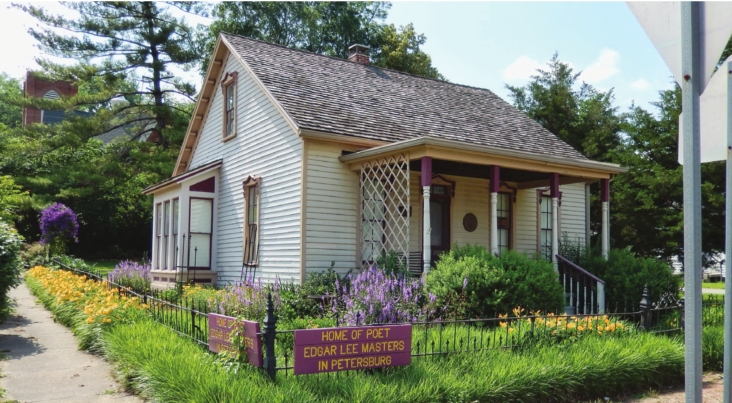
The only class of people less happy to confront dead writers than high school sophomores are probably mayors. Dead writers cause more trouble in their hometowns than even the most factious of them ever do when they are alive. Over in Petersburg, I hear, there’s a fuss about what to do about the boyhood home of Edgar Lee Masters, whose Spoon River Anthology made him famous and Petersburg and Lewistown notorious. The town owns the house, but few tourists come to see it and the mayor doesn’t see why the town ought to spend money to make a few tourists happy that could be spent making voters happy. In the meantime, the house is closed to the public during this, the 100th anniversary of the publication of Masters’ most famous book.
The Masters house in Petersburg is only one of the buildings associated with the lives of mid- Illinois’ literati that have been preserved. Almost all were once threatened with demolition or neglect; almost all were saved because a zealot mobilized townspeople to preserve them. Springfield’s Vachel Lindsay house had Elizabeth Graham, for example, just as Carl Sandburg’s birthplace in Galesburg had Mrs. Adda George. Such people don’t just care – they care a lot. When her research revealed the location of Sandburg’s birthplace, Mrs. George installed a boulder on the lawn and a plaque by the door; she did these things without the permission of the Italian woman who owned and lived in the house. “The woman sometimes hid the plaque and often tried to roll away the boulder,” wrote George. Imagine.
Illinois continues to rely on local volunteers to wage these fights against oblivion. This is not wise, especially in the case of artists. In an Illinois town, the constituency for dead poets is only slightly larger than the one for
live poets. The only time the math works out is when a public official
can claim – usually by resort to dubious math – that the town will earn
back in tourism what it spends on preservation.
This
rather haphazard approach to preservation means we risk losing things
that arguably ought to be saved. Floyd Dell is a more consequential
figure than Masters as both a writer and editor, but as far as I know
there is no historic site associated with Floyd Dell in either Barry or
Quincy, the communities in Pike and Adams counties, respectively, where
he spent much of his youth. Worse from a financial perspective, we also
risk spending what little money we have on things that don’t deserve to
be saved.
Because of the way that the present so inconveniently keeps
becoming the past, we will continue to confront these controversies. The
house in Lincoln that figured prominently in the novels and family
history by William Maxwell still stands because it is still lived in;
the present owners in 2002 consented to the installation in their front
yard of a plaque explaining its significance, which I call civilized,
but enlightened homeowners don’t live forever either. Nor is it likely
to be long before some jobs creator will propose to turn one of the
houses in Champaign and Urbana and Bloomington lived in by David Foster
Wallace into a Taco Bell.
If
one accepts that the sites attached to the lives of major writers,
architects, musicians and thinkers ought to be preserved for the
public’s edification, who decides who is major? At the local level, such
decisions are the result of enthusiasts arguing with aldermen; such
discussions seldom remind one of Socrates. At the state level, as
Petersburg learned in 2001, the legislature or governor decided which
sites merited saving, not the professionals of the IHPA. At every level,
the crucial criteria are fame in a given field – celebrity, in other
words – and potential as a tourism draw.
As
a sort-of writer I inclined to be generous toward memorializations of
other poor wretches in the trade, but I sympathize with mayors in these
matters. A town can’t afford to keep every old house standing because
someone who used to be famous lived in it. (Although how many towns have
more than one or two?) And I have to admit that I’m not sure what
visitors can learn from their childhood homes, which are distinct from
others of their period and class. The best thing that Petersburg could
do to remember Masters would be to ensure that the schoolchildren of
Petersburg learn about their famous compatriot. Better that writers live
in the heads of their townspeople than that their ghosts be housed in
museums.
Contact James Krohe Jr. at [email protected].
Editor’s note
It
is a relief that Gov. Bruce Rauner has, at least for now, backed off
from his bad decision to lay off the staff of the Illinois State Museum,
but it’s crazy that he hasn’t backed off his bad decision to close the
museum to the public. (See Patrick Yeagle’s report, “Illinois State
Museum closes to public,” p. 8.) So now we have loyal employees working
inside a closed museum, dusting the dioramas we suppose. The Rauner
reprieve apparently doesn’t cover the museum’s non-union top
administrators, who will lose their jobs through no fault of their own.
As museum board president Guerry Suggs says, the situation “makes no
sense.”
Several
friends have asked why Illinois Times is suing the governor over his
appointment calendar, implying that the move seems uncharacteristically
rude. In his commentary on p. 10 (“Suing the governor”), Bruce Rushton
explains that even though the attorney general has ruled that the
governor’s calendar is public information, the Freedom of Information
Act has no good enforcement mechanism. So going to court, where “it is
better to be a plaintiff than a defendant,” is an attempt to clarify the
public’s right to know.
This
week Illinois Times welcomes Lisa Ellis to our staff as associate
publisher. Lisa, who lives in Chatham, comes to IT with years of
advertising and marketing experience in the Springfi eld market. For 12
years she was at Illinois National Bank, where she was director of
marketing. Most recently she operated her own marketing, communications
and public relations fi rm. She replaces James Bengfort, who has been
IT’s associate publisher. He leaves this week to take the associate
publisher position at Oklahoma City Gazette, where he will be closer to
family and his roots. Farewell, James, and thanks for the past three
years. –Fletcher Farrar, editor and publisher


