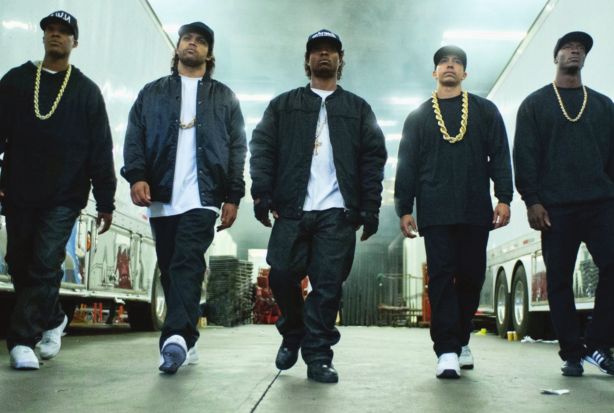
If F. Gary Gray’s Straight Outta Compton does anything right – and, for the record, it only errs in soft-peddling the private lives of its dynamic characters – it’s that it accurately depicts the seismic impact NWA’s music had on the culture of the 90s. Brimming with life, energy and anger, the driving beat of the group’s reality raps is the soundtrack of their lives as well as a generation, during a time where authority was questioned and words were as dangerous as a loaded pistol. The sense of unaffected emotion that’s so prevalent in NWA’s work serves as the foundation for this effective biopic, one that concentrates on the most important thing in these young men’s lives: their music.
While their story may play like a collection of clichés, with Ice Cube, Dr. Dre and Eazy-E’s widow, Tomica, serving as its producers, one assumes that there is some validity to this tale of the group’s rise, or at least their version of the truth. From the same crime-riddled neighborhood, the future members of NWA each provided a key component to the group’s dynamic. Cube (O’Shea Jackson Jr.), a natural poet and master of rhymes would provide the words that would help pave their way to success while Dr. Dre (Corey Hawkins) mixed sounds, scratched on turntables and learned the ropes that would serve him well as a producer. Drug dealer Eazy-E (Jason Mitchell) would use his ill-gotten gains to good use and bankroll the group as well as start the record label Ruthless Records, while MC Ren (Aldis Hodge) and DJ Yella (Neil Brown Jr.) would provide their own voices and words to help form the group’s progressive voice.
As the film plays out, we see these young, united men give voice to the anguish of their peers, much of it fueled by their contentious run-ins with the police as they find themselves victims of racial profiling by the police again and again. Their rise to fame is meteoric, drawing the ire of police forces from around the country as well as the FBI, while their sudden fame proves to be a double-edged sword as dissension takes root within the group, leading to its dissolution as well as fractured friendships.
Again, there isn’t a music career cliché that isn’t touched on here which makes it all the more regrettable that Gray and his producers weren’t willing to dig deeper and present NWA’s story warts and all. Of course, that would mean delving into incidents of domestic abuse perpetrated by Dre, among other things. Gray has said that such side stories would not have “served the narrative,” an approach that prevents the film from being both honest and exhilarating.
More than anything, Compton reminds us that their music is, unfortunately, as timely today as it was when first released. With incidents of police violence on black youth seemingly happening with disturbing regularity, NWA’s voice has become vibrant once more. Then again, their work has never gone out of style – it is timeless because it’s fueled by truth and passion, something that never goes out of style.
Contact Chuck Koplinski at [email protected].


