Yes, I know that asparagus is available in groceries these days pretty much year round, but it’s still something best enjoyed in spring, just plucked as it shoots from the earth in nearby fields. Grocery asparagus that’s been stored for long periods and shipped thousands of miles may be OK to satisfy off-season cravings, but its flavor pales in a taste test against the spears that make their seasonal appearance at farmers’ markets and local farm stands.
Growing up, I ate asparagus every day during its short season from mid-April through June; then it disappeared from the table for the rest of the year. Though it wasn’t explicitly stated, my family’s philosophy was clear: Why bother with something not at its prime, especially when so many other vegetables are coming into their own?
Thick or thin? Some folks mistakenly believe that thin stalks of asparagus are superior to thick, or vice-versa. The truth is that there’s no difference in flavor or tenderness. Thin asparagus isn’t younger; the spears push through the earth at their maximum width, thick or thin. An asparagus bed yields a variety of thicknesses growing alongside each other. That said, there are preparations that work better with one or the other. Anything calling for roasting, or even more so, grilling asparagus works better with at least medium thickness – thin asparagus too easily overcooks or burns. But I prefer thinner asparagus for eating raw. Most important is that asparagus in any given preparation are similarly sized, unless they’re puréed for soup or a sauce such as the one below. Professional chefs often peel the bottom of asparagus stalks. To me – especially for home cooking – it’s a fussy and unnecessary extra step.
My mother and grandmother prepared asparagus in just two ways: creamed over toast or poached and then dressed with browned butter. Later my mom made a radical departure from tradition: thinly sliced raw asparagus as a springtime component of her renowned salad. It was pretty much a kitchen sink creation: iceberg lettuce, different cheeses, salami, ham, hardboiled eggs, peppers, scallions, croutons and more, tossed with Good Seasons Italian vinaigrette. In addition to the asparagus, in spring she also added handfuls of violets, which never failed to intrigue guests. Mom’s salad was so popular that when she’d invite friends to dinner, they anxiously ask “Are you going to make your salad?” I still prepare asparagus almost every day when it’s in season. Occasionally I make classic creamed asparagus on toast. (Incidentally, my family’s version doesn’t contain cream; the sauce is made with the asparagus cooking water.) But over the years I’ve tried dozens of different preparations. Some were classic, some innovative and/or experimental; others gleaned from cookbooks or friends. A few have become part of my own asparagus ritual, recipes I have to make at least once each spring. Here are three, as well as an easy method to remove asparagus’ woody ends.
To
remove asparagus’ woody ends: Hold the asparagus stem upright in your
left hand (or the right, if you’re lefthanded) and gently bend it down
sideways until it breaks off. It will break at the tough/tender
juncture.
The butter,
lemon and Parmigiano-Reggiano in this pasta sauce showcase asparagus’
flavor without overwhelming or competing with it. It’s a snap to make,
taking less than 30 minutes from start to finish. Wonderful as a main
course, it’s also good as a first course or side dish. This sauce works
well with several different kinds of pasta, from linguine and gnocchi to
dry pastas such as penne and farfalle (bow ties), but my favorites for
this are orecchiette sometimes spelled “orechiette”) and campanelle.
Orchiette means “little ears.” Campanelle means belllike flowers.
Orchiette, thumb-sized cups and the ruffle-edged, curled campanelle are
ideal for absorbing and holding sauce. Both are available at the Italian
Food Mart, 416 E. Monroe, and Boccardi Italian Imports, 3132 Cockrell
Lane.
Pasta with asparagus and lemon
• 1 1/2 lbs fresh asparagus
• 6 T. unsalted butter, divided
• 1 T. grated lemon zest
• 1 T. fresh lemon juice, or more to taste
• 1 c. freshly grated Parmigiano-Reggiano, plus more for serving
• Salt and freshly ground pepper
Remove
the asparagus’ woody ends. Cut into approximately 2-inch pieces,
reserving the tips separately. In a large skillet or wok, sauté the stem
pieces in 4 tablespoons of the butter until the asparagus is just
barely tender. The stems should easily be pierced with a knife; be
careful to not to overcook. Spread onto a platter in a single layer to
cool. Sauté the asparagus tips in the remaining butter in the same
skillet, until barely crisp-tender; they should be more al dente than
the stems. Set the tips aside. Set the skillet aside for finishing the
dish.
Put the stems, lemon zest and juice in a blender or food processor.
Cook 1 pound of dried pasta in salted boiling water until it’s a couple of minutes shy of al dente. Drain the pasta, reserving 1
1/2 cups of cooking water. Add 1/2 cup of the water to the contents of
the blender and purée; add a little more pasta water if necessary.
Add
the remaining pasta water to the skillet; bring to a simmer. Add the
pasta and purée. Cook for a few minutes to incorporate the sauce into
the pasta. You’ll see when the sauce begins to thicken and absorb into
the pasta. Check the pasta to determine when it’s fully cooked. Stir in
the cheese and half the tips; season to taste with salt and pepper.
Place in a serving bowl or individual plates.
Sprinkle the remaining tips on top. Serve immediately with additional cheese alongside.
Serves 4-8.
The following preparations are made with asparagus spears either roasted or grilled.
To roast asparagus: Preheat the oven to 400 F.
Remove
woody ends from similarly sized spears, then brush lightly with olive
oil and/or butter. Place in a single layer in an oven-proof pan or
skillet with tight-fitting lid; sprinkle lightly with salt and cover.
Alternatively, place the asparagus on an aluminum foil sheet large
enough to make a sealed packet.
Roast
until crisp-tender, or until a knife just pierces through. Timing
depends on thickness, anywhere from 5 minutes for very thin stalks to 20
minutes for behemoths.
To
grill asparagus: Brush lightly with olive oil and sprinkle with salt.
Keep tips away from the hottest part of the fire. To avoid the stalks
falling between the grates and for easy turning, skewer several stalks
together in a “raft” with two wooden skewers. Grill just until crisp/
tender.
Polonaise
(Polish-style) denotes a dish topped with butter-toasted breadcrumbs,
grated hardboiled eggs and parsley; other ingredients are optional.
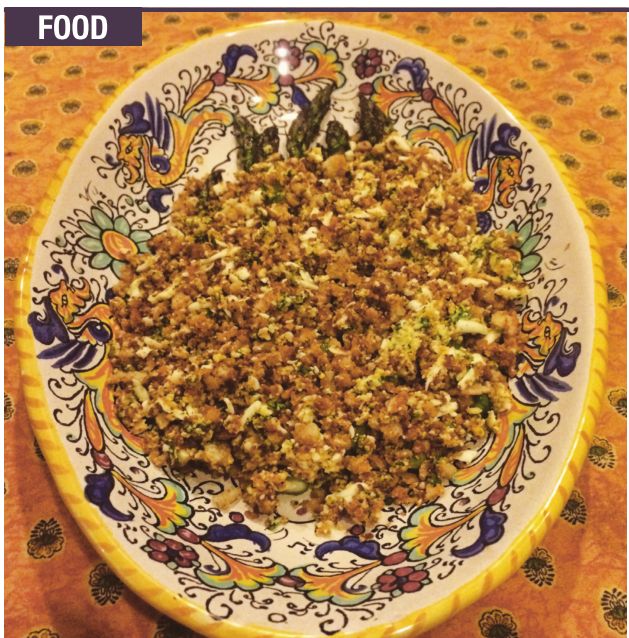
Asparagus polonaise
• For 1–1 1/2 lbs. roasted or grilled asparagus, warm
• 1 large hardboiled egg
• 1-2 T. lemon juice
• 2 T. butter
• 1 c. fresh breadcrumbs
• 1/2 c. Parmesan-type cheese, preferably freshly grated
• 1/4 c. chopped parsley, preferably flatleafed
• Salt and freshly ground pepper
Coarsely grate (or finely chop) the egg and stir in the lemon juice.
In
a medium skillet, melt the butter over medium heat. Stir in the
breadcrumbs, tossing frequently until they’re crisp and golden. Combine
with the remaining ingredients. Place asparagus on a platter; top with
the crumb mixture. Serve immediately, or place under a broiler until
lightly browned.
Milanese
(Milan-Style) denotes breaded and pan-fried meats. But this Milanese
classic diverges deliciously. My husband and I indulge in orgies of
this: double portions for an entire meal.
Per portion:
• Roasted or grilled asparagus, warm
• 1 (2 for an orgy) egg, poached, sunnyside up, or fried with liquid yoke
• Freshly ground pepper
• Parmigiano-Reggiano cheese
Top individual servings of asparagus with an egg. Sprinkle with pepper,
then top with the cheese. It can be grated, but preferably should be
shaved with a vegetable peeler or equivalent.
Contact Julianne Glatz at [email protected].


