
Compassionate response to victims gives them confidence to report
Julia Dixon only knew her attacker a few hours before her exciting new college experience became a nightmare.
It was her second weekend at college, and Dixon, then age 18, was watching YouTube videos with a group of new friends at her dorm. She wasn’t drinking or doing drugs, and she had shown no romantic interest in her attacker.
“It was the most benign social interaction I can possibly imagine,” Dixon recalls.
That didn’t matter. When Dixon went to her room to retrieve some candy her mom had sent, her attacker followed her and raped her in her own dorm room.
On college campuses across the nation, young women face the grim possibility of being raped or otherwise sexually assaulted. A 2009 survey commissioned by the U.S. Department of Justice revealed that 19 percent of women enrolled in undergraduate studies in the U.S. had been sexually assaulted or had been the victim of an attempted sexual assault. Considering that more than 8.6 million women attended undergraduate programs in 2013, it’s possible to extrapolate that roughly 1.6 million women in college were victims of sexual assault that year.
However, one would never know that from looking at the crime statistics gathered by colleges. The U.S. Department of Justice estimates that less than 5 percent of campus rapes or attempted rapes are reported by victims to law enforcement, and most colleges in Illinois and around the country report only a handful of incidents each year. Many report none. Although the federal government provides some guidance on handling sexual assault cases, schools often find it confusing, leading to uneven application. As a result, victims may be uncomfortable reporting their experiences and unsure about their rights and choices.
State lawmakers are considering legislation to help change that. A bill to standardize how schools handle sexual assault cases passed the Illinois House in April with strong support. The measure is aimed at combating the culture of rape that shames victims and too often fails to hold perpetrators accountable.
In Dixon’s case, she reported her rape to the local police department and submitted to a rape kit, the standard evidence collection procedure following a rape. She assumed the police would deal with her attacker and he would be out of her life within a couple of weeks. In reality, it was 20 months before she could begin to put the incident behind her. During that time, her attacker was free and continued attending the same university.
“I had no control over what he did during that time,” Dixon said. “I was trying to act normal and spectacularly failing at it. For me, it was almost two years of fear.”
Dixon’s attacker was eventually arrested and held accountable for his crime, but instead of being charged with rape, he pleaded guilty to a lesser crime and received a light jail sentence. He wasn’t required to register as a sex offender. Still, Dixon says that’s more justice than most victims receive. She says only two percent of rapists end up serving time.
In retrospect, Dixon wishes she had known about her rights, like the right to change her housing situation and the right to have a confidential adviser walk her through her legal options. Those rights are granted under Title IX, the federal anti-discrimination law for education, but many schools around the nation don’t follow the law. Dixon’s school wouldn’t even let her take her meals to her dorm room to avoid her attacker. She says she chooses not to publicly name the university – a public school in Ohio – to avoid giving the impression that the problem of sexual assault is confined to only certain schools.
Rolling Stone’s now-infamous story about “Jackie,” a pseudonym for a woman who alleged she had been repeatedly raped during a fraternity party at the University of Virginia, raised the issue of campus sexual assault to new heights of uncomfortable visibility in 2014. The magazine didn’t fully investigate Jackie’s claims in deference to what the author believed was a victim of a heinous crime, so when many details of Jackie’s allegations turned out to be implausible, it reinforced commonly held beliefs about rape victims making up stories for attention. Still, the story prompted several online commenters to share their own stories of being sexually assaulted at UVA and having their complaints brushed aside by the school.
Those commenters’ stories about UVA are hardly isolated to that school. Before the Rolling Stone article was published in November 2014, the New York Times ran
its own story in July 2014, detailing the story of a woman at Hobart
and William Smith Colleges in central New York. The woman in that story
reported her rape to the school, which subsequently found all three of
her alleged attackers – each a member of the school’s football team –
innocent, despite clear evidence of sexual contact and the victim’s
insistence that it was unwelcome.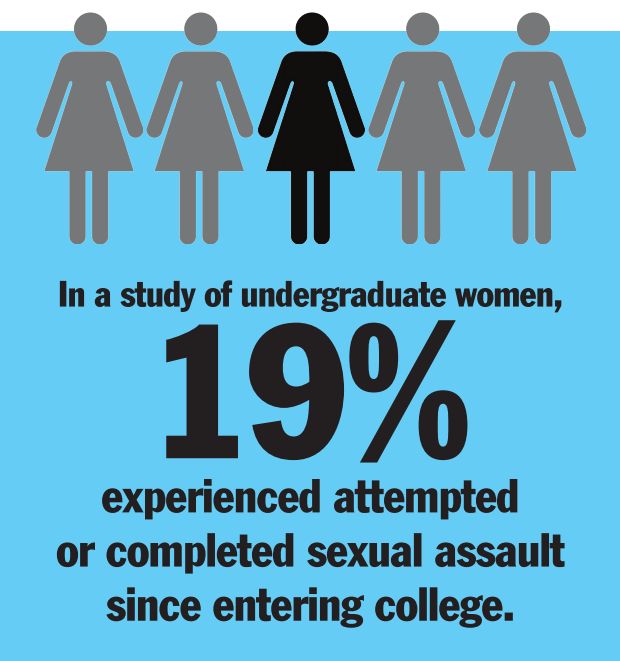
The
U.S. Department of Education announced in May 2014 that it was
investigating whether 55 schools across the U.S. had violated Title IX
by failing to adequately respond to incidents of sexual violence or
failing to provide adequate protections against it. Two Illinois schools
- Knox College in Galesburg and the University of Chicago – are on the
list, which has since been expanded to 108 schools. A school may be on
the list due to a complaint or because of what the Department of
Education calls a “compliance check.” Asked for explanation, a
department spokeswoman sent an updated list of schools under
investigation but offered no further comment.
Under
Illinois law, sexual penetration under force or without consent is
called “criminal sexual assault,” the legal term for rape. It’s a Class 1
felony, carrying a mandatory sentence of between 4 and 15 years in
prison.
Proving rape
in the criminal justice system can be problematic, however. If the
victim wasn’t sober, the accused can claim that the victim consented to
the sex act at the time and has since forgotten. The accused can also
claim that the victim is lying about having given consent out of regret
or that the victim is trying to harm his reputation by spinning
consensual sex as rape. If a victim simply didn’t say “no” or didn’t
physically resist unwanted sexual contact, the accused can claim that he
interpreted her silence as consent.
Illinois
Attorney General Lisa Madigan held three public meetings on college
sexual assault earlier this year, speaking to survivors of sexual
assault and college administrators.
“I
don’t think there’s any question that sexual violence is at epidemic
levels on college campuses,” Madigan said in an interview with Illinois Times. “There’s
been a revolution across the country, because the response by colleges
and universities has been ineffective and devastating. I think we have a
legal and moral obligation to improve our response.”
What
Madigan and her staff found at the meetings is that many colleges are
unclear on their responsibilities regarding sexual assault. The federal
Clery Act requires schools to publish crime statistics and maintain a
daily log of crimes for public inspection, but many of the other
requirements for colleges come from a series of letters and
question-and-answer sheets published by the U.S. Department of
Education. The letters and answer sheets aren’t technically laws, and
many schools find them confusing.
Additionally, Madigan says victims of sexual assault often feel like no one is listening and no one cares.
“Sometimes,
if a school simply responds in a human way instead of a defensive or
even legalistic way, that resolution would occur so much better,”
Madigan said. “There would be a sense of ‘I was heard and provided with
the accommodations I needed, and I was able to move forward.’ ” Madigan
and Karyn Bass Ehler, chief of the civil rights division in Madigan’s
office, used what they learned in the meetings to craft legislation that
clarifies the federal requirements and standardizes how universities
across the state respond to sexual assault allegations.
Rep.
Michelle Mussman, D-Schaumburg, sponsors House Bill 821, which attempts
to provide victims with a safe environment to report incidents and
offer a fair process to investigate those claims. Mussman has worked
with Madigan’s office to shepherd the bill through the House.
Mussman
says women who experience sexual assault may not report it to
authorities for a variety of reasons. Besides the societal stigma that
comes with having been raped, young women may worry about whether
they’ll be believed. Drug or alcohol use can add a layer of uncertainty
in a victim’s mind about how much liability she may have had in the
incident.
“Girls
historically put a lot of blame on themselves,” Mussman said. “They
worry about having someone say they’re (making accusations) for
nefarious purposes, but I can tell you that this is not something
someone would choose to bring upon themselves.”
Julia
Dixon says she chose to report her rape because she didn’t know what
else to do. She understands why other victims choose not to report,
however.
“I am a piece
of evidence; my body is a crime scene,” she said. “My reporting was so
counterintuitive for a victim because you’re relinquishing a lot of
control. Your fate is up to a lot of people you don’t know. The last
thing you want to do after you’ve had control over your body taken away
is to give control to a bunch of strangers. Who would want to do that?”
If Dixon’s university had offered her more control over her day-to-day
life after the rape, giving up control to the justice system wouldn’t
have been so taxing, she says.
That’s
what Mussman’s legislation is meant to address. Under the bill, both
public and private schools would have to develop campus sexual violence
policies, including information like how to report incidents and how the
school will respond. Victims would receive notification of their
various rights and options, including the right to change their class
schedule or housing situation, how to obtain an order of protection and
their right to confidentiality. A trained adviser would be assigned to
help victims navigate their options and seek help, and schools would
have to train students and employees on how to respond to allegations of
sexual assault. Additionally, the bill would require each school to
adopt a process for investigating sexual assault allegations that is
fair to both victims and the accused.
The
bill passed the Illinois House with a 113-2 vote on April 22 and awaits
a vote in the Illinois Senate. Polly Poskin of Springfield, executive
director of the Illinois Coalition Against Sexual Assault, says her
group provided feedback to Madigan’s office on crafting the bill, and
she expects it to pass the Senate with broad support. Poskin says the
bill would mean increased accountability among universities, which she
believes often make decisions based more on legal liability than on
what’s best for victims of sexual assault.
“If
one in five women experience sexual assault but only 5 percent report
it, you’ve not created an accessible environment for the student to
report the most heinous crime short of murder,” Poskin said. “Something
has to shift inside universities. We’re not convinced they are
adequately informing students of their rights.”
Madigan
says the training mandated in the bill for students and staff will
especially make a difference for young women facing the daunting task of
trying to resume their lives. For example, the panel charged with
investigating claims of sexual assault must understand how to be
sensitive to the victim and must understand the effects of a traumatic
experience on a person’s memory. In situations where the victim was on
drugs or alcohol, there is training available to help police and
schoolappointed investigators determine whether the victim was able to
give consent at the time of the incident, Madigan says.
If
rape is a crime, why not send victims to local law enforcement agencies
to treat each claim as a criminal matter? Currently, schools aren’t
required to refer rape cases to campus police or local law enforcement
because the victim is allowed to choose whether to report the crime.
Mussman’s bill wouldn’t change that.
“If
a victim wants to go to law enforcement, they should,” Madigan said.
“But so many of the responses and the accommodations needed to go
forward with life are only going to be available through the college or
university.”Mussman says the cumulative effect of her legislation is to “create an
atmosphere in which people understand rape is not okay.” She especially
hopes to reach men in college, where the college lifestyle and the
pressure to be macho can sometimes override better judgment. 
“It’s just important that we shed a lot more light on this,” she said. “These victims have remained quiet for a long time.”
For
the University of Illinois Springfield, the bill would essentially make
mandatory many things that the school already does. UIS spokesman Derek
Schnapp says the school has a sexual assault policy in place and
publishes an annual security report listing campus and community
resources for victims of crime. The university allows confidential
reporting of incidents and provides counseling services. Additionally,
the UIS Women’s Center functions as a place for sexual assault victims
to find a safe environment and information about their options. Besides
providing students with information on reporting sexual assault during
orientation, UIS sends campuswide announcements reminding students about
available support services throughout the year, Schnapp says.
UIS reported one forcible sex offense in 2012 and zero in 2011 or 2013. Data for 2014 has not been released.
Lt.
Brad Strickler with the UIS Police Department says the police host
“rape aggression defense” courses throughout the year, teaching
participants how to fight off an attacker. He says the course is
especially emphasized during the “Red Zone,” the time from August
through November when more than 50 percent of campus rapes occur.
Strickler also says part of his job is fostering a relationship with
students and university employees.
“We
try to make it a comfortable atmosphere,” he said. “I think most of our
students would tell you they feel safe, and we want them to feel open
and secure enough that they can come to us.”
Although
Julia Dixon, now age 25, is healing from her ordeal, she says it has
made her paranoid that other bad things could happen to her.
“We
talk about victims as survivors, but I definitely wasn’t a survivor
until my case ended,” she said. “For two years in college, I was a
victim. I almost miss being naïve. There’s so much safety and comfort in
waking up without knowing your life could be destroyed in a moment.”
Contact Patrick Yeagle at [email protected].


