A watchdog now holds the leash
Prison reform advocate leading state agency
STATE | Alan Kozeluh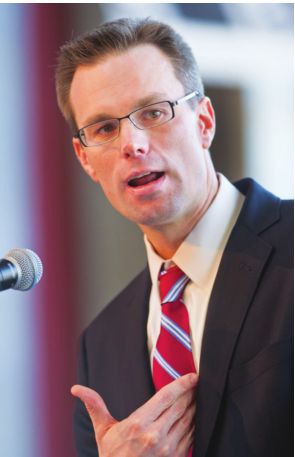
Gov. Bruce Rauner wants to reduce Illinois’ use of incarceration. His commitment to prison and sentencing reform is evident in the person he hired to crunch the numbers.
Until recently, John Maki served as the executive director of the John Howard Association (JHA), a Chicago-based watchdog group focusing on prison reform in Illinois. On Jan 20, Rauner announced Maki as his pick to head the Illinois Criminal Justice Information Authority (ICJIA), a state agency tasked with studying Illinois’ justice system and recommending changes.
Appointing Maki as executive director of ICJIA is one of several moves Rauner is making to refocus the state’s criminal justice efforts away from incarceration. He reiterated that point during a press conference last week announcing the creation of a commission on criminal justice and sentencing reform.
“In the Illinois Constitution, sentencing is supposed to have two goals,” Rauner said. “Number one: make sure the punishment fits the crime, and number two: help offenders become responsible citizens. Too often, that second goal gets overlooked.”
As executive director of the John Howard Association, Maki headed an organization whose focus was prisons and prison overcrowding. But ICJIA has a broader mission: serving as counsel to the criminal justice system at every level, from after-school programs to policing, to the court system – not just prisons. That suits Maki just fine.
Maki says it’s very hard – although not impossible – to reduce the use of incarceration safely by focusing on prisons alone.
“You have to look at the system as a whole,” Maki said.
The appointment is a promising sign for prison and sentencing reform advocates. Maki said the moment seems right for criminal justice reform.
“All across the country, there’s this consensus from the left and the right that we need to reduce our use of incarceration,” Maki said. “It’s really expensive and, more importantly, it’s reached a point where it not only does very little to help control crime, it may actually make crime worse.”
During his tenure at JHA, Maki worked with state legislators to create the Joint Criminal Justice Reform Committee, which made recommendations like implementing a “uniform cannabis ticket” and expanding specialized drug and mental health courts. Committee co-chairman Rep. Michael Zalewski, D-Riverside, characterized Maki as a focused and pragmatic reformer.
“I think that he brings a good perspective to the type of work he does,” Zalewski said. “He does it in a way that I think is perfectly reasonable but is still holding true to his core beliefs.”
Maki sees a need for a change in the usual approach to prison and sentencing reform.
“When you look across the country, typically when people go about reforming a justice system, what they really do is engage in kind of a trading game where they increase a little penalty and lower some penalties,” Maki said.
That attitude is reflected in how Zalewski says legislative bodies often approach reforms.
“Some ideas would reduce certain penalties and increase penalties for others,” Zalewski said.
But for Maki, that approach just isn’t enough.
“That might be a good thing, but it doesn’t actually meaningfully reduce our use of incarceration,” Maki said.
Maki said he wants to make sure Illinois puts more of its resources and federal funding into programs that can be measured as effective, as opposed to those that feel good and are merely well-meaning.
“That’s my goal; that’s what I expect,” Maki said. “At the end of my tenure, if I haven’t done that, I’ve failed.”
Contact Alan Kozeluh at [email protected].