Lincoln’s scandalous nephew
Eugene Clover, married to Lizzie Edwards, killed a man in the Sangamon County Courthouse
HISTORY | Erika Holst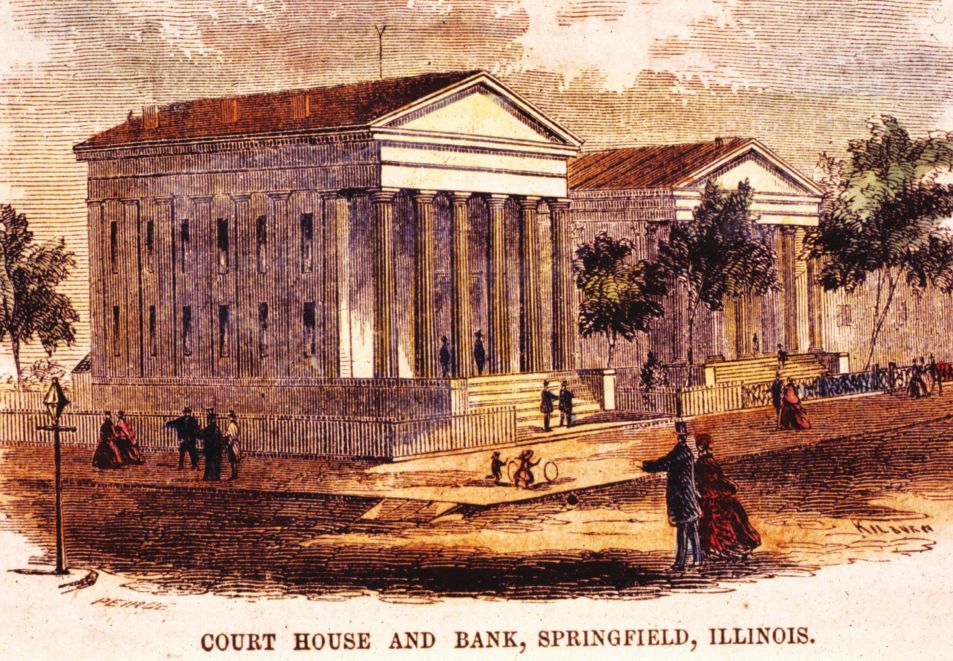
If
the Lincolns continued to take a Springfield newspaper even after they
moved to Washington, D.C., no doubt they would have been shocked by the
May 12, 1864, issue of the Illinois State Journal, which carried
the news that their nephew by marriage, Eugene P. Clover, had shot and
killed a Union soldier at the Sangamon County Courthouse.
It
wasn’t the first time Clover had shocked the family. On May 11, 1863,
he eloped with 20-year-old Lizzie Edwards, younger daughter of Mary
Lincoln’s sister, Elizabeth.
Clover’s
father, Lewis P. Clover, was not only the highly respected minister of
St. Paul’s Episcopal Church, he was also an artist who had trained with
Asher B. Durand and painted a portrait of Abraham Lincoln in 1860.
Eugene, however, had some problems with alcohol – family friend Mercy
Conkling noted that “he seems not to have any friends except one or two
saloon keepers.”
The
Edwards family strongly disapproved of him as a suitor for Lizzie. While
visiting the Lincolns in 1862, Mary’s sister, Elizabeth, wrote home to
her older daughter, “Do persuade [Lizzie] to see less of Eugene Clover,”
adding hopefully, “she will never become seriously interested in him,
without, I have been grossly deceived.”
She
had been grossly deceived. Eugene and Lizzie ran away together on May
11, 1863. Her family was devastated – and furious. Three weeks after the
wedding, a neighbor commented, “The family are not in the least
reconciled to Lizzie’s marriage and take not the slightest notice of her
or Eugene, and say they never will.” A month later, they were still
giving her the cold shoulder: “Her father & Mother are not in the
slightest reconciled to Lizzie’s marriage yet, and [are] quite as
determined as ever to cut her off.”
One
year after the elopement, a sordid series of events went down in the
Clover family. While walking in downtown Springfield, Eugene’s
9-year-old sister, Bertha, was kidnapped by John M. Phillips, a soldier
in the 7 th Illinois Infantry. Phillips pulled her into his buggy and
drove her two miles out of town, where he tried to rape her. According
to the Clover family, the rape, “though attempted, was unsuccessful.”
Phillips drove her back to town and was soon arrested.
News
of the fiendish act swept through town like wildfire, leaving outrage
in its wake. At 8 o’clock on the evening of the attack, a crowd of
citizens seeking vengeance broke down the door to the jail with an axe.
The sheriff, however, had moved Phillips to a safe place, and cooler
heads prevailed on the crowd to let the due process of the law take its
course.
The next day
all hell broke loose. En route from his jail cell to the Sangamon County
Courthouse, Phillips was met with an angry mob that followed him into
the courtroom. As Phillips was standing in front of the judge, Eugene
Clover stepped forward and fired three shots from a large revolver, one
of which struck Phillips in the shoulder. Phillips ran to the other side
of the room and begged the crowd to spare his life, but, as the
newspaper reported, “the firing and the sight of blood seemed to madden
the crowd to the highest degree, and the court room soon resounded with
curses and cries of ‘hang him,’ ‘damn him,’ ‘shoot him,’ ‘kill him.’” A
length of rope was procured, and the cries of “hang him” intensified.
At
this point a local attorney, A. W. Hayes, jumped up on a table and
pleaded with the crowd to let the prisoner be tried for his crimes in
court rather than murdered in cold blood. His entreaty gave the sheriff
enough time to pull the wounded prisoner into a small room, close the
door, and send a message urgently requesting a military guard.
Meanwhile,
the crowd’s bloodlust reached a fevered pitch. Another revolver was
pressed into Clover’s hand, and he with the rest of the mob surged
toward the room in which Phillips was hiding. Hearing the advancing
footsteps and assuming they belonged to the guard, the sheriff opened
the door.
Clover fired
six shots in quick succession at Phillips, who was lying on a bench.
The only shot to connect with its target struck Phillips in the thigh
and caused him to fall face first on the floor.
At
long last a military guard arrived. He addressed the crowd, asking them
to return to their homes and assuring them that, should the prisoner
live, he would be prosecuted to the fullest extent of the law.
The
prisoner didn’t live. The wound to his shoulder proved fatal, and he
succumbed to his injuries at about six o’clock that evening.
Eugene
Clover was charged with manslaughter but does not seem to have been
convicted. He and Lizzie went on to have two sons together.
At
some point, Eugene enlisted in the United States Cavalry. On Nov. 27,
1868, Clover’s cavalry regiment, led by George Armstrong Custer,
massacred a band of peaceful Cheyenne Indians on the banks of the
Washita River in the Indian Territory (modern-day Oklahoma). Clover was
killed in the attack. His body, later recovered, had been stripped,
mutilated, and decapitated.
Lizzie
Edwards Clover apparently mended fences with her parents, as census
records indicate that she and her sons moved back home after her husband
died. Lizzie and her kids were living in the Edwards’ house when Mary
Lincoln moved in after her stay at the asylum, and they were still there
when Mary came home to her sister’s house to die in 1882.
Erika
Holst is curator of collections at the Springfield Art Association. She
is grateful to Mary Beth Roderick for bringing this story to her
attention.


