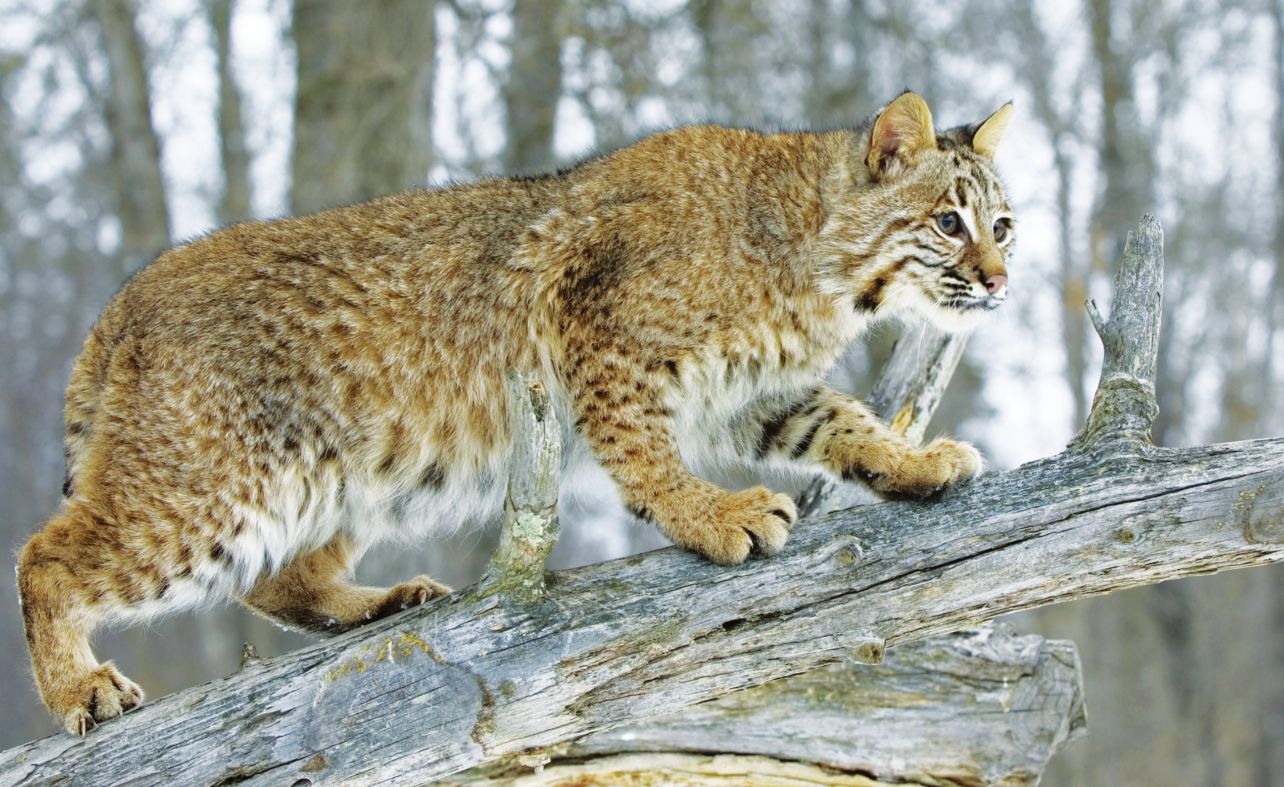
Killing bobcats
Is it time for Illinois to lift the ban?
WILDLIFE | Bruce Rushton
Bobcat hunting, Ron Edgerly swears, is about as much fun as a man can have in the woods. Just listen to him tell what happened when the quarry doubled back on its tracks in the frozen Gogomain Swamp in the upper reaches of Michigan.
“It was a cold year, 20 below zero,” recalls Edgerly, who started hunting bobcats when he was 13 and is still chasing cats as a septuagenarian. “I’m down on my hands and knees with my 12 gauge. This bobcat is running toward me, really coming on. The bobcat, all of a sudden, he jumped up into the air, 12 feet up off the runway.”
While the cat looked down from a tree, Edgerly’s two hounds sailed past, Wile E. Coyote style, intent on chasing down prey that bolted the opposite direction as soon the dogs were no longer behind it.
“The moral of the story is, my dogs were trained,” Edgerly boasts. “They probably ran that empty track 35 yards before they realized something was wrong. Within a halfhour, the two fast dogs caught him.”
Then there was the 40-pounder – huge for a bobcat – that Edgerly, then 73, bagged in 2012 without the help of dogs. He spent more than two hours tracking the cat through snow, then lured it into shooting range with the help of an electronic game caller that simulates the sound of a rabbit in distress. In addition to a pelt, he was rewarded with write-ups in newspapers and outdoor publications from coast to coast.
It is simple, really. All you have to do is find some bobcat tracks, guess where the creature might be headed, then set loose the hounds and keep up as best you can. If you don’t have dogs, stand next to a tree or climb up into an elevated stand, then stay absolutely still for an hour or so and hope that a cat fooled by fake rabbit cries comes along. Don’t worry about wind – unlike deer, bobcats don’t much care what the air smells like. But one tiny move and a bobcat, which relies on sight to hunt, will be gone. Edgerly swears they have 180-degree peripheral vision that extends to whatever might be above their heads.
“He’s stealthy, but he never gets in a hurry,” Edgerly says. “When it’s 20 below zero and you’re keeping silent and still, it’s pretty hard to stay warm no matter what you have on – to get cold, that’s just part of the game. The instant you see a bobcat, you warm up instantly. You’ve got to love the sport or you’re not going to do very well at it.”
Not everyone is so enthusiastic. Even Edgerly’s own son, raised as a hunter, no longer stalks bobcats.
“It is a lost art,” Edgerly bemoans. “It’s a dying, crying shame to see the young generation not having any interest in this. They’ve got their gosh darn cell phones and computers. Breaks my freaking heart.”
For cat hunters like Edgerly, who recalls bagging 23 cats in a single winter back in the 1950s, the good old
days are gone. The season bag limit in Michigan, he notes, has dwindled
from unlimited to one. But in Illinois, where bobcats have long been
protected, the door to hunting and trapping is starting to open. And not
everyone is happy about it.
A rebounding population
Former Gov. Pat Quinn is a bobcat’s best friend.
In
one of his last acts in office, Quinn vetoed a bill that would have
established a season for bobcat hunting and trapping. A ban on killing
bobcats that began in the 1970s, when the species was in serious
decline, was good for both people and bobcats, Quinn wrote in his veto
message, and lifting the ban would threaten the state’s ecosystem.
“To
subject the species to indiscriminate killing for recreational
amusement presents many serious risks and costs without much in return,”
Quinn wrote.
The
bobcat bill had sailed through the House on a 91-20 vote. The margin was
considerably smaller in the Senate, where it passed with just one vote
to spare and bobcats and their sympathizers left to wonder which way
nine senators who didn’t cast ballots might have gone.
“ It’s not the bobcat eradication bill. It’s the bobcat management bill.”
Sen. Sam McCann,
R-Carlinville, is sponsoring an identical bill this session. He says
that he loves cats and has a feline named Lily to prove it, but that’s
not the point.
“I was
asked by a group of constituents and the Department of Natural
Resources,” McCann says. “It’s not the bobcat eradication bill. It’s the
bobcat management bill.”
Whether
it’s blood lust or resource management, McCann’s bill is one of three
introduced so far this session to allow bobcat killing. Jen Walling,
executive director of the Illinois Environmental Council that lobbied
against the bill vetoed by Quinn, says that she’s optimistic that
bobcats will remain off-limits to hunters and trappers. The bill that
passed the Senate with a one-vote margin wasn’t debated in committee,
and so legislators didn’t get to hear from opponents, she said. The
council keeps a legislative scorecard, Walling said, and bobcat bill
vote tallies are included.
“We
had just started working on it,” Walling said. “I don’t see any of
those voting against it changing their votes. There are several
legislators who are aware they voted the wrong way.”
While
the measure ultimately failed, it was the closest the state has come to
having a bobcat season since hunting and trapping ended in 1972, with
the species being listed as “threatened” five years later thanks to
population decline. But notoriously elusive bobcats are rarely seen no
matter their numbers, and so deciding whether populations are at healthy
levels isn’t easy.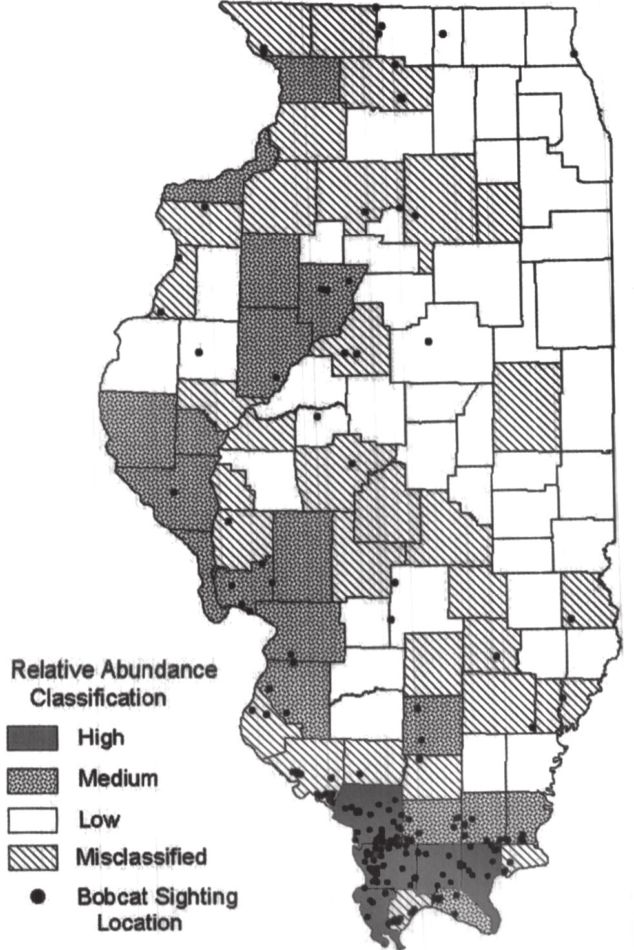
In
the seasons between 1966 and 1970, the Department of Natural Resources
tabulated approximately 1,100 pelts taken each year, suggesting that
bobcats were abundant, according to a 2002 report prepared by Southern
Illinois University researchers. Nonetheless, the state banned killing
them, and an SIU researcher later determined that the ban was a good
idea, given that just 89 sightings were reported between 1979 and 1982
in 52 counties. Researchers elsewhere postulated that intensive
agriculture in the Midwest had reduced bobcat habitat.
But
bobcats, like rats and whitetail deer, don’t necessarily mind living
close to people, and so the population climbed during the 1990s to the
point that cats were sighted in 99 of the state’s 102 counties,
including Cook County. The bobcat was removed from the state’s list of
threatened and endangered species in 1999.
The
bobcat was delisted after SIU researchers trapped 96 cats between 1995
and 1999 and found them to be healthy, if not particularly clever –
several bobcats were trapped more than once, including one that was
captured seven times. Researchers put radio tracking collars on the cats
and also studied carcasses of dead ones felled by cars or natural
causes, finding full stomachs and little sign of disease. Nearly 30
percent of the state, mostly in the south, along the Illinois River and
in northwest regions, had suitable habitat for bobcats, researchers
reported, and patches of suitable habitat were scattered throughout the
remainder of Illinois.
“It
seems clear from the data now available…that bobcats are secure in
Illinois,” SIU researchers wrote 13 years ago in their study report
partially funded by the state Department of Natural Resources. “The
widely distributed population occurs at moderate densities…and there is
no biological reason evident to suggest that bobcats could not stand a
regulated, limited harvest in Illinois.”
Bobcats
are found throughout the nation, with fewer than 10 states requiring
that hunters and trappers leave them alone. In California, for example,
more than 1,000 bobcats are killed each year. Science, SIU researchers
predicted in 2002, would not decide the fate of the bobcat in Illinois.
“Certain
stakeholders will likely oppose any strategy less than continued full
protection from harvest in Illinois,” researchers wrote. “Any proposal
to initiate a season, however restrictive, to hunt and trap bobcats will
likely be opposed in public forums and by legal action. … Because
agencies such as IDNR require
public
support of their policies to effectively manage natural resources,
whether or not a bobcat harvest is ever allowed in Illinois will be
decided by public opinion rather than biological data.”
Killing and cruelty
The
Department of Natural Resources pegs the number of bobcats in Illinois
at between 3,000 and 5,000 – enough, department officials say, for
hunters and trappers to kill 300. Opponents note that the population is
concentrated in southern counties and that the bill vetoed by Quinn did
not specify where bobcats could be killed. That would be decided by the
Department of Natural Resources, which is backing a bobcat season.
“We
have this history where this animal was threatened and now it’s turned
into a success story,” says Walling, who is concerned that there are too
few bobcats, especially outside southern Illinois, to allow for a
hunting and trapping season. “Why can’t we wait until the population
recovers more?” Proponents of bobcat killing warn that the population
must be controlled or bad things will happen. There are fewer wild
turkeys than there used to be, some say, and bobcats are to blame.
Bobcats kill deer, others warn, despite scant evidence that cats that
typically weigh less than 20 pounds dine on venison with any regularity –
and never mind that deer are hardly at risk of extinction.
Trail
cameras have captured bobcats attacking deer, but whether such killing
is commonplace isn’t clear. SIU researchers found remains of deer in
just three stomachs of 91 dead bobcats, and it was impossible to tell
whether the cats had killed, or just stumbled across carrion. Mostly,
the cats were eating voles, rabbits and squirrels, researchers found.
“We’ve
had a small but growing number of complaints about bobcats, usually
with poultry,” says Bob Bluett, a DNR wildlife biologist. “At least in
the eyes of a lot of landowners and sportsmen, when you bring an animal
back, you have a responsibility to manage it. … We’ve relied on hunters
and trappers and landowners to make this a successful recovery since the
1970s. Now that we have a healthy bobcat population in the state, there
is interest in a harvest. In some people’s minds, we might have a few
too many.”
Neal
Graves, president of the Illinois Trappers Association, says that
bobcats don’t generate nuisance complaints because they’re nocturnal and
so rarely seen. He accuses bobcats of attacking fawns and threatening
the state’s deer herd.
“A bobcat kills just to kill,” Graves says.
“You
watch a domestic cat, it’s the same thing. Your bobcat will be really
bad on turkey and pheasant eggs, as will the coons. If you’re out in the
wild and you’re starving, you’re going to eat anything you can get your
hands on.”
Standing
motionless in frozen woods for hours on end, clutching a gun and hoping
for a bobcat to pass your way is one thing. Setting out a line of traps
and coming back tomorrow is something else altogether. And so opposition
to bobcat killing, at least for some, is inextricably tied to whether
trapping them is cruel. There is also the question of what happens to a
bobcat once it is dead.
“Nobody
eats bobcats – they’re hunted entirely for fur and trophies,” notes
Kristen Strawbridge, Illinois state director for the Humane Society of
the United States that is
fighting
bills to legalize bobcat killing. “This misguided legislation would
subject bobcats to cruel and unsporting killing methods, such as the use
of steel-jawed leghold traps and being chased down by packs of hounds.”
Then
again, all mammals might not be created equal. While the Humane
Society, the Sierra Club and the Illinois Environmental Council have
battled to protect bobcats, there was no such organized effort to
protect river otters, which were declared legal for trapping by the
legislature in 2011 after being successfully re-introduced into the
state with critters caught in Louisiana and sent north to the land of
Lincoln. Unlike bobcats, trapped river otters – the sort featured in
Disney films that cavort and play and slither happily down muddy slides
and into rivers just for the fun of it – are drowned by design in traps
that keep them submerged until the trapper returns. Trapped bobcats are
generally dispatched quickly.
Noting
that there are far more otters – the Department of Natural Resources
puts the number at between 15,000 and 20,000 – than bobcats, Walling
said the Illinois Environmental Council decided not to oppose the otter
bill after speaking with ecologists and reading population studies.
“They’ve done really well,” Walling said.
“We don’t oppose hunting.”
Strawbridge
could not immediately say why the Humane Society, which opposes leghold
traps, did not fight otter killing with the same vehemence that it has
opposed bobcat hunting and trapping. But surveys commissioned by the
state Department of Natural Resources have shown that public opinion is
against trappers no matter the animal.
Telephone
surveys conducted in 1994 and 2002 for the Department of Natural
Resources showed that fewer than 30 percent of state residents approved
of hunting and trapping animals for their fur, with fewer people
supporting trappers than hunters. In 2009, surveyors tweaked the
question by emphasizing that hunting and trapping are closely regulated
and found that approval increased to more than 70 percent, with many
respondents changing their minds after being told that the state
regulates harvests and requires that trappers younger than 18 complete a
trapping education course. However, opposition to killing for fur
remained high, with just three in 10 respondents in 2009 saying that it
was OK to hunt or trap animals for their fur as opposed to killing for
food or to prevent overpopulation.
Gripping questions
The
modern leghold trap is a far cry from jagged-jaw traps of yesteryear.
Traps with teeth that tear into limbs are now illegal, and many come
with offset jaws so that the business ends of the trap don’t clamp
tightly together, which allows some room for circulation. Wildlife
biologists use leghold traps to capture animals for study and for
relocation. Still, the stigma remains strong enough that eight states
have barred commercial and recreational trappers from using leghold
traps.
A video posted
on the National Trappers Association website shows foxes and other
furbearing animals waiting patiently for kindly trappers to free them.
Once let go, the animals scamper off, apparently unharmed, after
trappers rub their paws a bit, not unlike giving someone a wrist massage
after handcuffs come off.
“The
norm is for the animal to hunker down and wait,” the narrator intones.
“Some drop off to sleep. … The experience is not much different from the
restraint of a pet dog with a leash or tether, only the animal is held
by the foot, not the neck.”
It
would be a more convincing demonstration if the trappers had put their
own hands in traps, an idea that wasn’t encouraged during the Illinois
Trappers Association annual fur auction in Fairfield last month.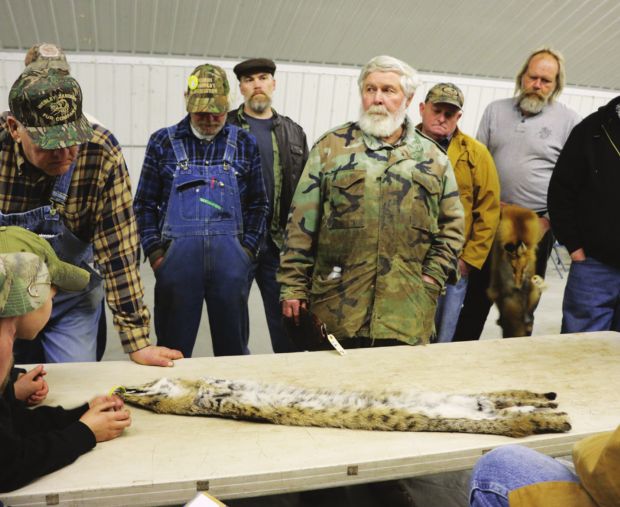
“I
wouldn’t suggest doing that,” a trapper advises when a neophyte asks
about putting his finger in a trap intended to capture raccoons. Another
warns that the raccoon trap likely carries enough power to snap a
pencil in two.
There
is no shortage of fur at the auction held at the Wayne County
Fairgrounds in Fairfield. It takes nearly seven hours to auction off
hundreds of hides from beavers, otters, foxes, raccoons and other
oh-so-soft animals. No one is getting rich. The 14 buyers present rarely
pay more than $30 for a pelt, with prices of less than $10 being the
norm, depending on the species and quality of fur. The concrete floor of
the unheated building is covered with plastic so that oils from the
untanned, or green, hides can’t leach into the concrete and leave behind
spots. A local service club sells chili.
“You do it because you love the outdoors,” Graves says. “All we are is a tool to help keep our wildlife in balance.”
Many
of the pelts will end up overseas, particularly Russia, China and
Korea, and so outdoorsmen – and they are virtually all male – at the fur
auction are keenly aware of the strength of the ruble, the direction of
the oil market and the coldness of the winter in countries thousands of
miles away. They also know that Illinois has come closer than ever
before to legalizing bobcat
trapping.
And they’re optimistic that Gov. Bruce Rauner, who professed himself an
outdoorsman on the campaign trail, will see the bobcat issue
differently than his predecessor.
These
guys spend a lot of time in the woods, and they say they started seeing
bobcats and bobcat tracks as far back as eight years ago.
“I
thought it was a coyote to start with,” says Jeff Merrick of Geff, who
saw his first bobcat four years ago while turkey hunting. “It raised its
tail and I saw white. I thought I was seeing things.”
There are two bobcat pelts for sale, one from Tennessee, the other from Kentucky, and interest is high.
“Is
there another one?” someone asks after the pelt from Kentucky sells for
$87.50, the highest price paid for any pelt the entire day. “Where did
that bobcat come from?” another person demands. “Is that a big one?”
someone else wonders.
Chane
Lyons of Sandoval, who both traps himself and buys fur to resell at
larger auctions, figures he paid more for the Kentucky bobcat pelt than
it was worth, but that’s what novelty will do. This pelt, he says, will
end up on a wall at his house.
Lyons
says that he’s trapped and released several bobcats while seeking
coyotes, once finding four in a single day. The way he figures it, the
chances of a bobcat bill passing are good, and so the days of freeing
bobcats caught in traps are coming to an end.
“I think it will eventually come into law,” Lyons says.
Contact Bruce Rushton at [email protected].


