A cautionary tale 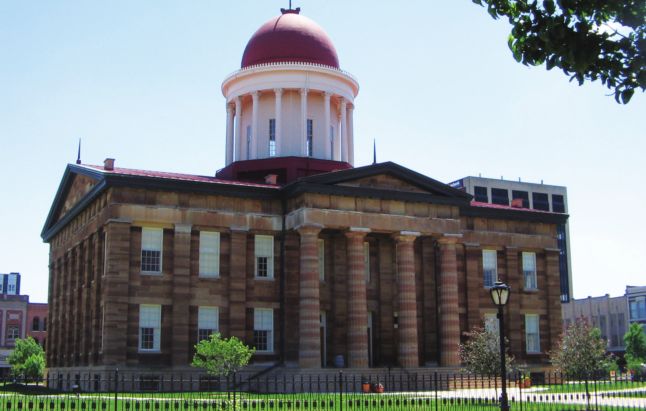
The lessons of Illinois’ historic sites history
DYSPEPSIANA | James Krohe Jr.
For those who don’t know the story, here’s what happened. Politically connected Springfieldians undertake to put more of the city’s long-hidden Lincoln legacy on display to new generations of visitors. They envision a new building that will invigorate tourism, restore downtown, and put Illinois on the tourism map. The idea is pushed by winds blowing its way; important history anniversaries are approaching, and the new site would make the perfect centerpiece for the parties.
A building soon morphed into a complex that would accommodate not only the past but the present, thanks to a new parking garage and modern new space for the state historical library, which has languished for years in cramped quarters. Costs thus grow – two, three, four times the initial estimate – but the sitting governor, beguiled by the possibilities and wishing to add to his legacy, sees to it that state government picks up most of the tab. In time the building, now facing a handsome new plaza, opens with much hoopla, and its backers await a new day to dawn downtown.
Yes, the opening of the Old State Capitol complex in 1969 was a big deal. Yet in the 12 years after it opened, it became clear that the restored 1837 Statehouse would fail to realize the extravagant promises made for it. As I tried to explain in a 1981 column in this paper, the new old Capitol had no significance left as an old building (it was reconstructed, there being nothing left of the original to restore) and no purpose as a new one. Installation of an elaborate sound-and-light show – the first manifestation of the Disney-fication of Lincoln sites that would reach its apotheosis in the ALPLM 30 years later – failed to make a dead building come to life. Thirty-three years after I wrote that column the building remains the least visited of the major Lincoln sites downtown; 190,000 fewer people bothered to drop by in 2014 than toured nearby Abe World.
The Abraham Lincoln Presidential Library and Museum, then, was not the first project of its kind to prove that the State of Illinois is better at building things than at managing them. The Old State Capitol opened under the care of the state’s Department of Conservation, which then managed the state’s historic properties. However, the DOC’s brief was natural resources and recreation and only incidentally historical preservation. (Apparently historic sites ended up at DOC because they were outdoors.)
Early in his term, Gov. Richard Ogilvie announced that the Old State Capitol would henceforth be the responsibility of the Illinois State Historical Library, as it was then known. The transfer reminded me then of those gruesome Soviet ex periments of the ’60s, when heads of Airedales were grafted onto the living bodies of German shepherds. For example, then-Gov. Otto Kerner in the 1960s promised, “Taxes won’t be used to pay for the build ing’s maintenance. Money collected from the use of the [underground] garage should take care of that.” And so it might have, if the building had remained under the DOC; fees collected by the DOC were paid into a separate state parks fund, out of which the department’s costs were paid, including maintenance. But the Historical Library could not legally receive such fees. When the building was transferred to the library, the revenue from its garage – the state’s share of which amounted to roughly $100,000 a year, which was real money in the 1970s – disappeared into the state’s general fund instead.
Many lessons might have been learned from the example of the Old State Capitol. They weren’t. Institutional memory is short; so is community memory. (What Illinois needs is a museum of the history of its historic sites.) The ALPLM is not only not unique in its problems in Illinois, it isn’t even unusual. If you need a laugh, read the history of the Illinois State Museum. Or Lincoln’s home. This history is not mentioned by the recent report by experts empanelled to advise the General Assembly on the restructuring of the ALPLM, and its causes are only alluded to.
The failures of the Old State Capitol begin to look generic to all such state undertakings – too much politics and not enough money, tribal antagonisms between anthropologists and artists and scholars, who are among our educated elites, and state managers who are not. The solutions to the ALPLM mess so far bruited by Speaker Madigan, by the boards involved and by the aforementioned study panel are not nearly bold enough. The most important questions are the ones not being asked: Is the State of Illinois capable of running such properties properly under any arrangement? And if not, what then?
Contact James Krohe Jr. at [email protected].
Editor’s note
It
was good to see some of the Obama swagger return during Tuesday night’s
State of the Union address. When the polls and the elections are going
the wrong way, when the culture wars and the race strife and the
terrorist attacks are at full swing, it’s easy to start thinking this
guy is not quite up to the task at hand. But no, he’s earned his gray
hair. The economy is improving, Obamacare is taking hold and yes, it is
smarter to use military restraint. “This is good news, people.” Did you
notice Obama gave a shout-out to his home state? He said he still sees,
as he said in Boston a decade ago, not a liberal or a conservative
America but a United States of America. “I said this because I had seen
it in my own life, in a nation that gave someone like me a chance;
because I grew up in Hawaii, a melting pot of races and customs; because
I made Illinois my home, a state of small towns, rich farmland and one
of the world’s great cities; a microcosm of the country where Democrats
and Republicans and Independents, good people of every ethnicity and
every faith, share certain bedrock values.” Well, the president is
entitled to a certain amount of hyperbole, and we’ll take a compliment
on the national stage when we can get it. –Fletcher Farrar, editor and
publisher


