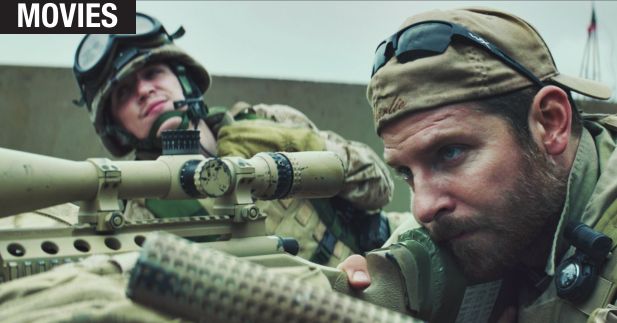
Sniper’s aim is true
FILM | Chuck Koplinski
His best and most-assured film since Invictus, Clint Eastwood’s American Sniper covers many themes the filmmaker has touched on over the course of his career. The devastating impact of violence, the importance of community and the irony and difficulty of feeling apart from that group are all issues effectively addressed here in this look at the life of Chris Kyle, the deadliest sniper in U.S. history. However, the film suffers from Eastwood’s tendency to overstate his point. Still, the movie’s positives outweigh its faults, most notably the performance by Bradley Cooper as Kyle, a completely transformative turn that will make you look at the actor in an entirely different way.
Eastwood is at the top of his game with the film’s opening sequence as we see Kyle perched on a rooftop in Fallujah, providing coverage for an advancing unit of ground troops. He sees a mother hand a young boy what may be a bomb, to which the soldier must determine if this is an actual threat and whether decisive action be taken. Eastwood and his editors, Joel Cox and Gary Roach, wring every last bit of tension they can from the scene before cruelly cutting away before its final outcome for a flashback to a moment in Kyle’s youth in which he shoots his first deer and his father makes the prophetic statement, “You’ll be a good hunter some day.” We get quick glimpses of the conservative Texas childhood the sniper had as well as the depth of his patriotism, which compelled him to join the Navy at the age of 30 with the intention of becoming a SEAL after a terrorist attack on a United States’ base in the Middle East. Obligatory moments in which we see Kyle get through basic training, meet his wife-to-be Taya (Sienna Miller) and discover his calling on the firing range are dispensed with quickly before we circle back to the opening sequence to witness its outcome.
Kyle completed four tours of duty over ten years time and the film falls into a rhythm recreating his experience. Threats are faced, Kyle saves his unit time and again, his kill total rapidly increases and then he’s granted leave to go home and reconnect with his family. As the movie runs through this cycle, the combat scenes become repetitious, while the final battle – a dire piece of action as an approaching sandstorm threatens to engulf all concerned – is so confusing in the way it’s filmed and edited that it proves more frustrating than thrilling.
However, the moments in which we see Kyle return home, becoming increasingly disengaged and unable to relate to his wife and children, is where the meat of the story lies. The bitter irony that Kyle is unable to enjoy the very liberty and freedom he’s fighting to provide those in a foreign land is underscored powerfully in these moments, none more so than in a scene in which the soldier takes refuge in a bar instead of coming straight home from one of his tours. The dimly lit room full of strangers provides him more solace than a loving wife and comfortable home. The film would have benefited with more moments like this, especially between Kyle and his wife.
In a year filled with strong male performances, Cooper’s ranks as one of the best. Having gained 40 pounds of muscle to emulate Kyle’s physicality, the actor immerses himself completely, as he’s able to project the mindset of this man who, whether it was his job, politics or personal life, kept things as simple and direct for himself as possible. When Cooper assures a psychologist that he’s “prepared to meet my maker and answer for every shot I took,” there’s a sincerity that’s been lacking in the actor’s other performances.
To be sure, Sniper meanders in its final hour and takes on a distracting, choppy feel because of the back-and-forth nature of the story. Yet, Eastwood’s strong straightforward narrative approach and Cooper’s powerhouse performance save it from being a run-ofthe-mill war movie, instead delivering a cautionary tale regarding the depth of service we ask of our soldiers and the price they ultimately pay.
Contact Chuck Koplinski at [email protected].


